How ISTQB Exams Are Scored: Questions vs Points
Every ISTQB certification page prints a question count and a point total, and on most exams they do not match. The pass mark is set against the points, which changes how many answers you actually need.
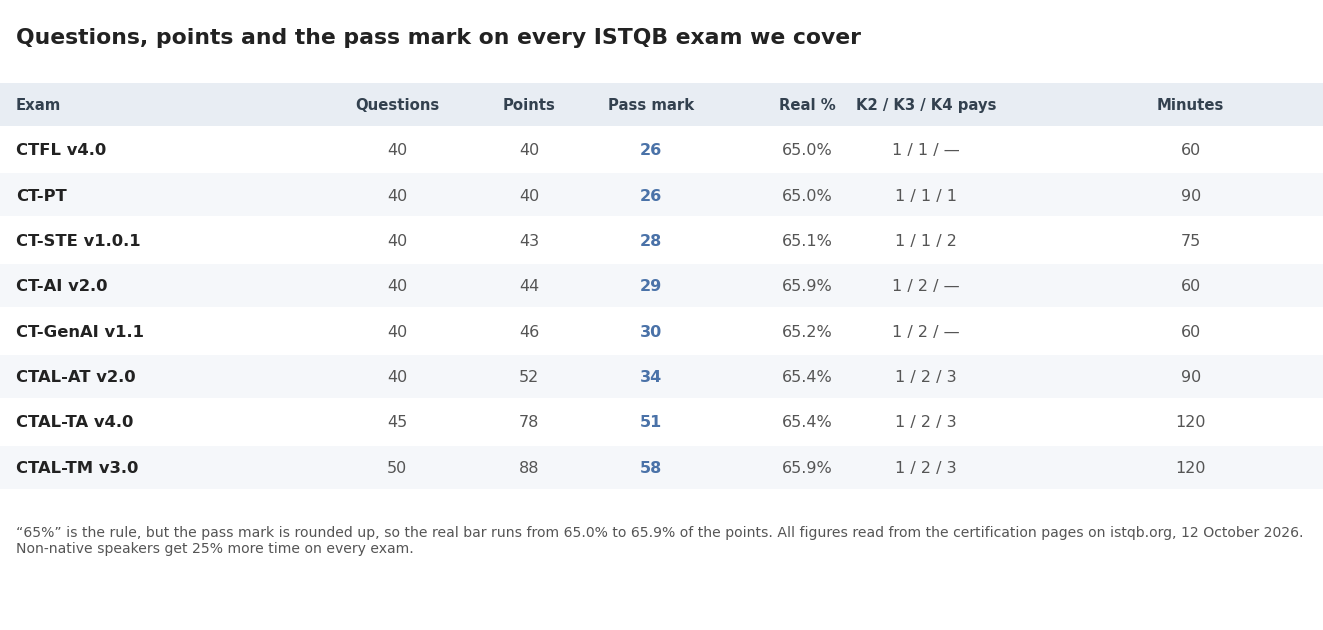
Every ISTQB certification page prints two numbers that look like they ought to match, and on most exams they do not. CTFL v4.0 is 40 questions and 40 points. CT-GenAI v1.1 is 40 questions and 46 points. CTAL-TM v3.0 is 50 questions and 88 points. The pass mark is quoted against the second number, never the first — which is why "65% to pass" does not mean "get 65% of the questions right" on six of the eight ISTQB exams covered on this site.
This article works the scoring through end to end: what a point is, where each pass mark comes from, the three different scoring models currently in use, and the calculation nobody publishes — how many questions you actually have to get right. Every figure below was read from the certification pages on istqb.org on 12 October 2026.
The unit of scoring is the point, not the question
Each question on an ISTQB paper carries a point value that is fixed when the exam set is built. The certification page publishes the sum of those values as Total Points, next to No. of Questions and Passing Score. Your result is the sum of the points you banked, compared against the passing score.
ISTQB's own rules document, Exam Structures and Rules v1.2, splits the behaviour in two. Section 5.2.1 covers Foundation level in one sentence: each question is worth exactly one point. Section 5.2.2 covers Advanced Level and the Specialist modules: the points available for a question should reflect its difficulty, so a K2 question is allocated 1 point and, in general, a K3 question 2 points and a K4 question 3 points.
The words in general are doing real work. The same paragraph allows a K3 question to be set at 1, 2 or 3 points and a K4 question at 2 or 3, at the question author's discretion — and two of the exams below use the bottom of that range. If you want the cognitive levels themselves explained, we covered what K1 to K4 actually ask of you in ISTQB K-levels explained.
Where the pass mark comes from, and why it is never exactly 65%
Section 5.3.1 of the same document gives the threshold: a score of at least 65% is required to pass. That percentage is applied to the point total and then rounded up to a whole point, because you cannot score a fraction of a point. The published pass marks follow directly:
CTAL-TM v3.0 — 65% of 88 points is 57.2, so the pass mark is 58, or 65.9%.
CT-AI v2.0 — 65% of 44 is 28.6, so the pass mark is 29, or 65.9%.
CTAL-TA v4.0 — 65% of 78 is 50.7, so the pass mark is 51, or 65.4%.
CTAL-AT v2.0 — 65% of 52 is 33.8, so the pass mark is 34, or 65.4%.
CT-GenAI v1.1 — 65% of 46 is 29.9, so the pass mark is 30, or 65.2%.
CT-STE v1.0.1 — 65% of 43 is 27.95, so the pass mark is 28, or 65.1%.
CTFL v4.0 and CT-PT — 65% of 40 is exactly 26, the only two that land on 65.0%.
So "65%" is the rule, not the bar. The real bar runs from 65.0% to 65.9% depending on how the rounding falls, and on CT-AI that rounding is the difference between 28 points and 29.
Three scoring models, not one
Reading across those eight exams, the 1/2/3 scale everyone quotes is only one of three arrangements actually in force.
Flat: CTFL v4.0 and CT-PT
CTFL is 40 questions, 40 points, 26 to pass, 60 minutes. Its cognitive split is 8 questions at K1, 24 at K2 and 8 at K3, and by rule 5.2.1 all of them score one point. A K3 question that makes you build an equivalence partition out of the stem pays exactly what a K1 definition question pays. The rest of the Foundation format is in our CTFL exam format and pass mark guide.
CT-PT is the surprise. It is 40 questions, 40 points, 26 to pass, 90 minutes — and its exam structure table lists nine K4 questions, the highest K4 count of any Specialist module. On the default scale those nine alone would carry 27 points and the paper would total 62. It totals 40, so every question pays one point regardless of level. That is a consequence of its age: the performance testing syllabus is still the 2018 edition.
Compressed: CT-STE v1.0.1
The 2025 Security Test Engineer exam is 40 questions and 43 points, 28 to pass, 75 minutes. Its mix is 24 K2, 13 K3 and 3 K4 questions. Priced on the default scale that mix would come to 59 points. The published total is 43 — the whole paper rises just three points above a flat count, which means the K3 questions here pay one point and the K4 questions two, the bottom of the range rule 5.2.2 permits. Anyone budgeting the analysis questions as triple-weight will mis-plan the paper. The format is on our CT-STE certification page.
Standard: the five weighted exams
The remaining five apply the 1/2/3 scale as written:
CT-AI v2.0 — 36 K2 and 4 K3 questions, no K4 at all: 40 questions, 44 points, 29 to pass, 60 minutes. The four 2-point questions and the chapter they sit in are mapped in our CT-AI v2.0 chapter map.
CT-GenAI v1.1 — 8 K1, 26 K2 and 6 K3 questions: 40 questions, 46 points, 30 to pass, 60 minutes. It is a Specialist module that still carries K1 questions, each worth one point.
CTAL-AT v2.0 — 31 K2, 6 K3 and 3 K4 questions: 40 questions, 52 points, 34 to pass, 90 minutes.
CTAL-TA v4.0 — 18 K2, 21 K3 and 6 K4 questions: 45 questions, 78 points, 51 to pass, 120 minutes.
CTAL-TM v3.0 — 26 K2, 10 K3 and 14 K4 questions: 50 questions, 88 points, 58 to pass, 120 minutes. The two Advanced Level papers are compared side by side in CTAL-TA or CTAL-TM: which one first.
How many questions you actually have to get right
This is the question candidates really want answered, and on a weighted paper it has no single answer. Because no question can be part-scored, the number of correct answers behind a given point total is a range. The two ends of that range are easy to compute: bank the dearest questions first to find the fewest answers that can reach the pass mark, and the cheapest first to find the most answers that can still fall short.
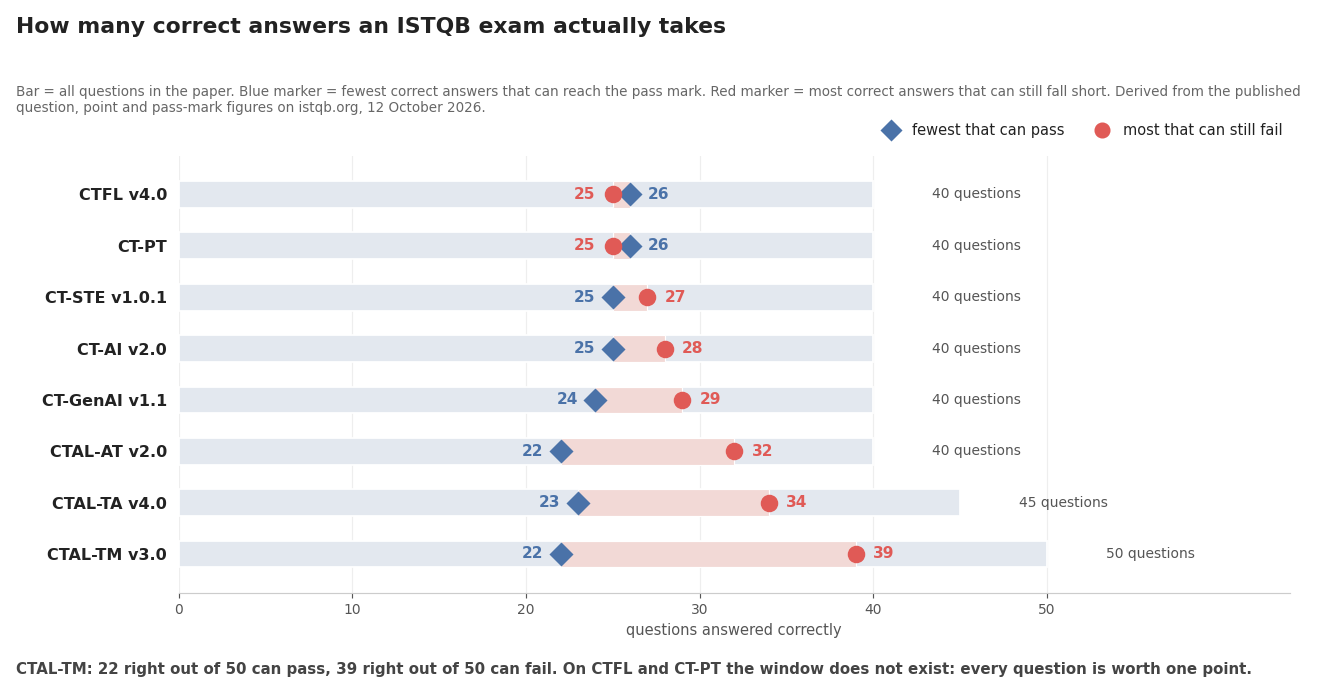
Take CTAL-TM. Its 14 K4 questions are worth 42 points; add eight of the ten K3 questions at 2 points each and you are at 58 — the pass mark, reached with 22 correct answers out of 50. Now run it the other way: answer every K2 and every K3 question correctly and miss all 14 K4 questions. That is 26 plus 20, or 46 points, from 36 correct answers out of 50 — twelve points short. Add three K4 questions and you are at 55 points with 39 of 50 right, and still short.
The same arithmetic across the eight exams:
CTFL v4.0 and CT-PT — 26 correct answers pass, 25 fail. No ambiguity at all.
CT-STE v1.0.1 — as few as 25 can pass, as many as 27 can fail.
CT-AI v2.0 — as few as 25 can pass, as many as 28 can fail.
CT-GenAI v1.1 — as few as 24 can pass, as many as 29 can fail.
CTAL-AT v2.0 — as few as 22 can pass, as many as 32 can fail.
CTAL-TA v4.0 — as few as 23 of 45 can pass, as many as 34 of 45 can fail.
CTAL-TM v3.0 — as few as 22 of 50 can pass, as many as 39 of 50 can fail.
Read the CTAL-TM line again: 39 right out of 50 is 78% of the paper, and it is a fail. 22 right out of 50 is 44% of the paper, and it is a pass. The gap between the two ends is a direct measure of how much the weighting matters — it is zero on CTFL and seventeen questions wide on CTAL-TM.
What the score does not contain
Three things are worth knowing because candidates routinely assume the opposite.
There is no partial credit. ISTQB's exam information page answers this directly: where a question is worth 3 points and asks you to select 2 options, you score the 3 points only if both correct answers are selected. Half right scores nothing, which makes multi-select K4 questions the highest-variance items on a weighted paper.
There is no per-chapter minimum. The rules define a single threshold for the whole exam. A chapter you answer badly costs you exactly its points and nothing more, so a weak area can be offset by strength elsewhere — within the limits the point arithmetic above sets.
And the scale is per certification, not per level. CT-STE and CT-PT are both Specialist modules and they score differently from each other. The row that governs your exam is the one on its own certification page, so check that rather than assuming the default.
Reading a mock result against the real scale
A practice tool that reports "28 of 40 correct" on CT-AI has told you almost nothing, because the result depends entirely on whether the four 2-point questions were among the 28. On the real paper that same performance is anywhere from 28 to 32 points against a bar of 29 — a pass or a fail depending on which questions went your way.
The fix is to practise against the published scale. Our full-length mocks use each exam's real question count, point total and pass mark: CTAL-TM mock exam 1 is 50 questions and 88 points with 58 to pass, not 50 questions and a percentage. Track points across your mocks rather than correct answers, and the number you are watching is the one the exam will actually use.
Where to check the numbers for your own exam
Each certification page on istqb.org carries an exam structure block with four lines: No. of Questions, Total Points, Passing Score and Exam Length in minutes, with the +25% allowance for candidates not sitting in their native language. That block is the authority, and it is the source of every number in this article. The split of those questions by chapter and by K-level lives in the Exam Structures & Rules Tables, linked from the downloads section of the same pages.
Be careful with third-party pages that state a pass mark as a count of correct answers — "26 out of 40" for an exam whose published figure is 30 of 46 points. That conversion silently drops the weighting, and on every exam except CTFL and CT-PT it gives you the wrong target. When a source and the certification page disagree, the certification page wins.
Once you know your exam's three numbers, the preparation plan writes itself: find the pass mark in points, work out how many of the heavy questions you can afford to lose, and practise at the level those questions sit at. Our CTAL-TM mocks and the rest of the free mock exams on this site are built to the same published scale, with a written rationale on every answer option.
Frequently asked
Of the points. ISTQB's rules require a score of at least 65%, and the score is counted in points. Only on exams where every question is worth one point — CTFL v4.0 and CT-PT — does that also work out to 65% of the questions.
Because it is rounded up to a whole point. 65% of CTAL-TM's 88 points is 57.2, and the published pass mark is 58, which is 65.9%. Across the eight exams the real bar runs from 65.0% to 65.9%.
Anywhere from 22 to 39 of the 50, depending on which ones. All 14 K4 questions plus eight K3 questions is 58 points from 22 answers. All 26 K2 and all 10 K3 questions is 46 points from 36 answers, which fails.
ISTQB scores Foundation level at exactly one point per question. For Advanced Level and Specialist modules the points reflect difficulty: a K2 question is one point, a K3 question is usually two and a K4 question usually three.
No. ISTQB states that where a question is worth three points and requires two selections, the three points are awarded only when both correct options are selected. A part-right answer scores nothing.
No. The rules set one threshold for the whole paper. A chapter you answer badly costs you its points and nothing more, so a weak chapter can be offset elsewhere.
Part of the ExamCaliber editorial team. Every ExamCaliber question and rationale is written and reviewed by hand against the current syllabus — never scraped from exam dumps.