ISTQB K-Levels Explained: Why a K3 Question Is Worth Two Points
What K1, K2, K3 and K4 mean, what each level is worth in every current ISTQB exam, and how the weighting changes what you actually need to score.
Every ISTQB syllabus tags its learning objectives with a K-level, and nearly every explainer on the web tells you the same four words: remember, understand, apply, analyse. Very few of them mention the part that actually moves your score. Above Foundation level, ISTQB does not pay the same amount for every question. A K2 question is worth one point. A K3 question is usually worth two. A K4 question is usually worth three.
On CTAL-TM that arrangement means 14 questions out of 50 carry 42 of the paper's 88 points. This article is about that side of K-levels: what the four levels are, what each one is worth in every current ISTQB exam, where the weighting is not what you would guess, and what it does to the arithmetic of passing. The numbers come from the ISTQB Exam Structures & Rules Tables version 1.19 (19 August 2026) and from ISTQB's own exam rules.
The four levels, and what each one asks you to do
K1 — Remember. You recognise or recall a term, a definition or a fact. No reasoning is required, and if you have not memorised it there is nothing to work out.
K2 — Understand. You pick the correct explanation, comparison or classification. This is the bulk of every ISTQB paper: you have to know why something is done, not just what it is called.
K3 — Apply. You take a technique and use it on a concrete case in the question stem: derive the test cases from a decision table, work out the boundary values, apply an estimation method to the numbers given.
K4 — Analyse. You break a situation into its parts and work out which factor drives the answer: read a defect report and decide what the root cause is, compare two risk profiles and choose the approach that fits.
Foundation exams use K1 to K3. Advanced and most Specialist exams use K2 to K4 and contain no K1 questions at all. Expert exams reach K5 (evaluate) and K6 (create) and assess those with essay questions rather than multiple choice. The level is printed on the objective itself — an identifier such as TM-1.3.4 in the CTAL-TM syllabus carries its K-level beside it — and the glossary terms listed at the head of each chapter come from the ISTQB glossary.
At Foundation level, every question is worth one point
CTFL v4.0 is 40 questions, 40 points, 26 to pass, 60 minutes. The K-split is 8 questions at K1, 24 at K2 and 8 at K3 — and all three levels score one point each. A K3 question that makes you build an equivalence partition out of the stem is worth exactly what a K1 question asking you to recognise a definition is worth.
That flat model is why the CTFL advice you see everywhere — answer what you know first, come back to the long ones — actually works at Foundation and stops working one level up. The 8 K3 questions are concentrated in chapters 4 and 5: five of them sit in chapter 4, the test techniques chapter, and three in chapter 5. The full chapter-by-chapter split is in our CTFL syllabus structure and chapter weights write-up.
Above Foundation, the points stop being equal
ISTQB's Exam Structures and Rules document sets the scoring rule for Advanced Level and Specialist modules in one sentence: a K2 question is allocated 1 point, and in general a K3 question should be allocated 2 points and a K4 question 3 points. The same paragraph then leaves room to move — K3 questions may be set at 1, 2 or 3 points, and K4 questions at 2 or 3.
So "a K3 question is worth two points" is a default, not a law. What each exam does is fixed per certification, in the Exam Structures & Rules Tables, and it is worth checking the row for the exam you are sitting instead of assuming.
What the current exams actually pay
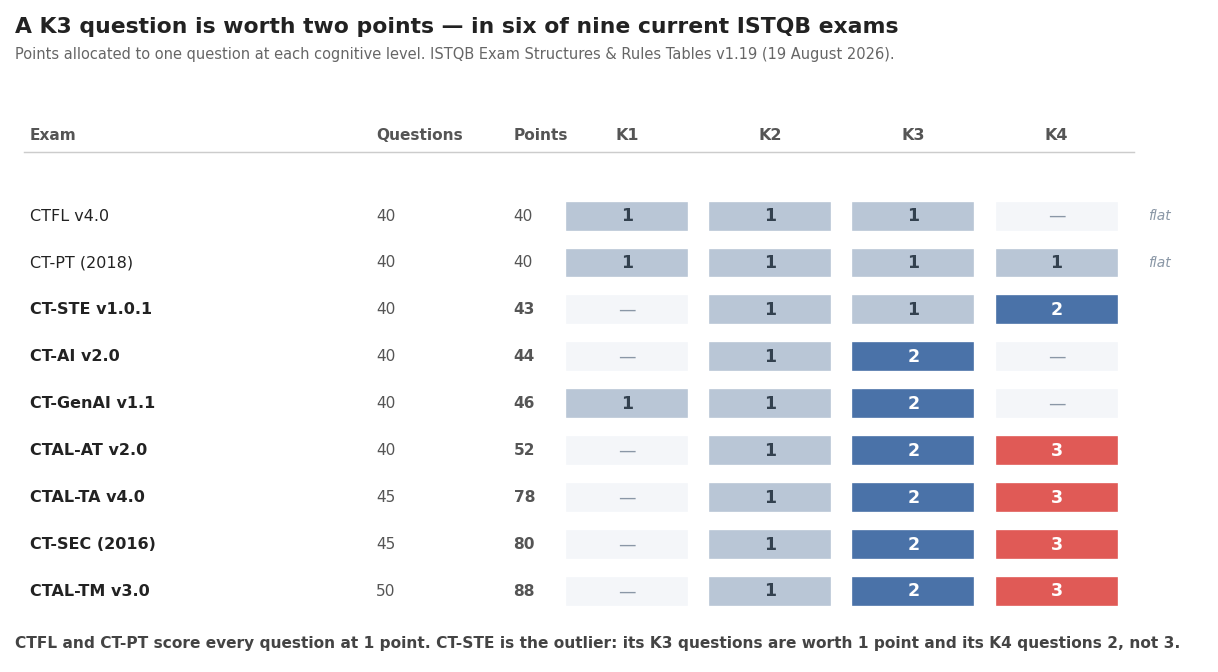
Six of the nine exams in the table pay two points for a K3 question: CT-AI v2.0, CT-GenAI v1.1, CTAL-AT v2.0, CTAL-TA v4.0, CT-SEC and CTAL-TM v3.0. Four of those six also carry K4 questions at three points each. The point totals follow directly from the mix:
CTAL-TM v3.0 — 26 K2 + 10 K3 + 14 K4 = 50 questions and 88 points, 58 to pass, 120 minutes.
CTAL-TA v4.0 — 18 K2 + 21 K3 + 6 K4 = 45 questions and 78 points, 51 to pass, 120 minutes.
CTAL-AT v2.0 — 31 K2 + 6 K3 + 3 K4 = 40 questions and 52 points, 34 to pass, 90 minutes.
CT-AI v2.0 — 36 K2 + 4 K3, no K4 at all: 40 questions and 44 points, 29 to pass, 60 minutes.
CT-GenAI v1.1 — 8 K1 + 26 K2 + 6 K3 = 40 questions and 46 points, 30 to pass, 60 minutes. It is a Specialist exam that still uses K1.
If you are choosing between the two Advanced Level analyst and manager exams, the weighting is one of the things that should decide it — we compared them side by side in CTAL-TA or CTAL-TM: which one first.
The two exams that break the pattern
CT-STE v1.0.1 is the one that catches people out. The 2025 Security Test Engineer exam is 40 questions and 43 points, 28 to pass, 75 minutes — and its K3 questions are worth one point, not two, while its K4 questions are worth two, not three. With 24 K2, 13 K3 and 3 K4 questions, the whole paper only rises 3 points above a flat count. Anyone who walks in expecting the usual 1/2/3 scale will mis-budget the analysis questions. Our CT-STE mock exam uses the real weighting.
CT-PT goes further and does not weight at all. Nine of its 40 questions are K4 — the highest K4 count of any Specialist exam — and every one of them is worth a single point, the same as a K1 recall question. The exam totals 40 points with 26 to pass. That is a consequence of its age: the CT-PT syllabus is still the 2018 edition, which we looked at in why the performance testing syllabus is still from 2018.
What weighting does to the arithmetic of passing
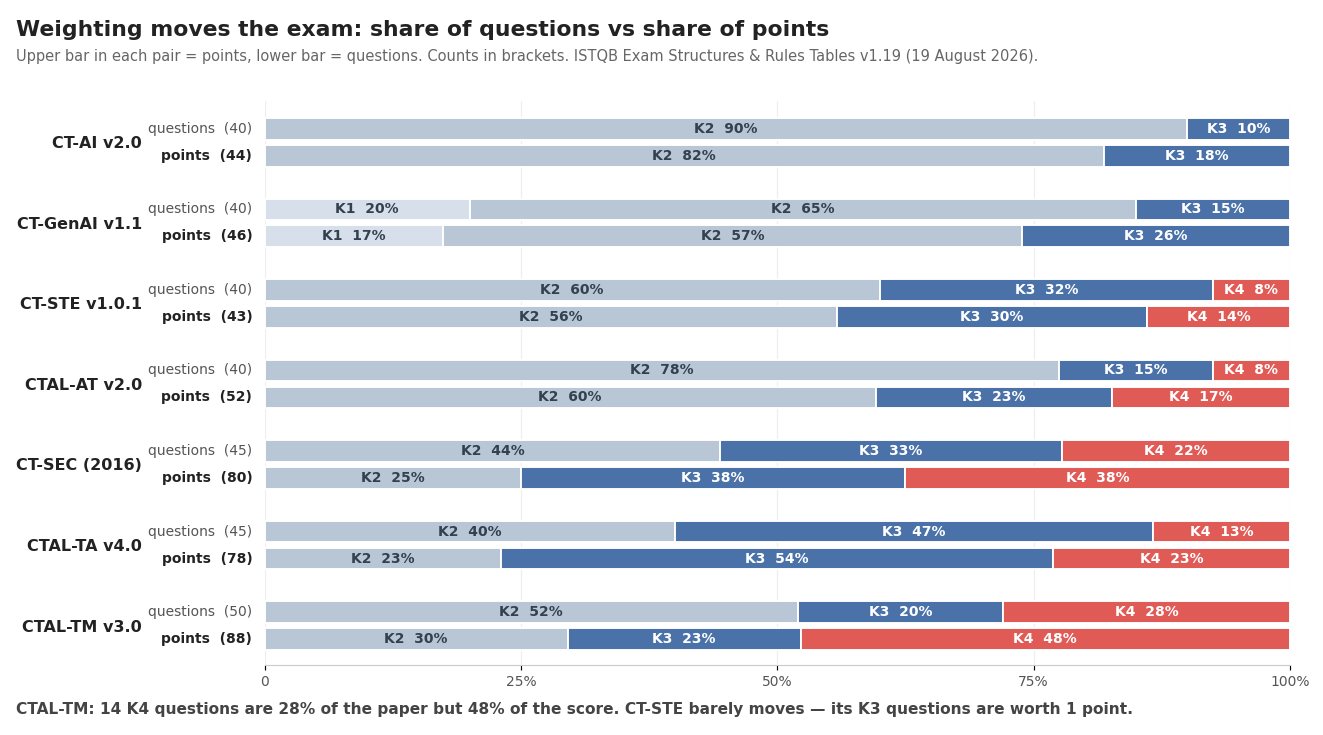
The gap between the two bars in each pair is the whole point. On CTAL-TM the 14 K4 questions are 28% of the paper and 48% of the score. The 26 K2 questions are just over half the paper and less than a third of the score. Run the pass mark through that: a perfect K2 performance is 26 points, a perfect K3 performance adds 20, and 46 is still 12 short of the 58 you need. There is no route through CTAL-TM that avoids the analysis questions.
CTAL-TA leans the other way. Its 21 K3 questions carry 42 of the 78 points — more than half the exam rests on applying test design techniques to a stem, which is exactly what the syllabus spends its largest chapter on. Its K2 questions are worth 18 points against a pass mark of 51, so recall and comprehension alone get you barely a third of the way. If you are preparing for it, the CTAL-TA study guide maps that back to chapters.
The flip side is CT-STE and CTAL-AT v2.0, where K2 still carries 56% and 60% of the points respectively. Those two reward broad coverage of the syllabus more than depth on a handful of techniques.
There is no partial credit on a multi-answer question
Weighting raises a practical question: if a K4 question is worth three points and asks you to pick two correct options, do you get something for getting one of them right? ISTQB's exam page answers it directly — where a question is worth 3 points and you must select 2 options, you score the 3 points only when you have selected both correct answers. A part-right answer scores nothing.
On a weighted paper that turns multi-select K4 questions into the highest-variance items on the exam. They are worth the most, they take the longest, and they are all or nothing. It is a good argument for leaving them until you have banked the single-answer questions, and a good argument for practising them specifically.
The clock is budgeted per K-level too
The same rules document sets a time guideline by cognitive level: one minute for K1, one to two minutes for K2, three minutes for K3 and four minutes for K4. Each exam's table then sums its own mix, and the totals are printed at the bottom of each table. They are informative.
CTFL v4.0 — 8 + 24 + 24 = 56 minutes budgeted against a 60-minute exam.
CTAL-TA v4.0 — 105 minutes budgeted against 120.
CTAL-TM v3.0 — 112 minutes budgeted against 120.
CT-PT — 100 minutes budgeted against an exam that runs for 90.
Two things follow. First, the slack is thin everywhere: on CTFL you have four spare minutes, not twenty, which is why the exam-day timing advice matters more than candidates expect. Second, the per-level budget is the best guide you have for practice: if a K3 question is taking you six minutes on a mock, the problem is not nerves, it is the technique.
Non-native speakers get 25% extra time on every one of these exams, which is the one reliable source of slack in the model.
How to use this while you revise
Find your exam's row first and write down three numbers: how many questions sit at each level, what each level pays, and what the pass mark is. Then plan against the points rather than the questions. On a weighted exam the question count tells you how long the paper feels; the point count tells you what passing it requires.
Work backwards from the pass mark the way we did for CTAL-TM above: assume you lose a reasonable share of the K4 questions and see whether the rest still adds up. If it does not, you know which chapters to work on, because the exam structure table also tells you which chapter each K4 question comes from.
Then practise at the level, not at the topic. K3 and K4 questions cannot be revised by re-reading the syllabus, because what they test is the step after reading it. Timed mock exams with a written rationale on every option are the cheap way to find out which technique you can actually apply under three minutes of pressure — that is what our free mocks for CTFL and the Advanced Level exams are built for.
Frequently asked
Only at Expert level. K5 (evaluate) and K6 (create) are assessed with essay questions, not multiple choice. Foundation, Specialist and Advanced exams are multiple choice and stop at K4.
No. Advanced syllabi contain no K1 learning objectives, so no question is set at K1. The glossary keywords listed in each chapter are still examinable, but they are tested inside K2 and higher questions.
In the ISTQB Exam Structures & Rules Tables on istqb.org. The current edition is version 1.19, dated 19 August 2026, and it gives one table per certification with questions, points and minutes broken down by K-level.
No. On CTAL-TM the 26 K2 questions are worth 26 of the 88 points and the pass mark is 58. Even a perfect K2 and K3 performance leaves you 12 points short, so some K4 answers have to land.
Not necessarily. The K-level describes what you are asked to do with the material, not how obscure it is. A K1 question on a term you never revised will beat you; a K3 question on a technique you have practised will not.
Part of the ExamCaliber editorial team. Every ExamCaliber question and rationale is written and reviewed by hand against the current syllabus — never scraped from exam dumps.