CT-PT: Why the ISTQB Performance Testing Syllabus Is Still From 2018
The ISTQB Performance Testing syllabus still carries the date 9 December 2018. What is still accurate in it, what it never mentions, and how the exam built on it is actually weighted.
The ISTQB Performance Testing syllabus carries the date 9 December 2018 on its cover. Eight years later it is still the only edition, and the exam you sit in 2026 is written against it. That fact alone makes candidates hesitate: a performance testing document that predates the mainstream of container orchestration, service meshes and distributed tracing sounds like a museum piece.
Three questions usually get mixed together here, and they have different answers. Is the 2018 syllabus actually still the current one? Is its content still correct? And what does the exam built on it actually ask? In order: yes, mostly, and something considerably more analytical than the syllabus's age suggests.
Yes, 2018 is still the current version
Checked again on 21 September 2026, against ISTQB's own pages rather than against secondary sources:
The CT-PT download page lists exactly three files: ISTQB CT-PT Syllabus v1.0 2018, plus Sample Exam A questions and answers at v1.3. There is no newer syllabus and no release notes document.
The PDF itself prints Version 2018 and the date 9 December 2018, across 59 pages. The "v1.0" label exists only in ISTQB's file name.
The certification page still gives 40 questions, 26 points to pass, 90 minutes with 25% extra time for non-native speakers, and CTFL as the entry requirement.
ISTQB's releases through 2025 and 2026 were CT-AI v2.0, CTAL-AT v2.0, Finance Testing and the GenAI module. Performance testing was not among them. Whether a v2.0 is in preparation has not been stated publicly in either direction.
One naming wrinkle worth knowing before you search for materials. The syllabus text calls the qualification Foundation Level Performance Testing, ASTQB hosts the same PDF under the file name CTFL-PT, and ISTQB's current portfolio lists it as the Specialist module CT-PT. All three names refer to one certification and one exam. Our CT-PT practice tests follow the same 2018 chapter structure for that reason.
What eight years did not change
Most of the syllabus aged well, because most of it is not tied to a platform. Five things in particular are as correct in 2026 as they were in 2018.
The quality model. ISO/IEC 25010 was revised in 2023 and grew to nine characteristics, but performance efficiency kept exactly the three subcharacteristics the syllabus uses: time behaviour, resource utilization and capacity. Chapter 1's foundation did not move.
The vocabulary of test types. Load, stress, scalability, spike, endurance, concurrency and capacity testing are still the terms teams use, and still the terms the exam expects you to separate.
The four routes to load generation, via the user interface, via the API, via captured communication protocols and via crowds, still describe every tool on the market, including the ones that did not exist in 2018.
Operational profiles, load profiles, ramp-up and steps, think time, and the definition that system throughput equals the number of virtual users divided by processing time plus think time. That arithmetic does not age. Neither does the syllabus's worked point that 500 users sending one request a minute impose sixty times the load of 500 users sending one request an hour.
The failure lessons. Missing or incorrect
correlationis still the main reason a recorded script will not replay. Percentiles still beat averages. The probe effect still distorts measurements. And performance testing still usually has no clear test oracle, which is exactly what juniors get wrong.
What the 2018 text simply does not contain
Search the syllabus for the words that define performance work today and the absences are consistent. Kubernetes, container, Docker, microservice, serverless, gRPC, WebSocket, HTTP/2, HTTP/3, observability, OpenTelemetry, service level objective, error budget, chaos engineering, shift-left: none of them appear anywhere in the document. The protocol list in section 4.2.1 still names Citrix ICA, CORBA and MQSeries next to HTTP, ODBC, JDBC, SOAP and REST. Chapter 1 still quotes seven seconds as the general industry rule of thumb for web response.
That has two consequences, and they point in opposite directions.
For your job, the syllabus is not a 2026 practitioner's reading list. It will not tell you how autoscaling behaves under a burst, what a cold start costs you, how much of your latency is sidecar overhead, or how to read a distributed trace. Cloud is present, but at the abstraction level of 2018: "dynamic/cloud-based systems" as one of nine architecture risk categories, and internal lab versus cloud IaaS versus cloud SaaS as deployment options for load generation.
For the exam, none of that matters, and this is the part candidates with real performance experience get wrong. The questions are written against this text. Answering from your own production platform, rather than from the syllabus, is a reliable way to lose marks on the distractors that sound modern.
The exam is more analytical than the syllabus's age suggests
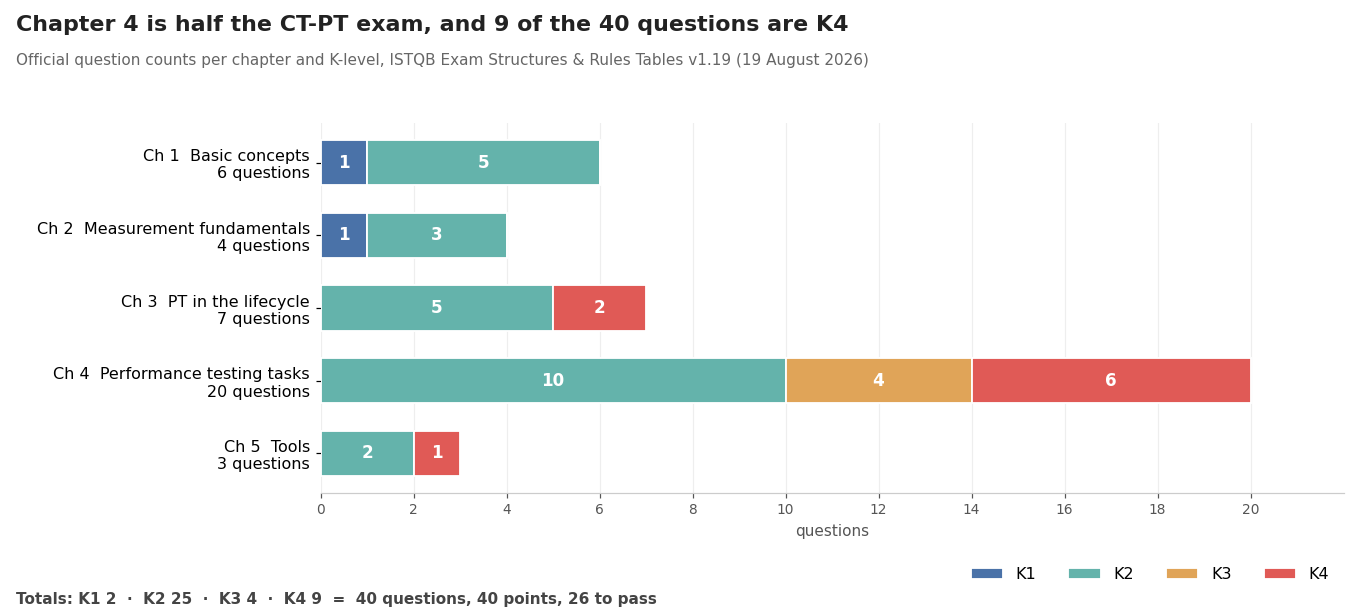
The official structure comes from the ISTQB Exam Structures and Rules Tables, version 1.19 of 19 August 2026. CT-PT is 40 questions worth 40 points, 26 to pass, and unlike some ISTQB exams every question is worth exactly one point regardless of its K-level. The chapter split is 6, 4, 7, 20 and 3 questions; the cognitive split is 2 at K1, 25 at K2, 4 at K3 and 9 at K4.
Nine analysis questions out of forty is a lot for an exam at this tier. In the same tables, CTFL v4.0 has zero K4 questions and the Agile Tester extension has zero. The Security Test Engineer module, released in 2025 and therefore seven years newer, has three. The 2018 syllabus produces the most analytical paper of the group.
The learning objectives explain why. Exactly one objective in the whole syllabus sits at K3: PTFL-4.2.7, implement performance test scripts consistent with the plan and load profiles. Ten sit at K4, and they are the substance of the certification: analysing performance risks across the lifecycle and determining the right activities per phase (3.3.1 and 3.4.1), deriving test objectives, outlining a performance test plan and building a presentation that explains it to stakeholders (4.1.1 to 4.1.3), analysing operational profiles, creating load profiles from them and analysing throughput and concurrency (4.2.3 to 4.2.5), analysing and reporting results (4.4.1), and judging tool suitability in chapter 5. There is very little to recite and a great deal to work out.
The 90-minute trap
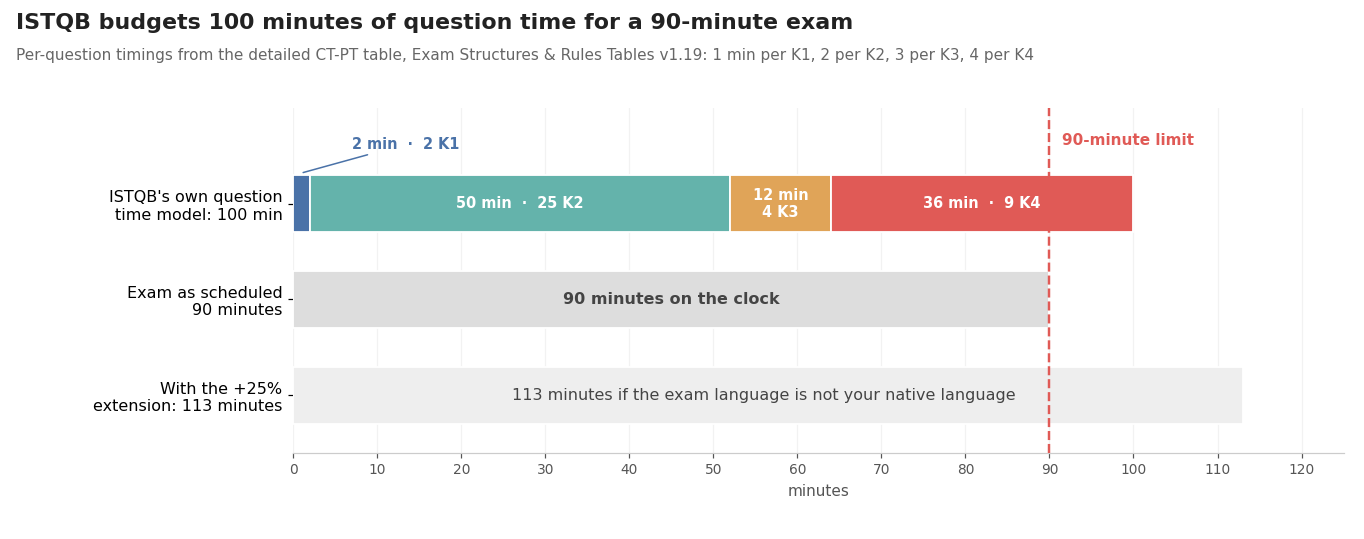
The same tables carry a per-question timing model: one minute for a K1 question, two for a K2, three for a K3 and four for a K4. Applied to the CT-PT mix that is 2 plus 50 plus 12 plus 36 minutes, and the total printed in the detailed CT-PT table is 100 minutes. The exam is scheduled for 90.
This is not a rounding artefact you can ignore. The board's own estimate of how long the paper takes exceeds the time the paper is given, by about eleven per cent. With the 25% extension for candidates whose native language is not the exam language, 113 minutes, you are back inside the model with room to spare. At 90 minutes you are not, and the pressure is not spread evenly: the model spends 36 of its 100 minutes on the nine K4 questions, which are also the ones with a scenario to read before you can start thinking.
The contrast with Foundation is instructive. On CTFL the same model budgets 56 of the available 60 minutes, so the clock is tight but solvable; we worked through that arithmetic in the CTFL exam day guide. On CT-PT the model overruns the clock outright.
One more number worth correcting while we are here. Several study sites still publish a 60-minute CT-PT exam. The ISTQB certification page, ASTQB's registration page and the summary table in the exam structure document all say 90. If a practice platform times you at 60 minutes, it is not simulating this exam.
Where the questions actually are
Chapter 4, Performance Testing Tasks: 20 questions, split 10 K2, 4 K3 and 6 K4. Planning, the performance test plan and its sections, protocols and transactions, operational and load profiles, throughput versus concurrency, script structure and correlation, execution and steady state, analysis and reporting. The syllabus gives this chapter 475 of its 875 training minutes and the exam gives it half the questions. Studying the five chapters evenly is the single most common preparation mistake.
Chapter 3, Performance Testing in the Software Lifecycle: 7 questions, 2 of them K4. Nine categories of architecture risk, from single computer through multi-tier, virtualized and cloud-based to mobile, embedded real-time and mainframe, plus the lifecycle models. Both analytical objectives in this chapter are K4, so expect a described project, not a definition.
Chapter 1, Basic Concepts: 6 questions, almost all K2. Principles, the types of performance testing, static versus dynamic, load generation, and the common failure modes with their causes.
Chapter 2, Performance Measurement Fundamentals: 4 questions. The three metric categories, Goal-Question-Metric as the selection method, the three sources of metrics, the probe effect, and why raw numbers mislead.
Chapter 5, Tools: 3 questions, one of them K4. Load generators, the management console, monitoring tools, and the four suitability factors: compatibility, scalability, understandability and monitoring.
Should you take it in 2026?
It is worth it if you want a structured vocabulary for performance work and a credential that hiring filters recognise, if you are moving into performance testing from functional testing, or if your employer pays and CTFL is already behind you. The K4 weighting means the preparation genuinely changes how you plan a performance test, rather than just adding terms you can recall.
It is the wrong purchase if what you actually want is current cloud-native performance engineering practice. The syllabus does not teach it and does not claim to. Read CT-PT as a discipline framework and get the platform specifics somewhere else.
One practical reassurance about the age question: ISTQB certificates at Foundation and Specialist level do not expire, so a certificate earned against a 2018 syllabus does not quietly become invalid when a v2.0 eventually appears. The broader question of whether any of these certifications pay for themselves is one we took apart separately in our honest take on ISTQB certifications. And if CTFL is still ahead of you, it is a prerequisite here, not an optional first step; the CTFL guide covers that exam.
How to study against an eight-year-old syllabus
Answer from the syllabus, not from your job. Where practice has moved on, the exam has not. Read the 2018 syllabus PDF as the source of truth for every answer.
Read chapter 4 twice before you read chapters 1 and 2 once. It is half the exam and more than half the training time.
Work through the official Sample Exam A. It is the only official question set for this module, and the separate answers document explains the reasoning rather than just marking the key.
Practise the analysis rather than the recall. Derive a load profile from an operational profile until the steps are mechanical, and write out a performance test plan's sections from memory with acceptance criteria assigned to the right stakeholder: response time to the user, throughput to the business, resource utilization to the system.
Then run full mocks under the real clock, because the official time model says you will have no slack. Our CT-PT mock exam runs 40 questions in 90 minutes with the same chapter weighting, and gives a written rationale for every answer option rather than just the correct one.
The age of the syllabus is a real limitation for your practice and a non-issue for your exam. Study it as the document it is, dated in its examples and sound in its structure, and the 2018 date stops being the interesting thing about CT-PT.
Frequently asked
Yes. The 2018 edition is still the only one ISTQB publishes, and exams are written against it. The certification's download page lists the v1.0 2018 syllabus plus Sample Exam A questions and answers v1.3, and no successor has been announced.
90 minutes, or 113 if the exam language is not your native language. The 60-minute figure that circulates on study sites contradicts both the ISTQB certification page and the official exam structure tables.
Yes. The syllabus states that the Foundation Level Core certificate must be obtained before taking the Performance Testing exam. No work experience is required.
No. None of those terms appear in the syllabus. Cloud is covered only as an architecture risk category and as a deployment option for load generation, at the level of abstraction of 2018.
More analytical. CTFL has no K4 questions at all; CT-PT has nine out of forty, and chapter 4 alone carries twenty questions. Recall alone earns very few marks.
Part of the ExamCaliber editorial team. Every ExamCaliber question and rationale is written and reviewed by hand against the current syllabus — never scraped from exam dumps.