ISTQB CTFL v4.0 Syllabus: Structure and Chapter Weights
The CTFL v4.0 syllabus has six chapters and 64 learning objectives, and the exam draws exactly 8, 6, 4, 11, 9 and 2 questions from them. Here is the official breakdown, the K-level split and how to study against it.
The ISTQB Certified Tester Foundation Level (CTFL) v4.0 syllabus has six chapters, 14 business outcomes and 64 learning objectives, and the exam draws exactly 8, 6, 4, 11, 9 and 2 questions from chapters 1 to 6. That distribution is not a rough guideline — it is fixed in the official ISTQB Exam Structures & Rules tables, so every real exam has the same shape: 40 questions, 40 points, pass mark 26 (65%), 60 minutes.
Most study guides quote the chapter weights "approximately". They do not need to be approximate. Below is the exact table, the K-level split behind it, and what each chapter is really testing.
How the CTFL v4.0 syllabus is organised
Version 4.0 was released on 21 April 2023 and became mandatory on 9 May 2024. The current document is the maintenance release v4.0.1 from September 2024 — it fixes wording, not content. Every chapter heading in the syllabus states its own training time, and accredited courses must deliver a minimum of 1135 minutes (18 hours 55 minutes) of instruction:
Chapter 1 — Fundamentals of Testing: 180 minutes
Chapter 2 — Testing Throughout the Software Development Lifecycle: 130 minutes
Chapter 3 — Static Testing: 80 minutes
Chapter 4 — Test Analysis and Design: 390 minutes
Chapter 5 — Managing the Test Activities: 335 minutes
Chapter 6 — Test Tools: 20 minutes
Each learning objective carries a K-level — K1 (remember), K2 (understand) or K3 (apply) — and the K-level determines what an exam question can ask you to do with that objective.
Chapter weights: where the 40 questions come from
This is the complete official picture — questions, K-level split, points and training minutes per chapter.
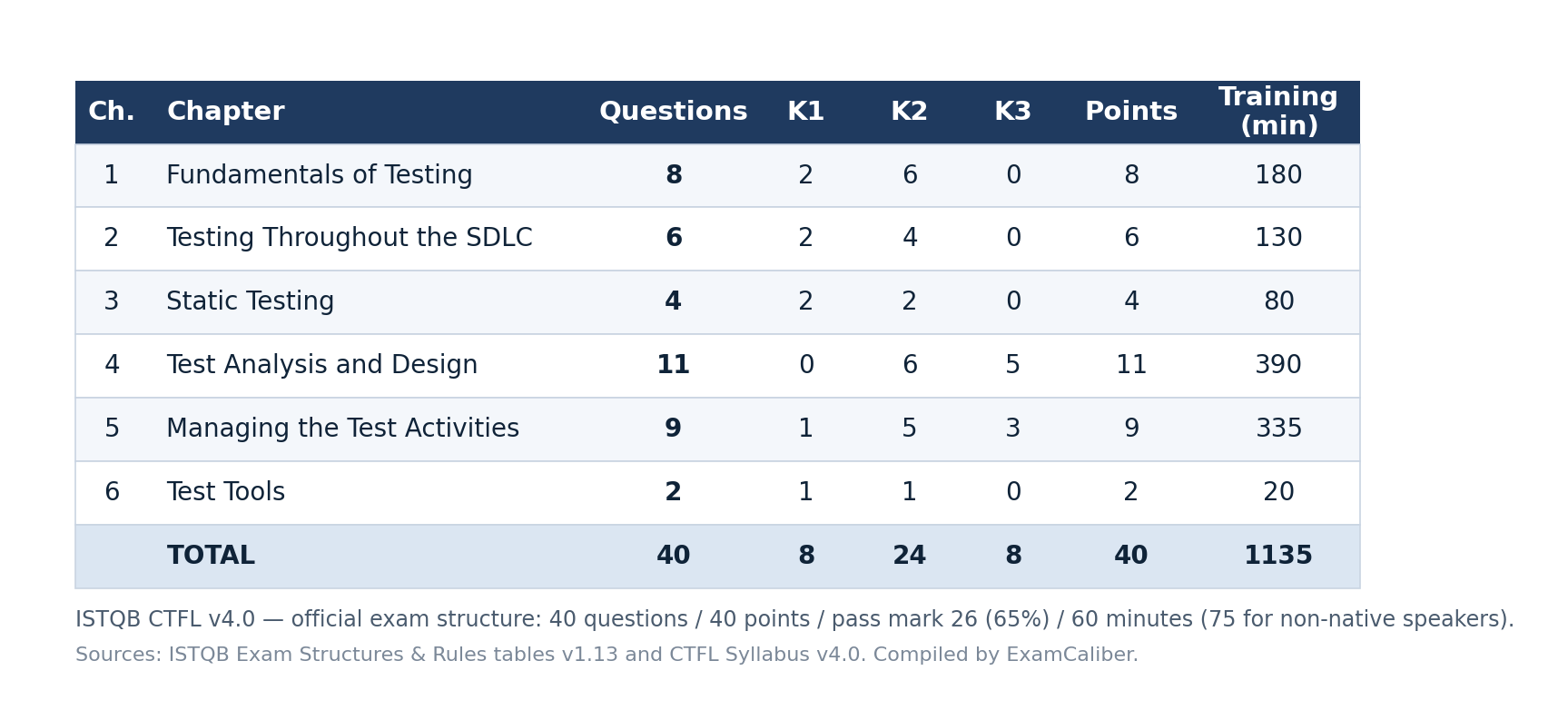
Read as exam share, the same numbers look like this:
Chapter 4 — 27.5% (11 questions)
Chapter 5 — 22.5% (9 questions)
Chapter 1 — 20% (8 questions)
Chapter 2 — 15% (6 questions)
Chapter 3 — 10% (4 questions)
Chapter 6 — 5% (2 questions)
Two consequences worth internalising. First, chapters 4 and 5 are exactly half the exam — 20 of 40 questions and 725 of 1135 training minutes. Second, chapter 6 is worth two questions and twenty minutes of teaching; if you are spending an evening on tool categories, you are optimising the wrong thing.
K1, K2 and K3: what the levels cost you
Across the whole exam the K-level budget is fixed as well: 8 K1 questions, 24 K2 questions and 8 K3 questions. Every question is worth one point regardless of level, which is exactly why K3 items decide the outcome — they take three to five times longer to answer for the same single point.
K1 (remember) — recall a term, a list or a fact. Concentrated in chapters 1, 2, 3 and 6.
K2 (understand) — explain, compare or classify a scenario. The bulk of the exam, in every chapter.
K3 (apply) — actually run a technique on given data. Only in chapters 4 (5 questions) and 5 (3 questions).
The five K3 objectives in chapter 4 are equivalence partitioning, boundary value analysis, decision table testing and state transition testing (plus acceptance test-driven development). We work through each of them with data in Black-Box Test Design Techniques (with Examples). Chapter 5 contributes its K3 questions through test estimation and risk-based prioritisation.
What each chapter actually tests
Chapter 1 — Fundamentals of Testing (8 questions)
Vocabulary and mental model: testing objectives, testing versus debugging, the error/defect/failure chain, the seven testing principles, the test activities and testware, and the roles and skills involved. Nothing here is K3, but the terminology underpins every other chapter, so a shaky chapter 1 quietly costs you marks in chapters 4 and 5.
Chapter 2 — Testing Throughout the SDLC (6 questions)
How testing fits sequential, iterative and incremental development; test-first approaches (TDD, BDD, ATDD); shift-left; DevOps and continuous testing; the five test levels; the four test types; confirmation versus regression testing; maintenance testing. The classic trap is treating test levels and test types as the same dimension — they are orthogonal.
Chapter 3 — Static Testing (4 questions)
Four questions, but dense: the value of static testing, static versus dynamic, the generic review process, review roles, and the four review types. Questions typically describe a meeting and ask you to name the review type, so learn the discriminators — who leads it, is there a defined process, are checklists used, are metrics collected.
Chapter 4 — Test Analysis and Design (11 questions)
The largest chapter and the only one where you must produce answers rather than recognise them: black-box techniques (equivalence partitioning, 2-value and 3-value boundary value analysis, decision tables, state transition testing), white-box techniques (statement and branch coverage), experience-based techniques, and collaboration-based approaches. Reading about these is not enough — five K3 questions expect you to compute.
Chapter 5 — Managing the Test Activities (9 questions)
Test planning and entry/exit criteria, estimation techniques, risk management (risk = likelihood × impact, project versus product risk, risk-based testing), monitoring versus control versus completion, configuration management, and defect reporting. This is the chapter candidates most often underweight because it feels like management theory rather than testing.
Chapter 6 — Test Tools (2 questions)
Tool categories, plus the benefits and risks of test automation, at a conceptual level. No product names are examinable. Two questions, twenty minutes of official training time — budget accordingly.
Turning the weights into a study plan
Allocate time in proportion to the official training minutes, not to how interesting a chapter looks. Roughly 34% of your hours belong to chapter 4 and 30% to chapter 5.
Read chapter 1 first for vocabulary, then jump straight to chapter 4 while you are still fresh — it needs practice, and practice needs repetition over days.
Practise the eight K3 skills by hand until they are mechanical: partitions, 2-value and 3-value boundaries, decision table collapse, state transition coverage, statement and branch coverage, three-point estimation, risk scoring.
Treat chapters 3 and 6 as memorisation sprints, not study sessions. Six questions between them.
Sit full 40-question timed mocks and check your errors by chapter. A 60% score built on chapter 4 failures is far more dangerous than the same score spread evenly.
For a week-by-week version of this, see our complete ISTQB Foundation Level guide, and for the mechanics of the exam day itself — timing, scoring, review flags — see ISTQB CTFL Exam Format Explained. For the practical side — what to study in which order, and how to use the mocks — see our CTFL how-to-pass guide.
Our free CTFL mock exams follow the official distribution exactly
A mock exam is only useful if its shape matches the real one. In July 2026 we rebalanced all 15 of our CTFL mocks so that every single one draws 8 / 6 / 4 / 11 / 9 / 2 questions from chapters 1 to 6 — verified question by question, not declared and approximated. Each mock is 40 original questions, 65% pass mark, 60 minutes, with a written rationale for every answer option (not just the correct one) and a PDF export of your result.
They are free and need no account: take a CTFL v4.0 mock exam.
Where to get the syllabus itself
The syllabus is free. Download the current PDF from the official ISTQB CTFL v4.0 page, and keep the ISTQB glossary open beside it — a large share of K1 and K2 questions are glossary definitions in disguise.
Frequently asked
Exactly 8 from Chapter 1, 6 from Chapter 2, 4 from Chapter 3, 11 from Chapter 4, 9 from Chapter 5 and 2 from Chapter 6 — 40 questions and 40 points in total. The split is fixed in the ISTQB Exam Structures & Rules tables, not left to the exam board.
Chapter 4, Test Analysis and Design. It carries 11 of the 40 questions (27.5%) and the largest share of accredited training time (390 of 1135 minutes). Chapters 4 and 5 together are exactly half the exam.
Eight. Five come from Chapter 4 (equivalence partitioning, boundary value analysis, decision tables, state transition testing) and three from Chapter 5. No other chapter contains a K3 learning objective.
Accredited courses must deliver a minimum of 1135 minutes of instruction — 18 hours and 55 minutes — distributed 180/130/80/390/335/20 minutes across chapters 1 to 6. Self-study normally takes longer.
26 points out of 40, which is 65%. You get 60 minutes, or 75 minutes if you sit the exam in a language that is not your native language.
Version 4.0.1, the maintenance release published in September 2024. It corrects wording in the v4.0 syllabus of April 2023 but does not change the learning objectives or the exam structure.
Part of the ExamCaliber editorial team. Every ExamCaliber question and rationale is written and reviewed by hand against the current syllabus — never scraped from exam dumps.