CTAL-TA or CTAL-TM: Which ISTQB Advanced Level Exam First?
Both exams run 120 minutes and both need CTFL. But CTAL-TM puts 42 of its 88 points behind K4 questions, and that changes which one you should sit first.
Two ISTQB Advanced Level exams, both sitting one step above the Foundation certificate, both requiring CTFL first, both running 120 minutes. CTAL-TA asks you to design tests. CTAL-TM asks you to run a test effort. Most guides stop there, hand you a list of job titles and let you match yourself to one.
That skips the more useful question: which of the two is actually harder to pass, and where the difficulty sits. The answer is printed in the ISTQB Exam Structures & Rules Tables (v1.19, 19 August 2026) and it is not the exam most people expect.
The short answer
You design, analyse and execute tests. Take CTAL-TA.
You already plan, estimate, report and lead a test team. Take CTAL-TM.
You could argue either way. Take CTAL-TA first, for a scoring reason set out below.
What each exam actually covers
CTAL-TA v4.0 has five examinable chapters: the Test Analyst's tasks in the test process, their tasks in risk-based testing, test analysis and test design, testing quality characteristics, and software defect prevention. It is a business-facing, black-box certificate. Code-level and structural techniques are not its subject; those belong to the Technical Test Analyst syllabus.
CTAL-TM v3.0 has three: managing the test activities, managing the product, and managing the team. Planning, monitoring and control, risk-based testing from the manager's side, test strategy, process improvement, tools, metrics, estimation, defect management, team skills and stakeholder relationships.
So one exam is deep and narrow across five chapters; the other is broad across three very large ones.
The published format, side by side
CTAL-TA v4.0: 45 questions, 78 points, 51 to pass, 120 minutes.
CTAL-TM v3.0: 50 questions, 88 points, 58 to pass, 120 minutes.
Both pass marks are the standard 65% of the available points, and both exams grant an extra 25% of time (150 minutes) when the exam language is not the candidate's native language.
The detail that carries everything else: at Advanced Level a question is not worth one point. A K2 question is worth 1, a K3 question 2 and a K4 question 3. That is why 45 questions add up to 78 points, and why two exams of almost the same length can feel nothing alike.
One number worth double-checking against older material: CTAL-TM's total was corrected by ISTQB to 88 points. Study guides and course pages written before the correction still circulate other totals, and at least two widely read pages currently give the exam duration as 90 minutes and 180 minutes respectively. The official tables say 120.
Each exam is decided by one chapter
Neither syllabus spreads its questions evenly. In CTAL-TA, chapter 3 (test analysis and test design) is 22 of the 45 questions and 42 of the 78 points. In CTAL-TM, chapter 1 (managing the test activities) is 26 of 50 questions and 46 of 88 points. In both cases a single chapter carries more than half the marks.
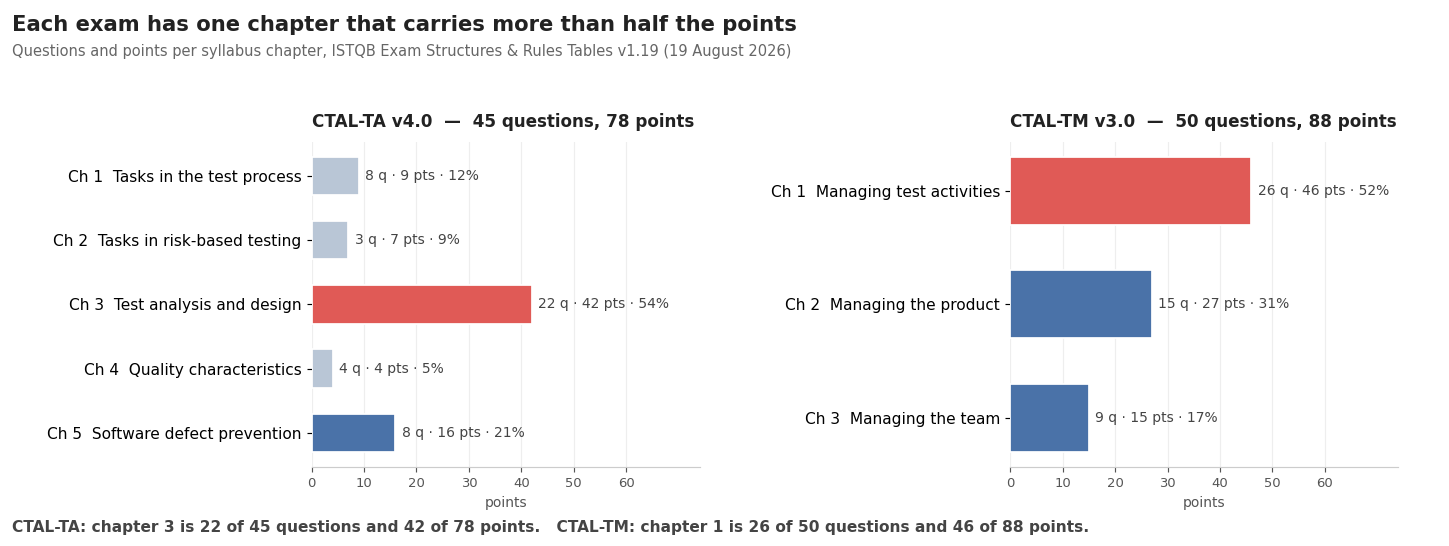
The practical consequence is the same for both, and it is uncomfortable: study time allocated evenly across chapters is study time misallocated. For CTAL-TA that means chapter 3 — domain, combinatorial and random testing, CRUD, state transition, scenario-based, decision tables, metamorphic testing and experience-based techniques — deserves roughly half of everything you do. For CTAL-TM it means chapter 1, and inside it the risk-based testing and test strategy sections.
The K-level split is where they really diverge
CTAL-TA is built from 18 K2 questions, 21 K3 and 6 K4. CTAL-TM is built from 26 K2, 10 K3 and 14 K4. Neither exam contains K1 questions.
Read that again, because it is counter-intuitive. CTAL-TM has more straightforward comprehension questions than CTAL-TA and, at the same time, more than twice as many analysis questions. It is a polarised paper: a large easy base and a large hard tail, with comparatively little in between. CTAL-TA is the opposite shape — its centre of gravity is K3, the level where you apply a technique to a given situation.
Why CTAL-TM cannot be passed without K4
Convert the question counts into points and the difference stops being a matter of taste.
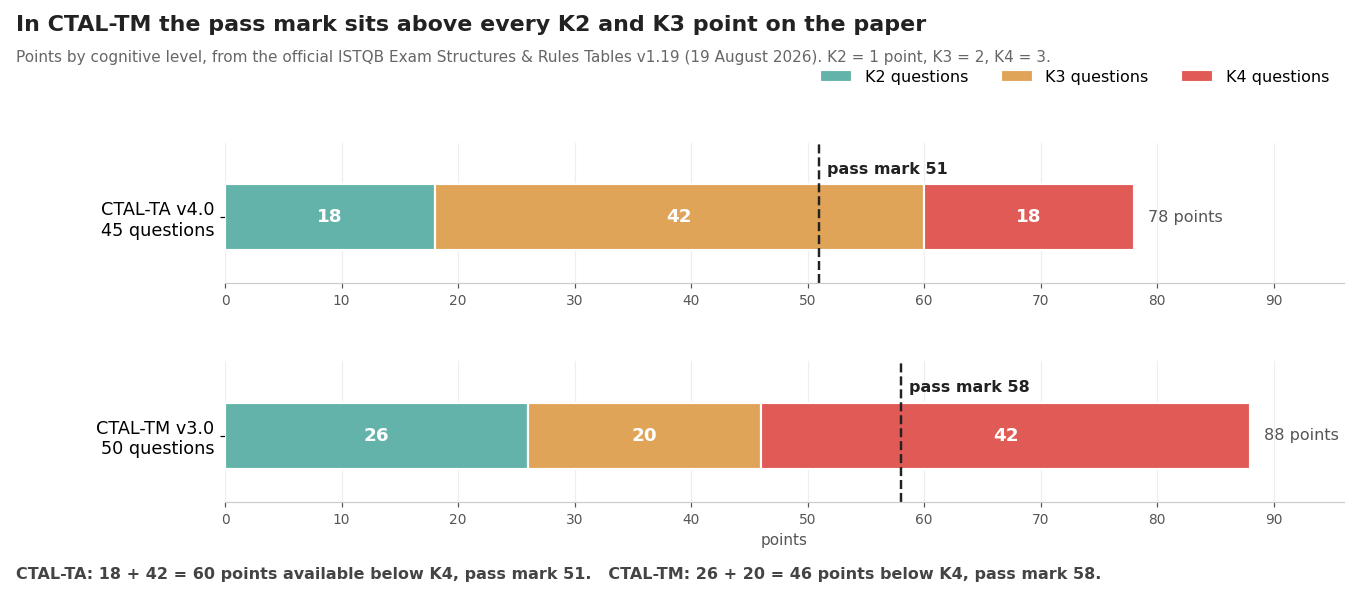
In CTAL-TM, the 26 K2 questions are worth 26 points and the 10 K3 questions 20 points. Everything below K4 therefore totals 46 points — against a pass mark of 58. A candidate who answered every single K2 and K3 question correctly and got nothing else would still fail by 12 points. At 3 points each, that is four K4 questions you must also answer correctly, and that is the best case, on a flawless run through the rest of the paper.
CTAL-TA does not work that way. Its 18 K2 questions and 21 K3 questions are worth 60 points between them, against a pass mark of 51. In principle the exam is passable without a single correct K4 answer — though it would take 51 of those 60 points, around 85% of everything below K4, so this is a margin rather than a strategy. The point is structural: in CTAL-TA the K4 questions are a cushion, and in CTAL-TM they are the floor.
If you have never sat a K4 question, that is the thing to go and practise before choosing. K4 asks you to break a situation down and compare options — pick the estimation technique for this project and justify it, work out which risks the given approach leaves uncovered — not to recall or apply a definition.
The clocks run differently too
ISTQB budgets its own exams using a per-question time model: one minute for a K2 question, three for K3 and four for K4. Run both papers through it and CTAL-TA comes to 105 minutes of the 120 available. CTAL-TM comes to 112.
Fifteen minutes of slack against eight. Neither exam is generous, but CTAL-TM is the one where a long stall on a single analysis question costs you something you cannot get back. Candidates taking the non-native extension get 150 minutes and a much more comfortable ratio in both cases.
Prerequisites and study hours
Both exams require the Certified Tester Foundation Level certificate, with v4.0 preferred, and both syllabi recommend at least a minimal background — the wording is around six months as a tester or developer. Neither sets a number of years. The official CTAL-TA page and the CTAL-TM page both add "sufficient practical experience" and leave the criteria to the Member Board or Exam Provider, so the bar is local.
Accredited training minima are close: 1,215 minutes (20.25 hours) for CTAL-TA across five chapters, 1,365 minutes (22.75 hours) for CTAL-TM across three. CTAL-TM is the bigger reading job per chapter by some distance.
If the underlying question is whether an Advanced Level certificate earns its keep at all, that is a separate argument and we have made it at length elsewhere.
Fewer K4 objectives, more K4 questions
One more pattern worth knowing before you revise. CTAL-TA has 36 learning objectives: 22 at K2, 11 at K3, 3 at K4. CTAL-TM has 48: 36 at K2, 5 at K3, 7 at K4.
Line those up against the question counts and both exams land on exactly two K4 questions per K4 objective — 3 objectives and 6 questions in CTAL-TA, 7 objectives and 14 questions in CTAL-TM. That makes the hardest part of each paper unusually predictable. In CTAL-TA the K4 objectives are TA-2.2.1 (risk control), TA-3.5.1 (applying the most appropriate techniques) and TA-5.3.1 (mitigating the recurrence of defects). In CTAL-TM they are TM-1.2.7, TM-1.3.4, TM-1.4.2, TM-1.6.3, TM-2.1.3, TM-2.2.3 and TM-3.1.2 — four of the seven inside chapter 1.
Seven sections, 42 points. There is no more concentrated use of revision time available in either syllabus.
So: which one first?
If your day job already is test management — you own the plan, the estimates and the reporting — go straight to CTAL-TM. CTAL-TA is not a prerequisite and the overlap is smaller than the shared "Advanced Level" label suggests.
In every other case, CTAL-TA first. Three reasons. It matches what most candidates do all day, so the K3 questions are about work you recognise. Its scoring forgives a weak K4 performance where CTAL-TM does not. And the vocabulary it drills — risk analysis and risk control, defect taxonomies, coverage criteria, quality characteristics — is the same vocabulary CTAL-TM then asks you to manage with, which makes the second exam meaningfully cheaper to prepare for than it looks.
Third option, if neither description fits: the Agile track is a different Advanced Level entry point with its own migration path, covered in our CTAL-AT and CTFL-AT guide.
Practising for the one you choose
Whichever exam you pick, practise against the real distribution rather than a flat set of questions. ExamCaliber's CTAL-TA mock exams are built to the official 8 / 3 / 22 / 4 / 8 chapter split and the K2–K3–K4 mix, so a score on one of them means roughly what a score on the real paper would mean — and every answer option, right or wrong, comes with a written rationale. The study plan for CTAL-TA sets out where the preparation hours actually go.
And whichever way you go, check the exam format on the ISTQB page for your chosen certification on the day you book. Version numbers, sunset dates and Member Board requirements move; the point totals in this article come from the official tables dated 19 August 2026.
Frequently asked
No. The only formal prerequisite for either exam is the Certified Tester Foundation Level certificate. The syllabi also recommend about six months of practical experience, and individual Member Boards or Exam Providers may add their own criteria.
Certificates already earned stay valid, but the v3.1 exam itself has been retired: ISTQB set its sunset at 16 May 2026 for English and 16 November 2026 for other languages. New candidates sit v4.0.
Yes. Both exams allow an additional 25%, which takes 120 minutes up to 150. The extension is requested through the Exam Provider when you register, not on the day.
No. Advanced Level questions are weighted by cognitive level: a K2 question is worth 1 point, a K3 question 2 points and a K4 question 3 points. That is why CTAL-TA has 45 questions but 78 points.
No. ISTQB Foundation, Specialist and Advanced Level certificates are issued for life. Only the Expert Level certificates carry a renewal period.
Part of the ExamCaliber editorial team. Every ExamCaliber question and rationale is written and reviewed by hand against the current syllabus — never scraped from exam dumps.