CT-AI v2.0 Chapter Map: How Many Questions Each Chapter Asks
The ISTQB exam structure tables say exactly how many questions each CT-AI v2.0 chapter contributes. Chapter 6 carries 10 of the 44 points; chapter 7 carries 2.
Most CT-AI study plans are built from the syllabus table of contents, which tells you how long a chapter is and nothing about how much it is worth. ISTQB publishes the other half of that picture: the Exam Structures & Rules tables, which fix how many questions each chapter contributes to every exam. This article maps the current v1.19 table onto the seven chapters of CT-AI v2.0 and shows where the points actually are.
The numbers that decide the paper
CT-AI v2.0 went GA on 17 April 2026 and reorganised the old 11 chapters into 7 around the machine learning lifecycle. We covered that reshuffle in what changed in the CT-AI v2.0 syllabus. The exam format survived the rewrite almost intact, but the scoring is worth reading carefully:
40 questions, all multiple choice.
44 points — more than the question count, because the K3 items count double.
29 points to pass. 65% of 44 is 28.6, and the pass mark is rounded up to the next whole point.
60 minutes, or 75 with the +25% non-native-language allowance.
36 questions at K2 and 4 at K3. No K1 and no K4 at all.
CTFL is the entry requirement; the accredited course is a minimum of 19.5 hours.
All of those figures are on the official CT-AI v2.0 certification page and in the ISTQB exam structure tables. If a study page tells you the exam is 120 minutes, it is describing something else.
The official chapter map
Questions and points per chapter, straight from the Exam Structures & Rules tables v1.19:
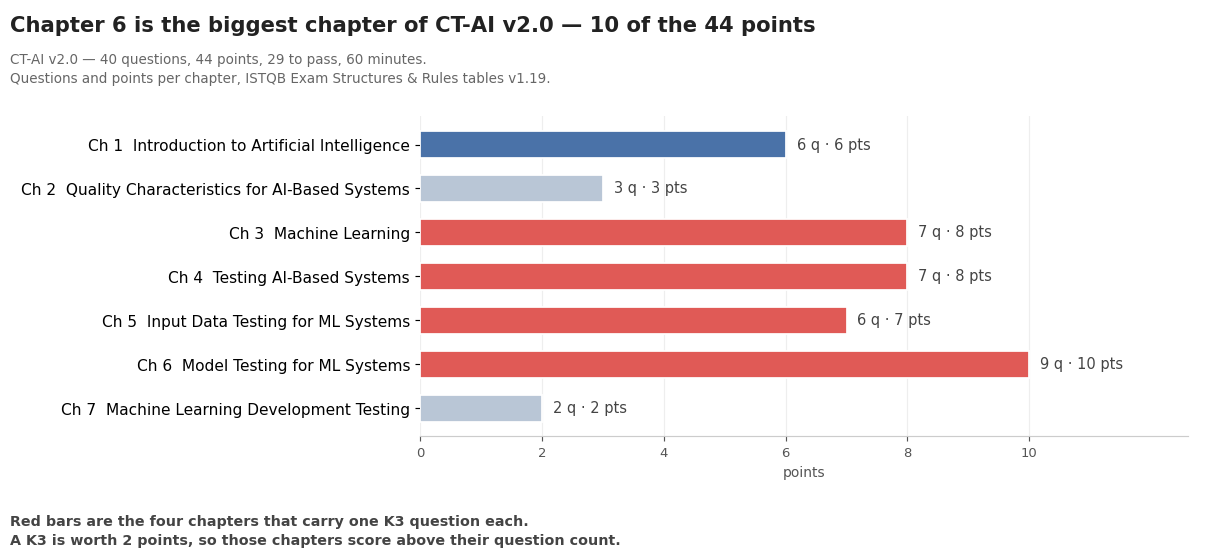
Introduction to Artificial Intelligence — 6 questions, 6 points.
Quality Characteristics for AI-Based Systems — 3 questions, 3 points.
Machine Learning — 7 questions, 8 points.
Testing AI-Based Systems — 7 questions, 8 points.
Input Data Testing for Machine Learning Systems — 6 questions, 7 points.
Model Testing for Machine Learning Systems — 9 questions, 10 points.
Machine Learning Development Testing — 2 questions, 2 points.
Chapter 6 is the biggest chapter, not chapter 3
Model Testing for Machine Learning Systems is the single heaviest block on the paper: 9 of 40 questions and 10 of 44 points, close to a quarter of everything available. Chapter 3, Machine Learning, is the chapter candidates fear and it is only 8 points.
The two chapters that v2.0 promoted into test levels of their own, input data testing and model testing, are 15 questions and 17 points between them. That is 39% of the exam sitting in material that did not exist as separate chapters in v1.0, which is the main reason a v1.0 study plan will not carry you through this exam.
At the other end, chapter 2 and chapter 7 together are 5 questions and 5 points — about one ninth of the paper.
Study time and exam weight do not line up
The accredited course is 1,170 minutes spread very unevenly across the seven chapters. Divide each chapter's training time by the points it is worth and the mismatch is hard to miss:
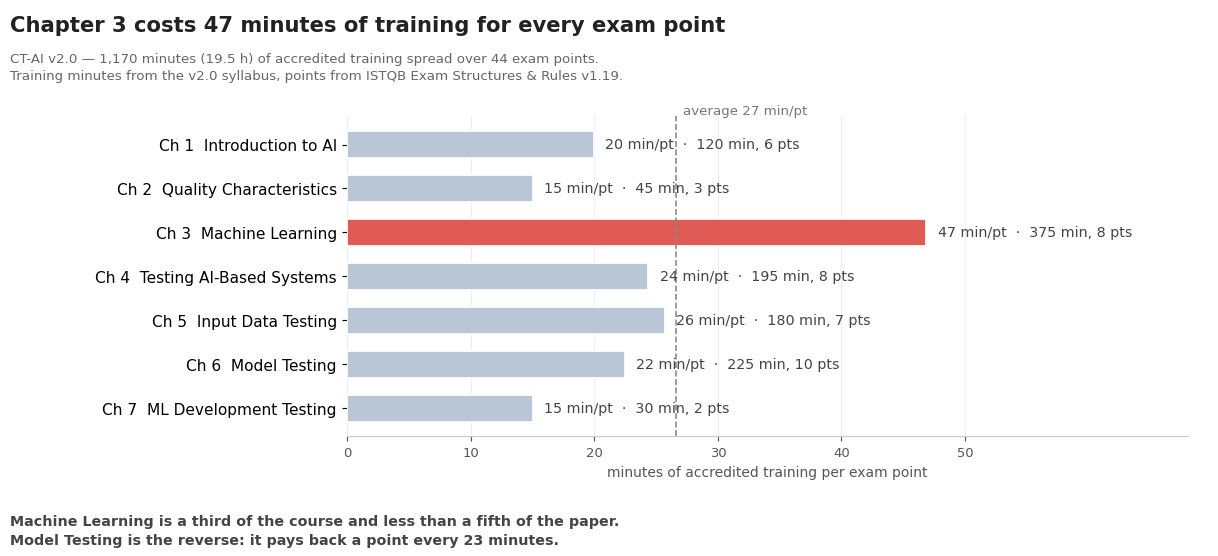
Chapter 3 takes 375 minutes — nearly a third of the whole course — and returns 8 points, which is 47 minutes of instruction per point against an average of 27. Chapter 6 is the opposite: 225 minutes for 10 points, a point every 23 minutes. Chapter 7 is 30 minutes for 2 points.
This is not an argument for skipping chapter 3. Its content on datasets, metrics and neural networks is what chapters 5 and 6 are built on, and the single calculation question on the paper lives there. It is an argument for allocating revision time by points rather than by course hours, which is the mistake most self-study plans inherit from the syllabus.
Where the four 2-point questions live
There are exactly four K3 questions, one each in chapters 3, 4, 5 and 6. Between them they carry 8 of the 44 points: 10% of the questions and 18% of the score. Three of the four map to a named learning objective in the syllabus:
AI-3.3.1— calculate common ML functional performance metrics from a given set of confusion matrix data. This is the one arithmetic question on the paper, and it is the reason precision, recall and F1 are worth drilling until they are automatic.AI-4.2.2— implement red teaming for GenAI systems, the clearest sign of how much LLM and agentic testing v2.0 absorbed.AI-5.1.5— apply dataset constraint testing.The fourth sits in chapter 6, with the rest of the model testing material.
Losing all four still leaves 36 points, comfortably above the 29 you need. The catch is that it also leaves you only seven wrong K2 answers of slack, so treating the K3 items as optional is a poor trade.
No K1 and no K4
Every question on CT-AI v2.0 is K2 or K3. There are no K1 recall items, so a glossary-only revision pass will not score; and there are no K4 analysis items of the kind that make CTAL-TM and CT-PT long papers, which is why 40 questions fit into 60 minutes. If the K-level system is new to you, our explainer on ISTQB K-levels covers how the weighting works across the scheme. Definitions themselves still matter — the ISTQB glossary is the wording the exam uses — but you will always be asked to apply them rather than repeat them.
What each chapter actually asks
1. Introduction to Artificial Intelligence — 6 questions, 6 points
AI effect, narrow versus general AI, AI technologies and frameworks, hardware, and AI as a service. All K2, all cheap: six points for two hours of course time.
2. Quality Characteristics for AI-Based Systems — 3 questions, 3 points
Flexibility and adaptability, autonomy, evolution, bias, ethics, side effects and reward hacking, transparency and explainability, and acceptance criteria. The smallest chapter by points and the one most often over-studied because it reads easily.
3. Machine Learning — 7 questions, 8 points
Forms of ML, the ML workflow, pretrained models, fine-tuning and RAG, data preparation, training/validation/test datasets, functional performance metrics for classification, and neural networks. One K3: the confusion matrix calculation.
4. Testing AI-Based Systems — 7 questions, 8 points
Locked versus adaptive systems and their testability, why a statistical approach is needed, test oracle problems, testing generative AI and LLMs, red teaming, test levels for ML systems and risk-based testing. One K3: red teaming.
5. Input Data Testing for Machine Learning Systems — 6 questions, 7 points
Input data risk mitigation, testing for bias, data pipeline testing, representativeness, dataset constraint testing and label correctness. One K3: dataset constraint testing.
6. Model Testing for Machine Learning Systems — 9 questions, 10 points
The largest chapter: how an ML model is tested in its own right, including the model-level risks chapter 4 defers here. Nine questions, one of them K3, and 225 minutes of course time — the best points-per-hour on the paper.
7. Machine Learning Development Testing — 2 questions, 2 points
Development-level risks and the testing around the ML development process itself. Two questions, 30 minutes of course time, and the last thing to revise.
A revision order built from the point table
Chapters 6 and 5 first — 17 of the 44 points, and the material furthest from anything CTFL covered.
Chapter 3, but weighted towards the metrics calculation and the dataset split rather than neural network theory.
Chapter 4, where the GenAI and red teaming material is the newest and the most likely to be phrased as a scenario.
Chapter 1 last among the serious chapters: six points that come almost free.
Chapters 2 and 7 at the end. Five points, 75 minutes of course material, no K3.
You are allowed to drop 15 points. Spent well, that margin covers one weak chapter; spent on chapter 3 theory it disappears into the two chapters that carry the most weight.
Numbers in circulation that no longer hold
120 minutes. CT-AI v2.0 is a 60-minute exam, 75 with the non-native extension.
Eleven chapters and 47 points. That is the v1.0 structure. It is still correct for anyone sitting v1.0 before it retires — 21 April 2027 in English, 21 October 2027 in other languages — and wrong for everyone else.
"65% of 40 questions". The pass mark is counted in points, not in correct answers: 29 of 44. Twenty-six correct answers can pass or fail depending on whether the K3 items are among them.
When in doubt, the v2.0 syllabus PDF and the exam structure tables on istqb.org are the only sources that settle it.
Practise against the real distribution
A mock exam is only useful if its chapter mix resembles the real paper. Our five CT-AI practice exams are 40 questions each, free, with no sign-up and a written rationale on every option — including the wrong ones, which is where the chapter-level gaps show up. Start with mock 1, then read how to pass CT-AI for the rest of the preparation path.
Score each attempt by chapter rather than by total. A 28 made of solid chapters 1 to 4 and a collapsed chapter 6 is a different problem from a 28 spread evenly, and only one of them is fixed by a weekend of revision.
Frequently asked
Six from chapter 1, three from chapter 2, seven from chapter 3, seven from chapter 4, six from chapter 5, nine from chapter 6 and two from chapter 7. That is 40 questions in total, worth 44 points.
29 of 44. The 65% threshold works out at 28.6 points, and ISTQB rounds the pass mark up to the next whole point.
Four questions are at K3 and count two points each; the other 36 are K2 and count one point each. 36 + 8 = 44.
60 minutes. Candidates sitting the exam in a language that is not their native language get an extra 25%, which is 75 minutes.
Chapter 6, Model Testing for Machine Learning Systems. It is nine questions and 10 points, the largest single block on the paper, and it needs only 225 minutes of the accredited course.
No. The 11-chapter, 47-point table belongs to CT-AI v1.0, which is being retired: English exams run until 21 April 2027 and non-English exams until 21 October 2027.
Part of the ExamCaliber editorial team. Every ExamCaliber question and rationale is written and reviewed by hand against the current syllabus — never scraped from exam dumps.