CTAL-TA v4.0 Sample Exam: What the Official Questions Test, Chapter by Chapter
The official ISTQB sample exam is the closest thing to a real CTAL-TA paper, and almost every study site links to it without saying what is inside. Here is the map: 45 questions, 78 points, which chapter owns each question number, and the four learning objectives the main set never tests.
ISTQB publishes one official sample exam for the Advanced Level Test Analyst certification, and it is the closest thing to a real CTAL-TA paper that a candidate can get for free. Most study sites link to the two PDFs and stop there. This article does the part nobody does: it maps the set. How many questions each chapter gets, how the 78 points are distributed, which questions are worth three points, and which learning objectives the main set never touches.
One warning before anything else. The files currently on istqb.org are version 4.1, dated 8 July 2025, and their revision history records a single change from v4.0: a corrected answer for question 14. The inner pages still carry the old v4.0 footer, so a copy saved earlier looks almost identical and marks one of your answers wrong. Check the cover page, not the footer.
What the official sample exam actually contains
The set is two documents: a questions PDF and an answers PDF, both v4.1, both marked compatible with syllabus v4.0. What is inside them:
45 numbered questions in the main set, plus 8 more in Appendix A — 53 in total.
Every question carries its own point value of 1, 2 or 3. The main set adds up to 78 points, the appendix to 12.
There is one set only. Unlike the Foundation sample exams, CTAL-TA is not split into Sets A, B, C and D.
The appendix questions are described in the PDF itself as not applying to every sample exam, so they are a supplement rather than part of the 78 points.
The questions PDF shows no learning objectives and no K-levels. Those live in the answers PDF only, which is why a usable map requires reading both documents side by side.
That last point is worth sitting with. The 78-point total is not printed anywhere in either PDF — it is the sum of the per-question values, and it happens to match the 78 points ISTQB lists in its Exam Structures and Rules Tables. The two documents agree, but only if you add them up yourself.
Where the 78 points sit
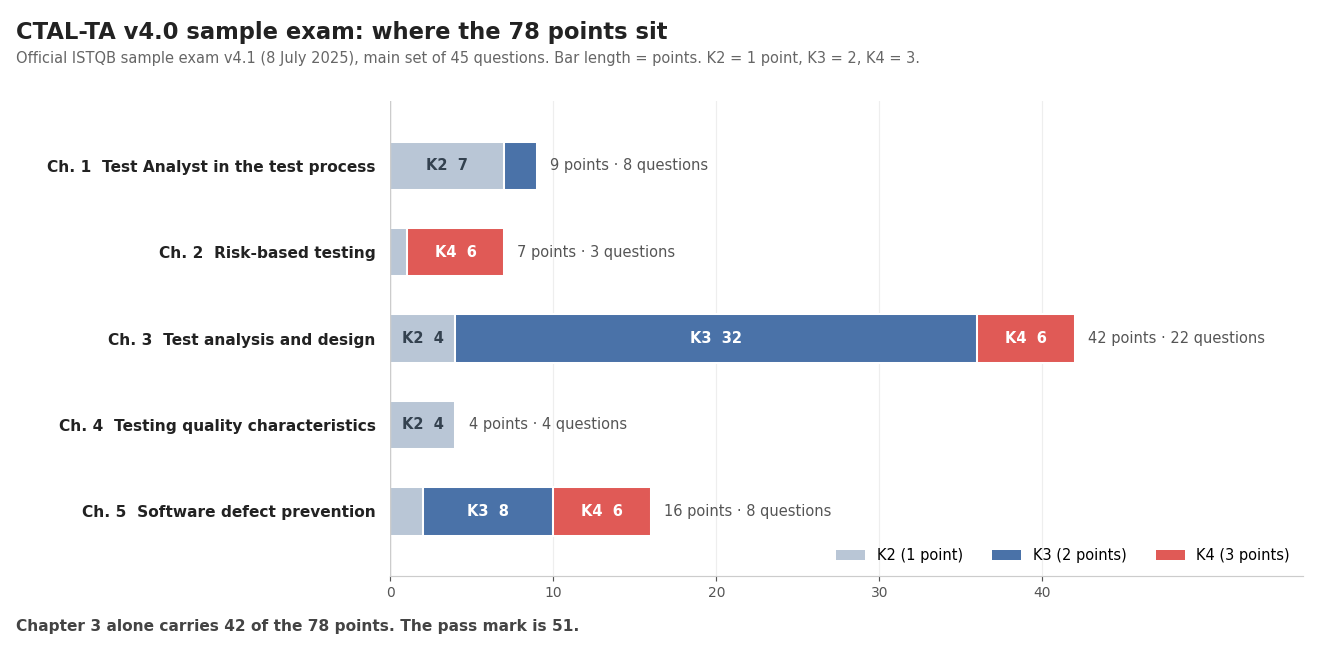
Counting questions and counting points give different answers, because a K4 question is worth three times a K2 question. Per chapter:
Chapter 1, the Test Analyst in the test process — 8 questions, 9 points.
Chapter 2, risk-based testing — 3 questions, 7 points.
Chapter 3, test analysis and design — 22 questions, 42 points.
Chapter 4, testing quality characteristics — 4 questions, 4 points.
Chapter 5, software defect prevention — 8 questions, 16 points.
Chapters 1 and 2 are a good illustration of the gap. Chapter 1 gets nearly three times as many questions as chapter 2, yet chapter 2 is worth more points per question and lands only two points behind. Chapter 4 is the opposite extreme: four questions, all K2, four points, and no way to earn more there. If you want the full logic of weighted scoring across all the ISTQB exams, we covered it in how ISTQB exams are scored.
The question number tells you the chapter
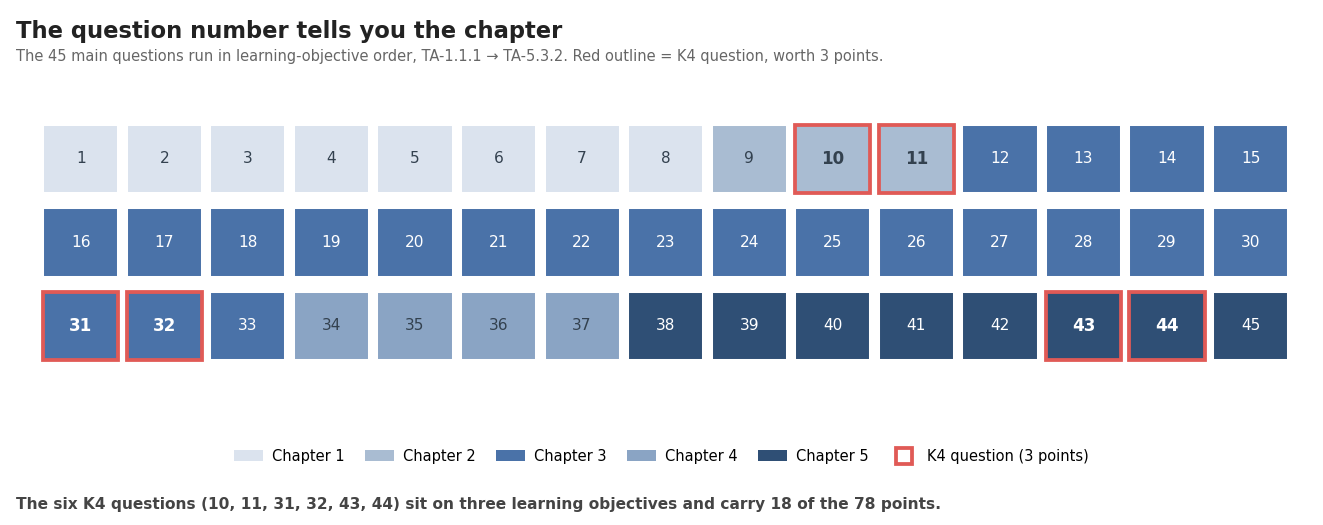
The main set runs strictly in learning-objective order, from TA-1.1.1 through to TA-5.3.2. Nothing is shuffled. That means the question number alone tells you which chapter is being tested:
Questions 1 to 8 — chapter 1.
Questions 9 to 11 — chapter 2.
Questions 12 to 33 — chapter 3.
Questions 34 to 37 — chapter 4.
Questions 38 to 45 — chapter 5.
This is more useful than it sounds. It lets you run a chapter-sized drill straight from the official set — finish chapter 3 in the syllabus, then sit questions 12 to 33 and nothing else — without first decoding the answer key to find out which questions belong where.
Chapter 3 is half the exam
Twenty-two of the 45 questions and 42 of the 78 points sit in chapter 3: 49 percent of the paper by question count and 54 percent by score. Sixteen of those 22 questions are K3, which on this exam means applying a technique to a given situation rather than describing it.
The chapter covers data-based techniques (domain, combinatorial and random testing), behaviour-based techniques (CRUD, state transition, scenario-based), rule-based techniques (decision tables and metamorphic testing), experience-based testing, and the selection of the most appropriate technique for a given defect type. Our CTAL-TA chapter 3 page breaks that down objective by objective. If your revision time is finite, this is where it goes.
The six K4 questions decide the result
CTAL-TA v4.0 has exactly three K4 learning objectives, and the sample exam gives each of them two questions:
TA-2.2.1— risk control. Questions 10 and 11.TA-3.5.1— applying the most appropriate test techniques. Questions 31 and 32.TA-5.3.1— mitigating the recurrence of defects. Questions 43 and 44.
Six questions at three points each is 18 points, or 23 percent of the paper, resting on three topics. The pass mark is 51 of 78. Get all six wrong and your ceiling drops to 60, which still passes — but with nine points of slack across the other 39 questions instead of 27. That is the difference between a comfortable exam and a nervous one. The point weighting itself is explained in our guide to ISTQB K-levels.
Four learning objectives appear only in the appendix
This is the finding that surprised us most. The syllabus carries 36 learning objectives — 22 at K2, 11 at K3 and 3 at K4. The 45 main questions reach 32 of them. The other four are TA-1.2.1, TA-1.2.4, TA-1.3.1 and TA-1.3.2, all from chapter 1 — the Test Analyst's involvement in test activities, and the tasks related to work products. They appear only as appendix questions A1 to A4.
So a candidate who downloads the questions PDF, works through the 45 numbered questions and calls it preparation has never been asked about four of the 36 objectives. They are all K2 and worth one point each, so the exposure is small, but it is exactly the kind of gap that turns into a wrong answer on the day. Do the appendix.
What the sample exam does not tell you
Neither PDF prints a pass mark or a time limit, which is why so many study sites quote them wrongly. The real figures come from the ISTQB Exam Structures and Rules Tables: 45 questions, 78 points, 51 points to pass (65.4 percent), 120 minutes, and an extra 25 percent — 150 minutes — for candidates not sitting in their native language. CTFL is a prerequisite.
Nor does the set tell you how long each question should take. The official timing model allows one minute for a K2, three for a K3 and four for a K4, which adds up to 105 minutes against a 120-minute exam. There is slack, but not much of it.
How to use the set without burning it
You get one clean run at the official sample exam. After that you remember the answers and it stops measuring anything. A sequence that gets more out of it:
Sit the 45 main questions under exam conditions, 120 minutes, before you feel ready. Score it by points, not by questions — a 60 percent question score and a 60 percent point score are rarely the same number.
Map every miss to its chapter using the number ranges above, then read the corresponding syllabus section rather than the answer explanation alone.
Fill the gap with questions you have not seen. Our three full CTAL-TA mock exams follow the same 45-question, 78-point structure and carry a rationale on every option, including the wrong ones; mock exam 1 is the place to start, and the CTAL-TA study guide sets out the order to work through the chapters.
Save the eight appendix questions for last. They are the only official material covering those four stranded objectives.
Check the version before you study
The CTAL-TA v4.0 syllabus reached general availability on 2 May 2025 and is the only current version. The previous v3.1 has been retired: 16 May 2026 for English, and 16 November 2026 for the other languages, after which no v3.1 exam is sat anywhere. Sample questions written against v3.1 no longer match the paper — the whole black-box technique classification in chapter 3 was reorganised in v4.0.
Two practical checks, then. Download the sample exam from the official CTAL-TA page rather than a mirror, so you get the current v4.1 files and not a cached v4.0 copy — the questions download page lists the version in the file name. And when a term in a question reads oddly, check it in the ISTQB glossary rather than guessing; Advanced Level questions lean on precise definitions far more than Foundation ones do.
If you are still deciding between the two Advanced Level analyst exams, we compared them in CTAL-TA or CTAL-TM: which one first. And if you want the same chapter-by-chapter treatment for a different certification, we did it for CT-AI v2.0.
Frequently asked
Forty-five numbered questions in the main set, plus eight more in Appendix A, so 53 in total. The main set is worth 78 points; the appendix adds another 12.
No. ISTQB publishes a single CTAL-TA sample set, not four interchangeable sets. If a site offers you "Set B" of the CTAL-TA sample exam, it is not the official material.
Version 4.1, dated 8 July 2025, compatible with syllabus v4.0. Its revision history records one change from v4.0: a corrected answer for question 14. The inner page footers were not updated, so check the cover page rather than the footer.
No. Neither PDF prints a pass mark or a duration. The 51-of-78 pass mark and the 120 minutes come from the ISTQB Exam Structures and Rules Tables, not from the sample set.
Six, each worth three points. They cover three learning objectives only: TA-2.2.1 (risk control), TA-3.5.1 (applying the most appropriate techniques) and TA-5.3.1 (mitigating the recurrence of defects). Together they are 18 of the 78 points.
Not in the main set. The syllabus has 36 learning objectives and the 45 main questions touch 32 of them. The remaining four appear only in Appendix A, so a candidate who works through the main set alone never sees them.
Part of the ExamCaliber editorial team. Every ExamCaliber question and rationale is written and reviewed by hand against the current syllabus — never scraped from exam dumps.