ISTQB CT-GenAI vs CT-AI: Which AI Testing Certification in 2026
Two ISTQB certifications have AI in the name and they answer different questions. CT-AI v2.0 is about testing AI-based systems; CT-GenAI v1.1 is about testing with generative AI. Here is what each exam actually asks, and where the points sit.
ISTQB now has two Specialist certifications with AI in the name, and they are not two routes to the same place. CT-AI v2.0 is about testing systems that contain artificial intelligence. CT-GenAI v1.1 is about using generative AI to do testing work. Both require CTFL, both are 40 questions in 60 minutes, and their syllabi share almost no learning objectives.
The difference in one sentence
In CT-AI the AI is the test object. In CT-GenAI the AI is the test tool. Every other difference between the two exams follows from that one.
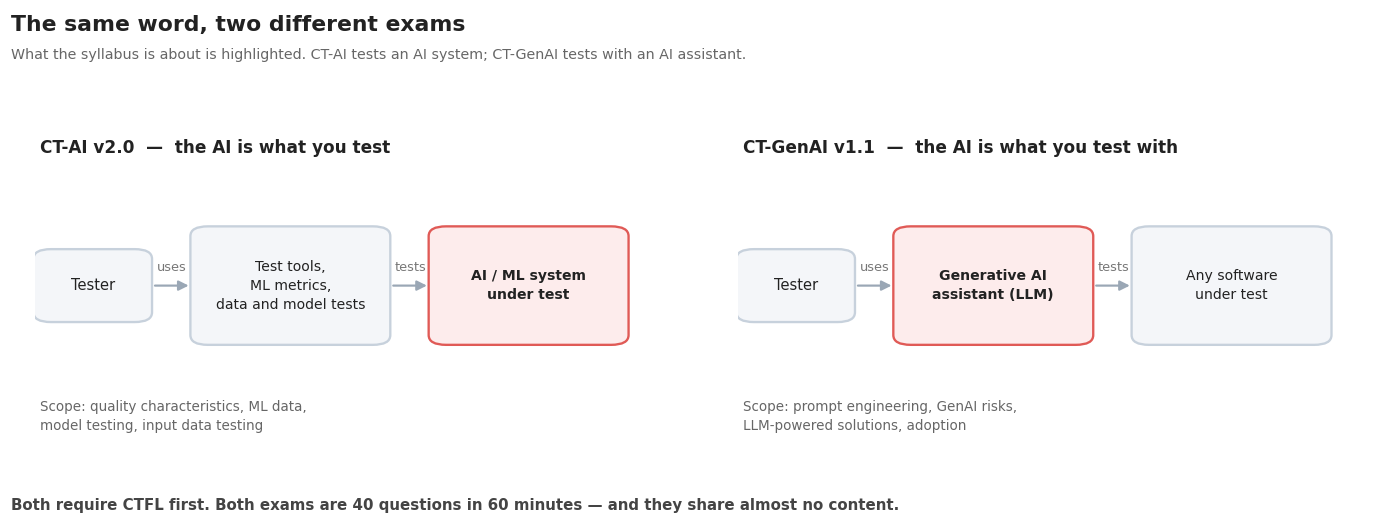
A practical way to decide: if the product you test has a machine-learning model inside it, you need CT-AI. If the product you test is ordinary software and you want an LLM to speed up test analysis, test design and test data generation, you need CT-GenAI.
What CT-AI v2.0 certifies
Version 2.0 of the Certified Tester AI Testing syllabus reached general availability on 17 April 2026 and replaces v1.0, which ISTQB now marks as retiring. Its seven chapters cover artificial intelligence as a subject, quality characteristics for AI-based systems, machine learning, testing AI-based systems, input data testing, model testing and machine learning development testing.
The exam is 40 questions worth 44 points, with 29 points needed to pass, in 60 minutes. Non-native speakers get 25% extra time. CTFL is the formal prerequisite, and ISTQB additionally recommends around six months of practical background as a tester, data scientist or developer, because the machine-learning material is dense.
Generative AI is in scope here too, but only as something you test: the chapter on testing AI-based systems includes testing generative AI and large language models. What changed between the two versions is covered separately in CT-AI v2.0 vs v1.0, and the full scope is in our CT-AI certification guide.
What CT-GenAI v1.1 certifies
The first version of Testing with Generative AI was released on 25 July 2025. Version 1.1 has been in force since 27 April 2026. It was a minor update: targeted corrections, terminology changes, clarifications around risk material and added context on LLM-powered agents. ISTQB stated that the structure, the learning objectives and the scope did not change, and that accredited training providers did not need reaccreditation. If you have v1.0 study material, it is not wasted.
The syllabus has five chapters:
Introduction to GenAI for Software Testing
Prompt Engineering for Effective Software Testing
Managing Risks of GenAI in Software Testing
LLM-Powered Solutions for Software Testing
Deploying and Integrating GenAI in Test Organizations
The exam is 40 questions worth 46 points, with 30 points needed to pass, in 60 minutes, again with 25% extra time for non-native speakers. CTFL is mandatory. Minimum accredited training is 815 minutes, about 13.6 hours. The certificate does not expire.
The two exams side by side
Questions: 40 in both.
Time: 60 minutes in both, plus 25% for non-native speakers.
Points: CT-AI 44, CT-GenAI 46.
Pass mark: 29 points for CT-AI, 30 points for CT-GenAI. Both are 65%.
Prerequisite: CTFL for both.
Current version: CT-AI v2.0 since 17 April 2026, CT-GenAI v1.1 since 27 April 2026.
The symmetry is the trap. The exams look interchangeable on paper and test completely different competencies.
Why 65% is not the same as 26 correct answers
Both exams are scored in points, not in questions, and the points per question are not equal. In CT-GenAI a K1 or K2 question is worth 1 point and a K3 question is worth 2. The question mix is 8 at K1, 26 at K2 and 6 at K3: 40 questions, 46 points. Sixty-five per cent of 46 is 30.
So answering 26 of 40 questions correctly is a pass only if enough of them were the heavy ones. Miss all six K3 questions and you have given away 12 of the 46 points before the easy ones are counted. The mechanics of weighted scoring across ISTQB exams are explained in ISTQB K-levels explained; the practical consequence for CT-GenAI is in the next section.
Where the CT-GenAI points actually sit
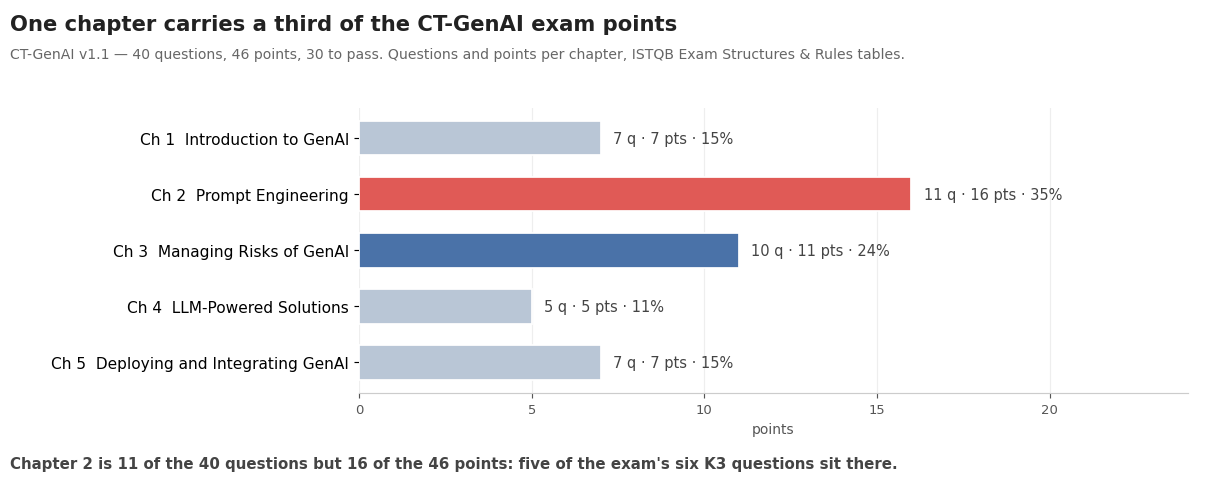
Chapter 2, Prompt Engineering, is 11 of the 40 questions and 16 of the 46 points: 35% of the exam from one chapter. Five of the exam's six K3 questions live there, which is also why its share of points is larger than its share of questions. The minimum accredited training time agrees: 365 of the 815 minutes belong to chapter 2.
Chapter 3, Managing Risks of GenAI, follows with 10 questions and 11 points. Chapters 1 and 5 carry 7 questions and 7 points each, and chapter 4, LLM-Powered Solutions, is the smallest at 5 questions and 5 points. A revision plan that gives five chapters equal time is wrong by a factor of three on the chapter that decides the result.
Practically, that means the K3 preparation for CT-GenAI is not memorising prompt-engineering terminology. It is being able to read a test situation and pick or build the prompt that fits it, which is what an Apply-level question asks for.
Where the two syllabi genuinely overlap
They do overlap, and pretending otherwise is unhelpful. Large language models appear in both. CT-AI asks how you test a system built on one: what the acceptance criteria are, how you handle non-determinism, how you test the data and the model. CT-GenAI asks how you prompt one, how you evaluate what comes back, and which risks you are accepting when you paste company code into it.
Vocabulary is shared, so terms such as hallucination, prompt, fine-tuning and LLMOps show up on both sides. The ISTQB glossary is the common reference. The learning objectives, which are what the exam actually tests, do not overlap in any meaningful way.
Which one to take first
Your product has a model inside it, or you are asked about bias, drift or model accuracy: CT-AI.
You test ordinary software and want AI help with analysis, design and test data: CT-GenAI.
You lead a team and have to roll AI tooling out responsibly: CT-GenAI. Its last chapter is adoption and change management, and its risk chapter covers data privacy and regulation.
You work close to data engineering or MLOps: CT-AI, and expect the machine-learning chapters to take most of your study time. A worked schedule is in our CT-AI study plan.
You hold neither and no CTFL: CTFL first, because both exams require it. Start with the CTFL v4.0 guide.
There is no official ordering between the two. If both apply to your role, CT-GenAI is the shorter path at 13.6 hours of minimum training against a heavier machine-learning syllabus, and it pays off immediately in daily work. CT-AI is the one that matters if your employer ships an AI feature.
How to practise
Reading the syllabus is not preparation for a weighted exam; sitting full-length mocks under the real clock is. ExamCaliber has free CT-AI v2.0 mock exams with a written rationale on every answer option, including the wrong ones, so a miss tells you why. If you want a single starting point, take CT-AI mock 1 cold, before you revise, and use the score per chapter to decide where the time goes.
CT-GenAI practice material on ExamCaliber is still being built, so for now the honest advice for that exam is to work through the syllabus chapter by chapter in proportion to the point weights above, and to practise writing prompts for real test activities rather than reading about them.
Frequently asked
No. CT-AI v2.0 certifies testing of AI-based systems; CT-GenAI v1.1 certifies using generative AI in your own testing work. Neither supersedes the other, and holding one is not a prerequisite for the other.
Yes. ISTQB requires the Certified Tester Foundation Level certificate before either the CT-AI v2.0 or the CT-GenAI v1.1 exam.
There is no fixed count. The pass mark is 30 of 46 points. K1 and K2 questions are worth 1 point and K3 questions 2 points, so how many correct answers reach 30 depends on which questions they are.
Chapter 2, Prompt Engineering. It is 11 of the 40 questions, 16 of the 46 points, and 365 of the 815 minutes of minimum accredited training.
ISTQB marks CT-AI v1.0 as retiring and v2.0 has been generally available since 17 April 2026, so new candidates should prepare for v2.0.
Part of the ExamCaliber editorial team. Every ExamCaliber question and rationale is written and reviewed by hand against the current syllabus — never scraped from exam dumps.