ISTQB Advanced (CTAL-AT v2.0) Mock Exam #3 — Questions & Answers
Every question in this mock exam, with the correct answer marked and a written rationale behind each option below — for reading and review, not a timed run.
Chapter 1 · Test Strategy and Test Approach Challenges — 5 questions
A travel-booking team works in two-week iterations. The seat-inventory and…
A travel-booking team works in two-week iterations. The seat-inventory and fare-rule engine is a legacy reservation core that the operations group can only rebuild during a monthly maintenance window; between windows the team codes against stubs of it. Which statement best describes how the team should distribute test types between the iteration and the period after the iteration?
Functional, black-box, white-box and exploratory testing of the new booking components stay inside the iteration using test doubles, while the runs that genuinely need the rebuilt legacy core - broad end-to-end and most non-functional testing - are scheduled after the iteration, and the split is recorded in the test approach and the Definition of Done.
This is the distribution chapter 1 describes: keep the fast, isolatable test types inside the iteration, place the ones depending on an integrated environment after it, and document the agreement.
Every test type is deferred to the period after the iteration, because results obtained against stubs of the legacy core carry no information about the delivered increment and would have to be repeated once the core is rebuilt.
Testing against test doubles still gives fast, useful feedback on the new components; deferring all test types removes the in-iteration feedback the Agile test approach depends on.
Only white-box testing stays inside the iteration, because functional and exploratory testing are technology-facing activities that need the rebuilt legacy core and therefore have to wait for the maintenance window.
Functional and exploratory testing are not technology-facing by definition, and much of both can run inside the iteration against the new components.
The distribution is left to each tester's own judgement during the iteration and is deliberately kept outside the Definition of Done, which covers development activities such as code review and merge rules.
The syllabus has the whole team agree the split and record it in the test approach and in the team's Definition of Done, which covers testing as well as development.
Chapter 1 asks the team to decide which of the five test types run during an iteration and which run after it, and to record that decision in the test approach and in the team's Definition of Done. Work that can be exercised against isolated components and test doubles belongs inside the iteration; work that genuinely needs the rebuilt, integrated legacy core is scheduled after it.
The travel-booking platform is being decomposed: new pricing and payment…
The travel-booking platform is being decomposed: new pricing and payment services now sit alongside the legacy reservation core, and the pipeline deploys to a staging environment several times a day. The team wants to keep its slow end-to-end suite small while still covering the risk that the new services and the legacy core disagree. Which two decisions match the syllabus guidance on when end-to-end testing should be performed? (Choose two.)
Keep end-to-end tests for the small number of high-risk user journeys that cross the new services and the legacy core, deciding the scope from risk, the feedback time the team needs and the maturity of the CI/CD pipeline.
These are exactly the three factors the syllabus lists for deciding whether and how much end-to-end testing to include.
Cover the agreements between the new pricing and payment services with contract testing, so that interface expectations are verified without needing a full end-to-end run each time.
The syllabus names contract testing and consumer-driven contract testing as the way to keep integration risk covered in a decomposed architecture without growing the end-to-end suite.
Grow the end-to-end suite until every combination of fare rule and payment method is exercised there, because end-to-end runs give the most precise localisation of the failing component.
The opposite is true: weak diagnostic power is one of the drawbacks the syllabus lists for end-to-end testing, along with cost of maintenance and long execution time.
Move all end-to-end runs into a hardening iteration before each release, treating the hardening iteration as the team's normal place for doing integration work.
The syllabus allows end-to-end testing in hardening iterations but warns that needing them may indicate insufficient attention to quality during the regular iterations, so they are not the normal home for integration work.
Retire end-to-end testing as soon as the pipeline deploys several times a day and rely on production observability instead, since deployment frequency is the factor that decides end-to-end scope.
Pipeline maturity is only one of three factors; risk and feedback time still apply, and observability supplements rather than substitutes for the high-risk journey coverage.
End-to-end testing is expensive to maintain, slow to run and weak at localising defects, so it is reserved for a small set of high-risk user journeys and is decided on three factors: risk (impact and likelihood), feedback time and the maturity of the CI/CD pipeline. Interface expectations between services are better covered by contract testing, which the syllabus names for microservice architectures.
A government benefits portal is delivered in iterations on top of a legacy…
A government benefits portal is delivered in iterations on top of a legacy payment-calculation engine. The calculation rules are audited by a regulator and must be evidenced, while the claim-submission journey changes almost every iteration in response to citizen feedback. The team is deciding where to use formal testing and where to use holistic testing. Which statement reflects the syllabus comparison of their benefits and drawbacks?
Formal testing suits the audited calculation rules because it delivers traceability, conformance and repeatability, while holistic testing suits the fast-changing claim journey because it brings different perspectives and earlier feedback; the two are complementary within one product.
This matches the complementarity the syllabus states: formal testing for critical and regulated parts, holistic testing for early feedback and complex, changing scenarios.
Holistic testing suits the audited calculation rules because systems thinking produces the documented evidence a regulator asks for, while formal testing suits the claim journey because its repeatability absorbs frequent change more cheaply.
The two are swapped: documented evidence is a benefit of formal testing, and holistic testing is the one described as difficult to measure and evidence.
Both areas should use formal testing, because the drawbacks of holistic testing - difficult to measure, requires a culture change, heavily context-dependent - outweigh its benefits anywhere a regulator is involved in some part of the product.
Those drawbacks are correctly named, but the syllabus does not extend a regulatory constraint on one component to the whole product; the claim journey still benefits from holistic testing.
Both areas should use holistic testing, because the drawbacks of formal testing - excessive rigidity, delayed feedback, low cognitive engagement - make it a poor fit once a team has moved to iterative delivery.
Those drawbacks are correctly named, but the syllabus keeps formal testing for critical components and regulatory conformance regardless of the delivery cadence.
Formal testing brings traceability, alignment, verification, conformance, repeatability and test automation, at the cost of rigidity, over-reliance on documented requirements, missing the unexpected, delayed feedback and low cognitive engagement. Holistic testing brings different perspectives, First Time Right and continuous testing, but is hard to measure, needs a culture change and is heavily context-dependent. The syllabus presents them as complementary: formal for critical and regulated components, holistic for early feedback and complex scenarios.
A smart-metering and billing product pushes monthly tariff changes through a…
A smart-metering and billing product pushes monthly tariff changes through a legacy rating engine. The regression suite has grown until a full run takes longer than an iteration, and the team must choose a regression test approach for the coming release. Which statement correctly differentiates the regression test approaches described in the syllabus?
A risk-based regression approach selects which regression tests to run from impact and likelihood, whereas a DevOps-oriented approach leans on smoke tests as quality gates together with feature toggles, canary releases and observability instead of re-running the whole suite.
Both descriptions match the syllabus: risk drives selection in one, pipeline and production mechanisms carry the regression risk in the other.
An incremental regression approach re-runs the complete suite in every iteration, whereas a risk-based approach re-runs the complete suite only before a release, so the two differ in execution frequency rather than in test selection.
Incremental regression grows and adapts the suite as functionality is added; the risk-based approach differs by selecting a subset, not by moving a full run to a different date.
A collaborative regression approach means the automation engineers alone own the regression suite, whereas an exploratory regression approach means the business representatives execute the scripted regression cases on their behalf.
Collaborative regression is the whole team taking part through bug bashes and walkthroughs, and exploratory regression is unscripted investigation, not scripted execution handed to another group.
An exploratory regression approach substitutes unscripted sessions for the suite and, unlike the other four approaches, leaves no record of what was covered, which is why it is used only when the suite is abandoned.
Exploratory regression is recorded - session sheets and charter completion give its coverage - and it complements rather than substitutes for the other approaches.
The syllabus differentiates five regression test approaches: incremental, risk-based, DevOps-oriented, exploratory and collaborative. Risk-based selects tests from impact and likelihood; the DevOps-oriented approach leans on smoke tests as quality gates, feature toggles, canary releases and observability rather than re-running everything; collaborative uses bug bashes and whole-team walkthroughs; exploratory sessions are recorded in session sheets.
The travel-booking team is preparing to release a redesigned check-out that sits…
The travel-booking team is preparing to release a redesigned check-out that sits on top of the legacy reservation core. In the release discussion the terms hardening iteration, feature toggle, user journey and bug bash are all used. Which statement uses these chapter 1 terms as the syllabus and the ISTQB Glossary define them?
A feature toggle lets the redesigned check-out be deployed switched off and then enabled for part of the traffic, while a bug bash is a time-boxed session in which a wider group hunts defects together.
Both definitions match the syllabus: the toggle is a deployment and release control used in DevOps-oriented regression, and the bug bash is a collaborative regression practice.
A hardening iteration is an iteration set aside for elaborating and refining the next batch of user stories, while a user journey is a test case that exercises a single screen of the check-out in depth.
A hardening iteration is for stabilisation before release, not backlog elaboration, and a user journey spans an end-to-end path rather than one screen.
A bug bash is the overnight automated execution of the regression suite, while a feature toggle is a version-control branch that keeps unfinished check-out work away from the trunk.
A bug bash is a human, collaborative session, and a feature toggle is a runtime switch in the deployed product rather than a branching strategy.
A user journey is the ordered sequence of build and deployment steps the pipeline performs for the check-out, while a hardening iteration is the iteration in which the team agrees its Definition of Done.
A user journey describes user behaviour through the product, and the Definition of Done is a team agreement that is not tied to a hardening iteration.
A feature toggle allows functionality to be deployed but kept switched off, or enabled for part of the traffic, and supports DevOps-oriented regression and A/B testing. A bug bash is a collaborative, time-boxed defect-hunting session used in the collaborative regression approach. A user journey is an end-to-end path a user takes through the product, not a single screen or a build sequence. A hardening iteration is an iteration dedicated to stabilisation before release, not to backlog elaboration.
Chapter 2 · People and Teams — 5 questions
A sports video-streaming team is spread across three time zones with only two…
A sports video-streaming team is spread across three time zones with only two hours of daily overlap. It has one accessibility specialist in one zone and one test automation specialist in another, and work regularly waits overnight for whichever specialist owns it. Which statement compares generalization and specialization within such a team the way the syllabus does?
Growing generalizing, T-shaped skills in each zone reduces the bottlenecks and keeps work moving outside the overlap window, while accessibility testing and test automation remain areas of deep specialist skill that is spread through knowledge sharing and pairing.
This is the balance the syllabus describes: generalization for flow and resilience, retained specialisms for the areas it names, with silos countered by sharing and pairing.
Generalization is pursued until both specialisms are spread evenly over the three zones, after which the specialist roles are dismantled, because the syllabus treats retained specialization as the cause of silos.
The syllabus keeps specialization for areas such as test automation and usability testing; silos come from a lack of knowledge sharing, not from having specialists.
With so little overlap each zone should be given one fixed speciality and all matching work routed to it, because specialization is the syllabus answer to a narrow overlap window between locations.
Routing work to whichever zone owns a speciality entrenches the silos and bottlenecks that generalization is meant to reduce.
The ratio of generalists to specialists is set by the syllabus rather than by context, so a streaming team applies the same proportion as a team working under medical device regulation.
The syllabus states the balance is context-dependent, with regulated domains leaning towards specialists and lean start-ups towards generalists.
The syllabus describes the Agile tester as a generalizing, T-shaped specialist: generalization brings a sustainable pace, fewer bottlenecks, resilience and shared ownership, while specialization remains valuable for test techniques, exploratory testing, test automation and usability testing. Silos are countered by knowledge sharing and pairing, and the right balance is determined by context rather than fixed by the syllabus.
On the government benefits portal, the business representatives who own the…
On the government benefits portal, the business representatives who own the eligibility rules sit in a time zone that overlaps the delivery team for only two hours a day, and over the last three iterations they have stopped taking part in any test activity. Which two measures match the syllabus examples of motivating business representatives to perform test activities? (Choose two.)
Involve them early in writing acceptance criteria and derive concrete examples together using ATDD or specification by example, so their contribution fits into a short structured conversation inside the overlap window.
Early involvement in acceptance criteria through ATDD, BDD and specification by example is the first example the syllabus gives.
Give them visibility of coverage dashboards, defect trends and quality-risk information, and connect these to business measures such as citizen satisfaction and support costs.
Visibility plus business-relevant metrics is explicitly listed as a way to motivate business representatives.
Ask them to sign off a test plan at the end of each iteration, so their involvement is concentrated in one formal approval that does not compete with the overlap hours.
A formal end-of-iteration approval is exactly the late, document-centred involvement the chapter moves away from; it is not one of the motivating examples.
Hand their acceptance testing to the team's own test automation specialist and send them the results afterwards, so their limited availability stops constraining the iteration.
Delegating their testing away removes the participation the objective is about, and loses the domain knowledge only they hold.
Log every ambiguity found in the eligibility rules as a defect assigned to the business representatives, so that the accumulated rework makes the cost of their absence visible to management.
Using defect counts against a group is not the kind of visibility the syllabus means; the metrics it names are shared quality signals, not individual blame.
Section 2.1.2 lists early involvement in acceptance criteria, ATDD, BDD and specification by example, discussing testability at backlog refinement, visibility through dashboards of coverage, defect trends and quality-risk information, business metrics such as customer satisfaction, support costs and feature adoption, participation in bug bashes and usability testing, and recognition of contributions. Formal end-of-iteration sign-off, delegating their testing away, and weaponising defect counts are not among them.
In the distributed streaming team a tester and a developer share only the…
In the distributed streaming team a tester and a developer share only the two-hour overlap window each day. The developer is rewriting the adaptive-bitrate playback logic and is nervous about breaking live match streams. The tester wants the whole team approach to genuinely assist the development work. Which action fits the syllabus summary of how the whole team approach assists the development team?
The tester uses the overlap window to coach the developer on component and component integration tests for the bitrate logic and to review concrete examples with them, so the developer gets fast feedback and can refactor safely.
Coaching on component and component integration tests to enable safe refactoring, plus early feedback from shared examples, is exactly what the syllabus describes.
The tester takes over writing the developer's component tests so the developer can concentrate on production code, which the chapter presents as the tester's main contribution to the development team.
The syllabus has the tester coach and review rather than own the developers' component tests; ownership stays with the developers under shared responsibility for quality.
The tester waits until the developer marks the story complete and then sends a written defect report in the next overlap window, which keeps the two roles separate and the feedback objective.
This is late feedback and reintroduces a hand-off; the whole team approach is built on collaboration during the work, not after it.
The tester joins code reviews only to confirm that coding standards were followed, and invites the developer into exploratory sessions only once the release has been streamed to viewers.
Testers join code reviews to contribute testability and risk insight, and developers are invited into exploratory sessions during development rather than after release.
Section 2.1.3 lists early feedback through ATDD and BDD, examples instead of specifications, coaching developers on component and component integration tests so refactoring is safe, testers joining code reviews and developers joining exploratory sessions, use of production analytics, and early involvement of operations and security.
The streaming product is prototyping a multi-camera view for live matches…
The streaming product is prototyping a multi-camera view for live matches. Before committing to the full implementation the team wants quick, unbiased first-impression feedback on the prototype and is considering tissue testers. Which statement matches the syllabus on how and when tissue testers should be used?
Bring them in early while the design is still cheap to change, explain very little to them beforehand, and do not use the same person a second time once they have seen the design, because their value lies in being unfamiliar with it.
All three points match section 2.2: early use, minimal briefing, and no reuse of a tissue tester who has already seen the design.
Brief them thoroughly on the design intent and the acceptance criteria first, then keep the same small group across several iterations so that their feedback becomes more consistent and comparable over time.
Both halves reverse the guidance: extensive briefing and reuse destroy the fresh perspective that makes a tissue tester useful.
Use them at the end of the release as an extra pass over the structured test cases, since their purpose is to add execution capacity once the regression suite has outgrown the team.
Tissue testers give early informal feedback on design and assumptions; they are not extra capacity for scripted execution late in a release.
Use them in place of structured testing in volatile products such as live streaming and video games, where the syllabus positions them as the team's primary source of quality information.
The syllabus states explicitly that tissue testers do not replace structured testing, even in the volatile sectors where they are common.
Tissue testers are fresh-eyes testers brought in temporarily from outside the team for quick informal feedback, typically in volatile sectors such as the video game industry. They are most valuable early, before expensive investment; they should not be briefed extensively; and the same person should not be reused once they have seen the design, because their fresh perspective is gone and bias sets in. They supplement structured testing rather than substituting for it.
The distributed streaming team is writing down how it works, and the terms acceptance test-driven development, behavior-driven development and tissue tester appear in the description. Which statement uses these chapter 2 keywords as the ISTQB Glossary defines them?
In acceptance test-driven development the team agrees concrete examples together and derives acceptance tests from them before the code is written, and a tissue tester is a temporary tester from outside the team used once for fresh-eyes feedback.
Both definitions are the glossary ones: ATDD derives acceptance tests from collaboratively agreed examples up front, and a tissue tester is an external, single-use fresh-eyes tester.
In behavior-driven development a tester writes the behavioural tests once the developers have finished the increment, and a tissue tester is a team member who rotates into a testing role for one iteration.
BDD drives development from behaviour agreed up front, and a tissue tester comes from outside the team rather than rotating within it.
Acceptance test-driven development differs from behavior-driven development in that the first is performed only by business representatives and the second only by developers, with testers taking part in neither.
Both are collaborative practices in which testers participate; neither is restricted to one role.
A tissue tester is an automated check that is discarded after a single execution, and behavior-driven development is the practice of writing behaviour in a formal notation for external audit.
A tissue tester is a person, not a disposable automated check, and BDD is about collaborative discovery of behaviour rather than audit notation.
In ATDD the team collaboratively agrees examples and derives acceptance tests from them before the code is written. BDD expresses the intended behaviour collaboratively and drives development from it; it is not a tester activity performed after the increment. A tissue tester is a temporary tester from outside the team used once for fresh-eyes feedback.
Chapter 3 · Test Management and Test Process Improvement — 7 questions
The smart-metering and billing team plans at two levels: for each two-week iteration, and for the quarterly release in which a new time-of-use tariff goes live for all meters. Which statement summarises how test planning is performed in Agile software development as the syllabus describes it?
Iteration planning covers high-level test conditions, clarified acceptance criteria, environment and data readiness and the team's Definition of Done as exit criteria per story, while release planning covers release-wide quality risks, dependencies and integration points, how regression is managed across iterations and release readiness assessment.
This is the two-level split the syllabus sets out, with the right activities on each level.
All test planning is done once at release level, because planning inside a two-week iteration would duplicate decisions already taken for the quarter and only the release-level Definition of Done is binding.
Planning happens on both levels; iteration planning makes the story-level decisions that release planning cannot anticipate.
All test planning is done inside each iteration, because the release scope emerges from the iterations, so a release-level test strategy and release readiness assessment are not needed in Agile delivery.
The syllabus keeps release-level planning, including a release test strategy and readiness assessment, alongside iteration planning.
Iteration planning covers the release-wide quality risk assessment and the integration points with the meter data collection network, while release planning covers the high-level test conditions and the readiness of test data for each story.
The two levels are swapped: release-wide risks and integration points belong to release planning, while test conditions and data readiness per story belong to iteration planning.
Section 3.1.1 splits planning into iteration planning (working through the product backlog, risk-storming sessions often moderated by the tester, high-level test conditions, clarifying acceptance criteria, choosing test types, levels, approaches and techniques, iteration readiness of environments and data, CI and continuous testing, and the team Definition of Done as story-level exit criteria) and release planning (business goals, backlog scope and order, release-wide quality risk assessment, dependencies and integration points, effort estimation with metrics-based and expert-based techniques, a release-level test strategy, a mind-mapping workshop, release-level Definition of Done and release readiness assessments).
A test manager joining the smart-metering team asks how test monitoring and test control work now that there is no detailed up-front test schedule to compare progress against. Which statement explains test monitoring and test control in Agile software development as the syllabus does?
Monitoring uses shared visualisations and trends - burn-down charts, cumulative flow diagrams, dashboards, defect discovery trends, automated coverage and production monitoring data - and control is exercised by the whole team in stand-ups, iteration reviews and retrospectives, triggered by automated test feedback and production signals.
This is the syllabus position: trends and shared visibility instead of conformance to a plan, with control distributed across the team and triggered by real feedback.
Monitoring compares actual test execution against a baselined iteration test schedule, and control means the test manager reassigning testers whenever the recorded variance exceeds the agreed tolerance for the iteration.
This is the conformance-to-plan model the chapter moves away from, and it concentrates control in one role rather than the team.
Monitoring is limited to the automated test results in the pipeline, because those are the only objective data available inside an iteration, and control is exercised only at the release readiness assessment.
Pipeline results are one input among several named, and control is exercised continuously in the team's regular events rather than only at release.
Monitoring is replaced by the Definition of Done, so no measurement is needed during the iteration, and control consists of refusing to accept any story whose acceptance criteria changed after iteration planning.
The Definition of Done provides exit criteria but does not remove the need to monitor trends, and refusing changed stories contradicts the team's response to change.
Section 3.2 replaces conformance-to-plan monitoring with trends and shared visualisations: burn-down charts, cumulative flow diagrams and automated dashboards, plus trends in defect discovery, automated test coverage, exploratory findings and production monitoring data. Control is exercised by the whole team in daily stand-ups, iteration reviews and retrospectives, and is triggered by automated test feedback, production monitoring signals and customer feedback loops.
The smart-metering team reports test coverage to a steering group that has begun…
The smart-metering team reports test coverage to a steering group that has begun treating a single percentage figure as proof that testing is complete. The team wants its reporting to compare the different types of coverage honestly. Which two statements about coverage for test reporting match the syllabus? (Choose two.)
Exploratory coverage is reported through session-based test management, for example as test charter completion rates, rather than as a percentage of test cases executed.
This is the reporting mechanism the syllabus names for exploratory coverage.
Code coverage should be reported with care and supplemented by techniques such as fault seeding or assertion quality reviews, because a high figure does not by itself indicate the tests would detect failures.
The syllabus warns against treating code coverage as a proxy for quality and names these supplements.
Requirements coverage should be reported against a separate traceability matrix maintained outside the backlog, because acceptance criteria are too volatile to serve as traceable units.
The syllabus uses acceptance criteria produced through ATDD and BDD as the traceable units, supported by lightweight traceability in the backlog tool.
Infrastructure and environment coverage is not reportable in Agile delivery, because environments are provisioned on demand and therefore have no stable configuration to measure against.
The syllabus reports it as operational coverage using observability data, precisely because environments change.
The four coverage types should be combined into one weighted index so the steering group receives a single comparable figure per iteration.
Collapsing them into one figure is what creates the illusion of completeness the syllabus tells teams to resist.
Section 3.3 compares four coverage types: requirements coverage traced through acceptance criteria produced by ATDD and BDD; code coverage, which must be treated with care and supplemented by fault seeding or assertion quality reviews because it is not a proxy for quality; exploratory coverage reported through session-based test management and test charter completion rates; and infrastructure and environment coverage, reported as operational coverage through observability. The syllabus warns that teams should resist the illusion of completeness created by metrics.
Two teams working on the smart-metering billing platform want to improve the way…
Two teams working on the smart-metering billing platform want to improve the way they test. Management has asked for a comparison of the two teams' quality figures to decide which team's practices should be copied. Which statement matches how the syllabus says test process improvement should be performed in Agile software development?
Each team runs focused, test-specific retrospectives and small experiments, frames every improvement as a hypothesis to be evaluated, and keeps metrics visible within the team while avoiding benchmarking one team against the other.
This combines the syllabus approaches - focused retrospectives, small experiments, improvement as a hypothesis - with its explicit caution against cross-team benchmarking.
The two teams' metrics are published side by side each iteration so the better-performing team's practices can be mandated for the other, which the syllabus presents as the fastest route to organisation-wide improvement.
The syllabus explicitly warns against cross-team benchmarking of visible metrics, and mandating practices ignores context and resistance to change.
Improvement is driven by an external assessor who audits both teams against a maturity model and issues a ranked improvement plan, because self-assessment lacks the objectivity Agile teams need.
The syllabus favours baseline assessment through Agile test assessments, self-assessments and checklists owned by the teams, not an externally imposed ranked plan.
Improvement work is deferred until the metrics have stabilised over several quarters, because acting on a single iteration's data risks local optimization and the syllabus therefore rules out short experiments.
Local optimization is a real caution, but the syllabus encourages small, short experiments rather than deferring improvement until metrics stabilise.
Section 3.4.2 names six approaches: focused test-specific retrospectives, baseline assessment through Agile test assessments and self-assessments or checklists, joint risk workshops, strengthening CI/CD feedback loops, small experiments such as session-based test management, and careful use of visible metrics without cross-team benchmarking. It also names Value Stream Mapping, PDCA and causal loop diagrams, treats sociotechnical factors and resistance to change as real constraints, and asks that every improvement be framed as a hypothesis.
The smart-metering programme documents its practices and uses the terms Goal-Question-Metric, dark launch, canary release and community of practice. Which statement uses these chapter 3 keywords as the syllabus and the ISTQB Glossary define them?
Goal-Question-Metric derives the metrics from the goal through explicit questions so that each metric has a purpose, and a canary release exposes the new billing version to a small subset of meters before wider rollout.
Both are the standard definitions: GQM works goal to question to metric, and a canary release limits initial exposure to a small subset.
A dark launch deploys the new tariff logic and switches it on for all customers at midnight without prior announcement, while a canary release deploys it to a full replica environment for a final regression run.
A dark launch deploys without exposing the functionality to users, and a canary release is a limited production exposure, not a replica environment run.
A community of practice is the governance board that approves each team's test plan before an iteration starts, while Goal-Question-Metric is the practice of collecting all available pipeline metrics and later selecting the useful ones.
A community of practice shares knowledge rather than approving plans, and GQM starts from goals rather than from whatever data happens to be available.
A canary release and a dark launch are two names for the same mechanism, and both describe running the new version alongside the old one and comparing outputs before switching over.
They are distinct: a dark launch hides the functionality from users, while a canary release exposes it to a small subset of them.
Goal-Question-Metric is the model that derives metrics from goals via questions, so that measurement serves a purpose rather than being collected for its own sake. A canary release exposes a new version to a small subset of users or nodes first. A dark launch deploys functionality to production without exposing it to users. A community of practice is a cross-team group that shares knowledge on a topic; it is not a governance body that approves test plans.
A sports video-streaming provider has won the rights to a three-week…
A sports video-streaming provider has won the rights to a three-week international tournament. The opening match is on a fixed calendar date that cannot move, and audience forecasts put concurrent viewers at roughly twenty times the normal Saturday-afternoon peak. The team of nine delivers in one-week iterations and deploys to production daily. The playback client and the new multi-language commentary selector are built in-house; entitlement checking and payment run through a third-party provider whose staging environment is available only two afternoons a week. Production telemetry is rich for playback quality but almost absent for the commentary selector, which was written in the last three iterations. Leadership has said publicly that a stream failure during the opening match is the one outcome it will not accept. The tester is asked to outline the project test strategy using the testing quadrants before the final four iterations start. Which two decisions correctly apply the quadrants and the syllabus context factors to this situation? (Choose two.)
Because business criticality and the immovable opening-match date dominate, weight Quadrant 4 heavily for the playback path with automated load and resilience testing at forecast peak, run daily in the pipeline so that a failing peak-load result blocks the release rather than being discovered during the tournament.
Domain criticality and delivery frequency are two of the eight context factors, and technology-facing product critique at forecast peak is Quadrant 4 work; automating it in the daily pipeline is what makes it usable at a one-week cadence.
Because observability of the new commentary selector is almost absent, use simulations and prototypes in Quadrant 2 to agree its intended behaviour with the business before implementation continues, and add the telemetry the selector currently lacks.
The syllabus names low observability as the context factor answered by simulations and prototypes in Quadrant 2, and the missing telemetry is what makes production feedback possible later.
Because the third-party entitlement and payment provider offers staging only two afternoons a week, plan the entitlement and payment coverage as end-to-end runs concentrated in those two afternoons and treat that as the Quadrant 1 contribution for the release.
Concentrating coverage into two weekly windows lengthens feedback time in the very last iterations, and end-to-end runs against a third party are not Quadrant 1 work; the tooling and infrastructure constraint is answered with test doubles.
Because the date is fixed and capacity is short, drop Quadrant 3 activity for the tournament and reinstate business-facing product critique such as usability and exploratory work only after the closing match.
Quadrants 3 and 4 are where innovation and learning happen; removing business-facing critique from a brand-new commentary selector shortly before its highest-exposure use leaves its riskiest area unexamined.
Because leadership has named a single unacceptable outcome, replace the quadrant-based outline with a risk register alone, since the quadrants describe test types rather than a way of allocating effort across a project.
The learning objective is to outline the project test strategy using the quadrants; they organise the strategy across technology-facing and business-facing work, and a risk register complements rather than replaces them.
Section 3.1.2 has the strategy outlined from the quadrants (Q1 technology-facing guiding development, Q2 business-facing guiding development, Q3 business-facing critiquing the product, Q4 technology-facing critiquing the product) and shaped by eight context factors. Here business criticality and a hard date raise the weight of Q4 non-functional work on the playback path; low observability of the commentary selector is the factor the syllabus answers with simulations and prototypes in Q2; and the constrained third-party environment is a tooling and infrastructure constraint answered with test doubles rather than with more end-to-end runs. The syllabus notes that Q1 and Q2 typically ensure repeatability and confidence while Q3 and Q4 foster innovation and learning.
The smart-metering and billing team has tracked two measures over eight two-week…
The smart-metering and billing team has tracked two measures over eight two-week iterations. The first is feedback time: the elapsed minutes from a developer pushing a commit to the team seeing the automated test result for it. The second is the share of defects closed within an iteration that were later reopened. Team size and scope per iteration have been stable throughout; the tariff-rating component gained a large number of new automated checks around iteration 4, and several of those checks share a single database fixture that is rebuilt per run.
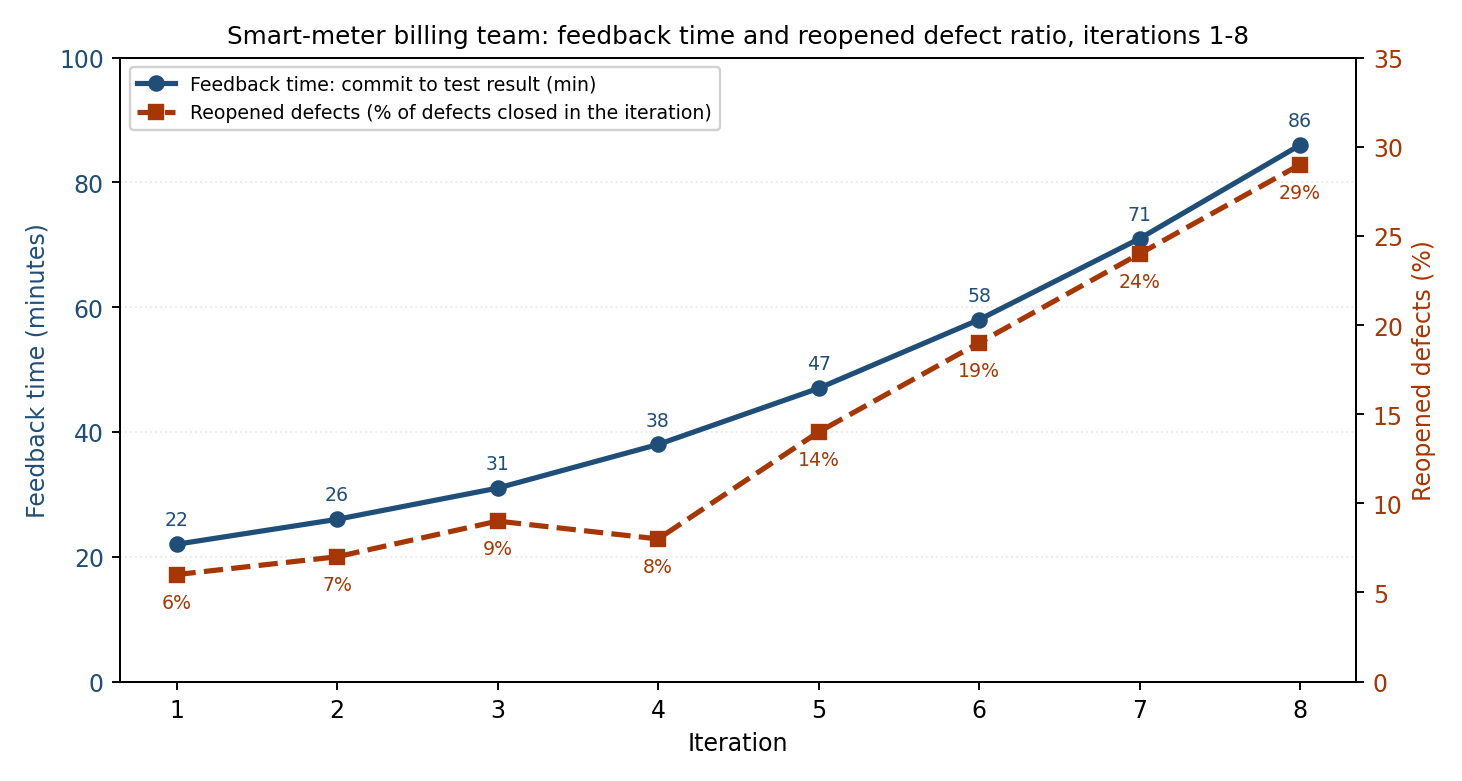
The team wants to select test process improvement measures from these two metrics for the next quarter. Which two selections are best supported by the data and by the syllabus guidance on metrics-based improvement? (Choose two.)
Treat the growth from 22 to 86 minutes as a lead-time signal and introduce smart test selection, while continuing to measure test execution lead times so the effect of the change is visible in the following iterations.
The syllabus pairs a rising lead time from code commit to feedback with smart test selection, and keeps measuring the lead time so the improvement can be evaluated as a hypothesis.
Treat the rise in reopened defects from around 8 per cent to 29 per cent from iteration 5 onwards as a defect and test debt signal: bring in whole-team defect triage, involve testers earlier in refinement, and address the shared database fixture while measuring the maintenance effort it costs.
A rising reopened share after new interdependent checks were added is the test debt and verification signal the syllabus answers with whole-team triage, earlier tester involvement and explicit measurement of maintenance effort.
Read the two curves together as evidence that individual developers are committing less carefully since iteration 4, and report the reopened share per developer at the next iteration review so ownership becomes visible.
The section positions metrics as a team feedback mechanism, not a comparison between individuals, and per-person reporting undermines the psychological safety it asks teams to protect.
Because the new checks arrived in iteration 4, set a code coverage target for the tariff-rating component for the next quarter and make progress towards that percentage the team's improvement goal.
This is the local optimization the section warns against: it optimises one number that the data does not implicate, while leaving both observed signals unaddressed.
Because both curves rise together, conclude that the second curve is caused by the first and act only on feedback time, since a single root cause makes any further measure redundant for this quarter.
Correlated trends do not establish a single cause; the syllabus asks for root cause analysis, and the shared fixture points to a distinct problem that a shorter pipeline would not resolve.
Section 3.4.1 treats metrics as a feedback mechanism, pairs each signal with a measure, and warns against local optimization. A lead time from commit to feedback that has almost quadrupled is the signal the syllabus answers with smart test selection and with measuring test execution lead times, so that the pipeline gives an answer inside the working rhythm again. A reopened-defect share that jumps after the fixture-sharing checks were added points at a defect verification and test debt problem: whole-team defect triage, earlier tester involvement, and measuring maintenance effort while addressing the shared-fixture dependency. Reading these two curves as a productivity comparison between people, or as a case for chasing a coverage percentage, are the local-optimization traps the section warns about.
Chapter 4 · Shift Left — 9 questions
The government benefits portal has no maintained specification for its…
The government benefits portal has no maintained specification for its award-letter generation: the written requirement is two years old and the behaviour has drifted. The team does, however, have acceptance criteria on each story, agreed examples, acceptance-level test cases, test charters and monitoring data from production. Which statement gives the best example of testware used as a form of requirements, as the syllabus describes it?
The agreed examples and acceptance-level test cases are maintained as executable specifications through ATDD, so they describe the current intended behaviour of award-letter generation and stay accurate because they are executed on every change.
This is the syllabus notion of living requirements: testware produced collaboratively and executed continuously remains a trustworthy statement of intent.
The production monitoring data is treated as the requirement for award-letter generation, since what the live system currently does is by definition what the business needs it to do.
Monitoring data becomes a source of testable hypotheses or decision rules; observed behaviour is not automatically the intended behaviour.
The two-year-old requirement document is formally retired and archived, after which the automated test scripts become the requirement because no other written source remains for the team to consult.
Testware acts as requirements because it is collaboratively agreed and kept current, not because other documents were removed; absence of alternatives is not what gives it authority.
The test charters are used as the requirement for award-letter generation, since a charter states a mission and scope and therefore already contains the expected results that the letters must satisfy.
Test charters are named among the testware that informs requirements, but a charter is a mission and scope for a session rather than a statement of expected results.
Section 4.1.1 lists user stories with acceptance criteria, checklists, BDD scenarios, acceptance-level test cases, examples, test charters, contracts and automated test scripts as testware that acts as living requirements, with ATDD, BDD and specification by example producing executable specifications. In DevOps contexts monitoring logs, customer analytics and feedback loops become testable hypotheses or decision rules. Testware serves as requirements because it stays current and executable, not because a document was formally replaced.
Before building a new hardship-payment application journey on the benefits…
Before building a new hardship-payment application journey on the benefits portal, the team spends part of a backlog refinement session drawing the journey scene by scene with the business representative, and then draws what will be tested across the main and alternative paths. Which statement explains how storyboarding and testboarding increase the quality of the test basis, as the syllabus describes them?
Storyboarding surfaces usability problems, missing transitions and persona gaps in the journey, while testboarding makes the main and alternative scenarios visible so terminology is shared and priorities are agreed; used iteratively both act as living documentation that exposes requirements drift.
This matches both definitions and the syllabus points about iterative use, shared terminology, living documentation and drift detection.
Storyboarding produces the test cases for the journey and testboarding reviews them afterwards for defects, so the two techniques form a sequential design-then-review pair used once per feature.
Storyboarding visualises the journey rather than producing test cases, and both techniques are applied iteratively rather than once as a sequential pair.
Testboarding visualises the user journey from the persona's point of view while storyboarding visualises the coverage of main and alternative scenarios, which is why testboarding is run with the business representative and storyboarding with the developers.
The two definitions are swapped; storyboarding is the journey visualisation and testboarding is the coverage visualisation.
Both techniques are performed after the journey has been implemented, because their purpose is to document what was built so that the team has a maintainable record for the next release.
Both are shift-left techniques applied during refinement and planning, before implementation, so that they improve the test basis rather than record the outcome.
Section 4.1.2 defines storyboarding as visualising the user journey scene by scene, which surfaces usability problems, missing transitions and persona issues, and testboarding as visualising what will be tested - main and alternative scenarios - which aligns terminology, sets priorities and improves the maintainability of test cases. Both are applied iteratively during backlog refinement and iteration planning, both act as living documentation, and both reveal requirements drift.
The travel-booking team runs an example mapping session on a story about…
The travel-booking team runs an example mapping session on a story about refunding a cancelled multi-leg itinerary. After twenty minutes the table holds one yellow card, five blue cards, twelve green cards under a single blue card, and seven red cards. Which reading of this session matches the syllabus?
Seven open questions show much is still unknown about the refund rules, and one business rule carrying twelve examples signals a story that is too large, so the story should be sliced before it is taken into an iteration.
This applies both syllabus signals correctly: many red cards mean unresolved unknowns, and a rule with many examples means the story needs slicing.
Twelve examples under one rule show the rule is well understood and ready to implement, and the seven open questions can be resolved during implementation because example mapping is time-boxed rather than exhaustive.
A rule accumulating many examples is a sizing signal, not a readiness signal, and leaving seven open questions for implementation defeats the purpose of the session.
Five business rules against one story is the imbalance to act on, and the correct response is to split the story into five stories, one per rule, keeping the original acceptance criteria on each of them.
The number of rules is a sizing signal, but copying the original acceptance criteria onto each slice is explicitly ruled out; acceptance criteria are rewritten per slice.
The session should continue past its time box until every red card has been converted into a green one, because unanswered questions are the only outcome example mapping is designed to remove.
The session runs until the scope is clear or the time box ends; remaining questions are a legitimate outcome that informs whether the story is ready.
In example mapping a yellow card is the user story, blue cards are business rules, green cards are examples that later become test cases and red cards are open questions. The session continues until the scope is clear or the time box ends. Many red cards indicate that much is still unknown; many blue cards, or one rule carrying a large number of green examples, indicate the story is too large and should be sliced.
The benefits-portal team has written its hardship-payment stories around a…
The benefits-portal team has written its hardship-payment stories around a single fluent applicant who submits online with all documents ready. Reviews of these stories are quick and unanimous, and the first production release generates many support calls about applicants who cannot complete the journey. Which statement gives the best example of how bias negatively affected product quality here, and what the syllabus offers against it?
The happy-path story anchored the team so that edge cases and accessibility needs were underestimated, and quick unanimity points to conformity bias, which the whole team approach can amplify; diversity of thought, exploratory sessions with debriefs and tissue testers are the countermeasures.
This names the anchoring effect and conformity bias correctly, recognises that the whole team approach increases the risk, and lists countermeasures the syllabus gives.
The problem is confirmation bias in the support team, which recorded only the calls that matched its expectation, so the countermeasure is to re-code the support call data before drawing conclusions about the journey.
Confirmation bias is a real named bias, but the described defect arises during story writing and review; re-coding support data does not address the anchoring in the test basis.
The unanimity in review shows bias was absent, because a shared view across a cross-functional team is the syllabus indicator that the story has been examined from several perspectives.
The syllabus warns the opposite way: the whole team approach increases the risk of bias, and easy unanimity is a signal of conformity rather than of thorough examination.
The countermeasure is to make one team member formally responsible for challenging every story, since concentrating the challenge in a single accountable role is how the syllabus removes bias from refinement.
The syllabus relies on diversity of thought, psychological safety, pairing and fresh eyes rather than assigning the challenge to one designated role.
Section 4.1.4 defines bias as a systematic deviation from neutrality or accuracy and names confirmation bias, the anchoring effect - where happy-path stories cause edge cases, accessibility and internationalization to be underestimated - and conformity bias. It states plainly that the risk of bias is increased by the whole team approach. Countermeasures include diversity of thought, exploratory testing through session-based testing, psychological safety, debriefs after sessions, paired testing, tissue testers and root cause analysis.
A tester on the smart-metering team is reviewing a requirement for the new time-of-use tariff. It reads: the bill shall reflect peak and off-peak consumption promptly after the meter reports it. Which statement best explains how requirements engineering supports shift left in this case?
Applying the validation criteria during refinement exposes that promptly is ambiguous and not testable, so the tester asks for a stated interval and a defined peak window, and the ambiguity is removed before any code is written.
This is shift left through requirements validation: the unambiguous and testable criteria are applied early, so the defect is prevented rather than found later.
The tester records promptly as a defect against the requirement and asks the business analyst to reissue the specification, since requirements engineering supports shift left by moving defect reporting earlier in the lifecycle.
Shift left is about collaborative clarification during the requirements work, not about relocating a formal defect-reporting hand-off to an earlier point.
The tester leaves the wording as it is and writes an exploratory test charter to discover what promptly turns out to mean once the tariff calculation has been implemented and deployed to staging.
Vague acceptance criteria are indeed a reason for exploratory testing, but here the requirement can be clarified before implementation, which is the cheaper shift-left outcome.
The tester rewrites the requirement as a state transition diagram, because the syllabus lists semi-formal scenario models as the specification form that satisfies all five validation criteria on its own.
Semi-formal models add precision, but no notation satisfies the validation criteria by itself; the missing interval and peak window still have to be elicited from the business.
Section 4.2 names four requirements engineering activities - elicitation, analysis, specification and validation - and five validation criteria: correct, unambiguous, complete, consistent and testable. Semi-formal scenario models such as use cases, business process models and state transition diagrams, together with glossaries, give the specification more precision. The tester applying the validation criteria during refinement is what makes the shift left concrete: the ambiguity is removed before code is written.
The benefits-portal team wants to shift left by clarifying acceptance criteria…
The benefits-portal team wants to shift left by clarifying acceptance criteria with the business representative earlier. The business representative has strong domain knowledge but finds abstract rule statements hard to review, and the team is short of time in the overlap window. Which combination of activities fits the syllabus guidance on elicitation and on shift left?
Hold a short workshop built on a prototype of the eligibility screens and work from concrete examples with the business representative, using testboarding to show what will be tested, and treat any AI-suggested ambiguities as input to that conversation rather than as its conclusion.
Workshops and prototyping are named elicitation methods, concrete examples suit a reviewer who struggles with abstractions, and the syllabus positions AI tooling as a supplement to human analysis.
Send the abstract rule statements to an AI tool to generate acceptance criteria and test scenarios, then have the business representative approve the generated set, so the scarce overlap time is spent on approval rather than on discussion.
The syllabus states AI tools supplement rather than replace human analysis; reducing the business representative to an approver removes the structured conversation shift left depends on.
Postpone the acceptance criteria until the eligibility screens have been implemented, then walk the business representative through the working software, since a running screen is the most concrete basis for a conversation.
Working software is concrete, but waiting for implementation moves the clarification to the right; prototyping gives the same concreteness before the code is written.
Ask the business representative to write the acceptance criteria alone between sessions and have the team refine whatever arrives, so no shared time is consumed and the domain knowledge reaches the team directly.
Elicitation in the syllabus is collaborative; solo authoring loses the structured conversation and the shared terminology that make the criteria testable.
Chapter 4 names interviews, workshops and prototyping as elicitation methods, and has the team work from concrete examples rather than abstract statements, using example mapping, storyboarding and testboarding at backlog refinement. AI or LLM tools may help find ambiguities in requirements, suggest test scenarios and detect coverage gaps in user stories, but the syllabus states they supplement rather than replace human analysis.
In its working agreement the benefits-portal team uses the terms shift left, test basis, testware, specification by example and test session sheet. Which statement uses these chapter 4 keywords as the syllabus and the ISTQB Glossary define them?
The test basis is the body of knowledge from which tests are analysed and designed, and specification by example builds that basis from concrete examples agreed together with the business representative.
Both definitions are correct, and they capture why example-based work improves the quality of the test basis.
Testware means the tools the team uses to design and execute its tests, and shift left means moving the test execution stage nearer the start of the release calendar without changing the activities themselves.
Testware is the work products of the test process rather than the tools, and shift left changes which activities happen early, not merely when execution is scheduled.
A test session sheet is the template on which the iteration test plan is recorded, and the test basis is the environment and data configuration against which the tests are run.
A test session sheet records an exploratory session, and the test basis is the knowledge tests are derived from rather than an environment configuration.
Specification by example means illustrating a finished specification with examples once it has been approved, and testware is the subset of test work products that has been automated.
The examples drive the specification rather than illustrate a finished one, and testware covers manual work products as well as automated ones.
Shift left means performing test activities earlier in the lifecycle to prevent defects. The test basis is the body of knowledge used as the basis for test analysis and design. Testware is the work products produced during the test process. Specification by example derives the specification from concrete, collaboratively agreed examples. A test session sheet is the record of an exploratory test session, not a test plan template.
The travel-booking team brings this story into refinement: "As a traveller I…
The travel-booking team brings this story into refinement: "As a traveller I want to book a multi-city itinerary, choose my seats and pay, so that I receive a confirmed ticket." Its acceptance criteria are: (1) the traveller can search flights for up to five cities; (2) an itinerary can be held for 30 minutes without payment; (3) held seats are released when the hold expires; (4) the traveller can select a seat on each leg; (5) seat maps for the legs served by the legacy reservation core are read-only; (6) payment can be made by card or by stored account credit; (7) a confirmed ticket is emailed within two minutes of payment; (8) a failed payment leaves the itinerary held for the remainder of the 30 minutes. Refinement takes 40 minutes and ends with the team agreeing the story cannot be finished in one iteration. The team decides to slice it along the workflow dimension. Which slicing is correct according to the syllabus?
Three slices following the steps of the journey: search and hold an itinerary with automatic release on expiry; select seats on a held itinerary, read-only where the legacy core serves the leg; pay a held itinerary and receive the confirmed ticket, including the behaviour after a failed payment. Each slice gets its own rewritten acceptance criteria and the three together cover criteria 1 to 8.
This follows the workflow dimension step by step, gives each slice one narrow traveller outcome, rewrites the criteria per slice and demonstrably covers the original story.
Three slices following the architecture: first the itinerary and seat data model, then the booking and payment services, then the traveller-facing screens, with the original eight acceptance criteria attached unchanged to each slice so nothing is lost between them.
This slices by architectural layer rather than by workflow, leaves the first two slices with no user outcome to test, and copies the original criteria, which the syllabus rules out.
Two slices by outcome type: one slice covering the whole journey when everything succeeds, and a second slice covering every error and expiry case across search, seat selection and payment, so the exceptional behaviour can be scheduled later.
The second slice bundles several unrelated behaviours from different workflow steps, which the syllabus tells teams to avoid, and it invites the anchoring effect by treating the happy path as the real story.
Three slices by the people available: one for the developer who knows the legacy reservation core, one for the front-end developer, and one for the tester to cover payment, with the acceptance criteria distributed between them as the work is picked up.
Slicing by who will do the work is not one of the six dimensions, produces slices with no independent user outcome, and leaves the criteria unrewritten.
Section 4.1.5 lists six slicing dimensions - workflow, data complexity, interface, scenario, vertical slicing and constraints - and states the rules: rewrite the acceptance criteria for each slice, never copy the original criteria into the slices, give each slice one narrow user outcome, avoid mixing several behaviours in one slice, and ensure the slices together cover the original story. Testability is the main criterion. Slicing by architectural layer or by who will do the work is not slicing along the workflow.
The smart-metering billing team has this story: "As a customer I want to settle…
The smart-metering billing team has this story: "As a customer I want to settle my electricity bill using any of the supported payment options so that my supply is not interrupted." The supported options are monthly direct debit, one-off card payment, bank transfer with a payment reference, and a prepay top-up voucher; each option has different settlement timing, different partial-payment rules and, in the case of the voucher, a separate reconciliation file from the retail partner. The acceptance criteria mix all four options in six criteria, one of which reads "partial payments are allowed where the option supports them". Direct debit accounts for 78 per cent of settlements, while vouchers account for 3 per cent and carry the reconciliation risk. The team must slice this story so that each slice is testable and can be finished inside one two-week iteration. Which slicing best applies the syllabus rules?
One slice per payment option, taking direct debit first for value and the voucher early because of the reconciliation risk, with the acceptance criteria rewritten per slice to state that option's settlement timing and its own partial-payment rule explicitly, and with the four slices together covering the original six criteria.
This slices by variant, orders slices by value and risk, and replaces the untestable conditional criterion with an explicit rule per option, which is what makes each slice testable.
One slice per payment option, with the original six acceptance criteria attached to each slice so that the reviewer of any slice can still see the complete intended behaviour, and with the ambiguous partial-payment criterion left as written for the team to interpret per option.
The variant dimension is chosen correctly, but copying the original criteria into the slices is explicitly ruled out and the conditional criterion stays untestable.
Two slices by settlement timing: one covering the options that settle immediately and one covering the options that settle later, since grouping by timing keeps the number of slices small and each slice still delivers a working payment path.
Each slice still bundles several options with different partial-payment rules and, for the voucher, a separate reconciliation file, so the behaviours remain mixed and the slices stay too large to finish.
Four slices by reconciliation effort: one slice implementing the payment capture for all four options, and three further slices adding reporting, reconciliation and customer notification across all options at once.
Only the first slice delivers a customer outcome and the rest cut across every option, so the slices are neither independently testable nor a workflow or variant split.
Slicing along the data complexity or variant dimension takes one payment option per slice, ordered by value and risk, with the acceptance criteria rewritten so that each slice states its own settlement timing and partial-payment behaviour. Testability is the primary criterion: the criterion "where the option supports them" is untestable until it is restated per option. The original criteria must not be copied into the slices, and each slice must deliver one narrow customer outcome while the slices together cover the original story.
Chapter 5 · Agile Approaches and Test Techniques — 12 questions
A tester on the government benefits portal has half a day to examine a newly added document-upload feature for which the acceptance criteria are thin, and decides to work from test heuristics. Which statement explains test heuristics as the syllabus does?
Heuristics are fallible aids to thinking that are most valuable exactly under time pressure and incomplete information, and they come in categories that include guidelines, generic checklists, rules of thumb, mnemonics, and analogies and metaphors.
This is the syllabus position on both the nature of heuristics and the five categories it lists.
Heuristics are formal test design techniques whose steps produce a repeatable set of test cases from a given specification, which is why the syllabus places them alongside boundary value analysis and decision table testing.
Heuristics are fallible aids rather than formal techniques with defined coverage; they guide thinking instead of deriving a repeatable case set.
Heuristics are checklists maintained by the team for its own product, so published sources such as usability heuristics or the OWASP Top 10 fall outside the definition and are treated as standards instead.
The syllabus names those published sources as examples of generic checklists, which is one of the five heuristic categories.
Heuristics substitute for a test oracle, because a rule of thumb about how a feature should behave provides the expected result that thin acceptance criteria fail to supply.
Heuristics help generate ideas and questions; the expected result still comes from oracles, and mnemonics such as FEW HICCUPPS help identify oracles rather than replace them.
Section 5.1.1 presents heuristics as fallible aids that are especially useful under time pressure, incomplete information and high uncertainty. It names five categories: guidelines, generic checklists (including Nielsen's usability heuristics, the OWASP Top 10, Beizer's taxonomy and IEEE 1044), rules of thumb, mnemonics, and analogies and metaphors. Heuristics guide thinking rather than guarantee outcomes, and they do not replace techniques or oracles.
A tester preparing exploratory work on the smart-metering billing product wants…
A tester preparing exploratory work on the smart-metering billing product wants to use two mnemonics: one to widen the product dimensions being considered, and one to decide what to compare observed behaviour against when the acceptance criteria are thin. Which two statements about the mnemonics named in the syllabus are correct? (Choose two.)
SFDIPOT widens the dimensions of the product being examined, and its Time and Operations dimensions are the ones that prompt questions about billing period boundaries, clock changes and how field staff actually operate the product.
SFDIPOT stands for Structure, Function, Data, Interfaces, Platform, Operations and Time; Time and Operations are the dimensions that raise exactly those questions.
FEW HICCUPPS is a set of test oracles, so it offers bases for comparison such as history, comparable products, claims made about the product, and applicable statutes when the acceptance criteria say too little.
The syllabus presents FEW HICCUPPS as a mnemonic for test oracles, which is precisely what a tester needs when acceptance criteria are thin.
FEW HICCUPPS lists the product dimensions to cover, so the tester should use it to widen coverage, while SFDIPOT supplies the oracles against which billing output is compared.
The two roles are swapped: SFDIPOT covers product dimensions and FEW HICCUPPS supplies oracles.
RCRCRC is the mnemonic to use for the oracle problem here, because its Repaired and Chronic elements identify the parts of the billing engine whose behaviour can be trusted as a reference.
RCRCRC - Recent, Core, Risky, Configuration, Repaired, Chronic - is a regression selection mnemonic and does not supply oracles.
TERMS should be applied to widen the product dimensions, since Tools and Technology, Execution and Maintenance together describe the aspects of the metering product a tester should visit.
TERMS describes success factors for test automation rather than dimensions of the product under test.
SFDIPOT covers Structure, Function, Data, Interfaces, Platform, Operations and Time and is used to widen coverage across product dimensions - the Time and Operations dimensions are what raise questions about billing periods, clock changes and how the product is actually operated. FEW HICCUPPS covers Familiarity, Explainability, World, History, Image, Comparable products, Claims, Users' desires, Product, Purpose and Statutes, and is a set of test oracles: things behaviour can be consistent or inconsistent with. RCRCRC is the regression mnemonic, I SLICED UP FUN is the mobile one, and TERMS covers test automation success factors.
The travel-booking team plans a set of test tours across the booking portal and is deciding which district each tour should visit. Which statement explains test tours as the syllabus describes them?
Each tour gives exploration a theme and a viewpoint on a district of the product - for example the business district for the core booking capability, the historical district for older functionality, or the seedy district for negative testing and fault attacks.
This matches the syllabus: tours are themed journeys through named districts, with the seedy district covering negative testing, error guessing and fault attacks.
Each tour is a scripted sequence of steps through one district that is repeated identically in later iterations, which is what makes tours suitable as a regression suite for the booking portal.
Tours guide exploration rather than script it; their value lies in the varied paths a tester takes under the theme.
A single session must visit all six districts in a fixed order, because the districts are defined as consecutive layers of the product from the interface inwards to the data.
The districts are themes rather than architectural layers, and a session is free to focus on the districts that carry the risk in question.
Tours are grouped by the role of the person running them - the business district for business representatives, the hotel district for operations staff - which is how the districts get their names.
The districts describe areas and characteristics of the product, not the role of the person touring them.
Section 5.1.3 presents test tours as themed journeys through the product using the districts described by Whittaker: business district, historical district, tourist district, entertainment district, hotel district and seedy districts, the last covering negative testing, error guessing and fault attacks. A tour gives a theme and a viewpoint for exploration; it is not a scripted test suite and it does not have to visit every district in every session.
Ahead of the tournament the streaming team runs a mob testing session on the new commentary selector with seven participants in one room and a facilitator. Which statement describes mob testing as the syllabus does?
Seven participants sits within the usual five to eight; the roles rotate roughly every four minutes with the navigator taking over as driver, the moderator stays outside the rotation and may take any role except driver, and the session closes with a retrospective in which observations are grouped.
All four details match section 5.2.1: group size, rotation cadence and direction, the moderator's constraint, and the closing retrospective.
The moderator takes the driver role at the keyboard so the group can concentrate on observing, and rotation happens once per hour so that each participant has time to settle into the role before handing it on.
The moderator is the one role that may not drive, and rotation is about every four minutes rather than hourly.
Only the navigator and the driver take part actively while the rest of the group works on other tasks and is called in when a defect needs confirming, which is what distinguishes mob testing from pair testing.
The mob observes and contributes throughout; the whole group being engaged is what swarming means here.
A session runs for a full working day so that the whole commentary selector can be covered in one sitting, and the retrospective is deferred to the team's regular iteration retrospective to save time.
A mob testing session typically lasts about two hours, and the syllabus asks for a retrospective directly after the mobbing session.
Mob testing, also called ensemble testing, usually involves five to eight people and builds on the idea of swarming. The roles are Moderator, Navigator, Driver and the Mob of observers; rotation happens roughly every four minutes, with the navigator becoming driver and the driver returning to the mob. The moderator sits behind the group, does not rotate and may take any role except driver. A session typically lasts about two hours and is followed by a retrospective in which observations are written down and grouped.
In the distributed streaming team, a senior tester and a newly hired tester in…
In the distributed streaming team, a senior tester and a newly hired tester in another time zone have been pair testing the entitlement flow in every overlap window for three weeks. Both report that the sessions have become tiring and that the senior tester now makes most of the decisions. Which response fits the syllabus discussion of pair testing?
Both symptoms are the known drawbacks of mental fatigue and one participant dominating, so the pair should be used strategically on the complex parts rather than in every window, should swap roles regularly, and should agree a clear objective before each session.
These are exactly the three remedies the syllabus offers for the two problems described.
Pair testing is unsuitable for mentoring, so the junior tester should work alone and bring findings to the senior tester afterwards, which removes both the fatigue and the dominance problem at once.
Mentoring junior testers is one of the situations the syllabus names as particularly suitable for pair testing; the answer discards the benefit instead of managing the drawbacks.
The pair should be extended into a mob so the workload is spread over more people, since the syllabus recommends escalating from pair testing to mob testing whenever fatigue appears.
Mob testing is a separate practice chosen for its own reasons; the syllabus does not present it as the remedy for fatigue in a pair.
The senior tester should keep the decision-making role permanently so the junior tester can observe without pressure, because differing testing styles within a pair are the drawback the syllabus warns about most.
Fixing the roles entrenches the dominance problem; the syllabus asks for regular role swaps instead.
Section 5.2.2 lists the situations in which pair testing is particularly valuable - exploratory testing, complex or new features, cross-functional UI and API work, and mentoring junior testers - and the problems it brings: high effort cost, differing styles, one participant dominating, and mental fatigue. The solutions it gives are to apply pair testing strategically rather than continuously, to swap roles regularly, and to set clear objectives before the session.
A developer on the benefits portal generated the appeal-submission screen from a natural-language prompt, and the generated code passes the checks that were generated alongside it. The team decides to apply vibe testing. Which statement explains vibe testing as the syllabus presents it?
It is intent-first validation: the tester checks what the appeal-submission screen should do in the real world rather than what the generated code happens to do, which is how silently omitted input validation and role-based rules come to light.
This is the syllabus definition, including the specific gaps it names for generated code.
It is the practice of having the language model generate the test cases from the same prompt that produced the code, so that the tests and the implementation are guaranteed to be consistent with the stated intent.
Tests derived from the same prompt inherit the same omissions; vibe testing deliberately starts from real-world intent rather than from the generated artefacts.
It is a standardised AI-assisted test level positioned between component integration testing and system testing, applied whenever any part of a product was generated from a prompt.
The syllabus describes it as new and not yet standardised, and it is an approach rather than a test level.
It is an informal first impression of the user interface recorded by the tester before any structured testing begins, similar to the feedback a tissue tester gives on a prototype.
That describes fresh-eyes feedback from a tissue tester; vibe testing is about validating intended behaviour of AI-generated functionality.
Vibe testing is a new, not yet standardised AI-assisted approach that grew alongside vibe coding. It is intent-first validation: checking what the application should do in the real world rather than what it currently does, which is what catches the things a language model silently omitted - input validation, handling of invalid data, and role-based logic.
The benefits-portal team's testing notes use the terms epic, test charter, test smell and edge case. Which statement uses these chapter 5 keywords as the syllabus and the ISTQB Glossary define them?
An epic is a large body of work broken down into user stories, and a test charter states the mission and scope of an exploratory session as a testable hypothesis rather than listing the steps to follow.
Both definitions are correct, including the mandatory minimum content of a charter.
A test smell is a defect found in a test case during review, so every smell recorded against the appeal-submission cases has to be corrected before those cases may be executed.
A test smell is a symptom of poor test design that signals risk and cost; the syllabus notes it is not always a problem that must be fixed.
An edge case is any test case derived from an alternative scenario in the story, and an epic is a user story that has been estimated as too large for a single iteration.
An edge case sits at the extreme of the operating range rather than in any alternative scenario, and an epic is a body of work broken into stories rather than an oversized single story.
A test charter is the session record produced after exploratory testing, containing the coverage achieved and the anomalies observed, while a test smell is the term for an area of the product that has historically been defect-prone.
The record produced afterwards is the session sheet; the charter is written beforehand. A defect-prone area is not a test smell, which concerns the design of tests.
An epic is a large body of work that is broken down into user stories. A test charter is a short statement of the mission, scope and test objectives of an exploratory session, framed as a testable hypothesis; its mandatory minimum is mission or test objectives plus scope. A test smell is a symptom of a poorly designed test, which signals risk and maintenance cost rather than proving a defect exists. An edge case is an input or condition at the extreme of the operating range.
The government benefits portal has an epic: "Claimants can report a change of…
The government benefits portal has an epic: "Claimants can report a change of circumstances through whichever channel suits them." It breaks down into four user stories, one per channel: the web portal, the mobile app, the telephone contact centre where an agent enters the change on the claimant's behalf, and a paper form that is scanned and read by a document-recognition service. All four feed the same change-of-circumstances service. The stories carry acceptance criteria for the web and mobile channels; for the contact centre the only criterion is "the agent can record the change while the claimant is on the call", and for the paper channel there are no acceptance criteria at all because the recognition service is still being procured. Production data shows 61 per cent of changes arrive by web, 22 per cent by phone, 14 per cent by app and 3 per cent by paper, but phone-originated changes generate four times as many later corrections as web-originated ones. The tester must analyse the epic and its stories to create test charters for the coming iterations. Which two decisions are correct according to the syllabus? (Choose two.)
Write a charter for the contact-centre channel with a high priority even though it carries only 22 per cent of the traffic, because the vague single criterion and the fourfold rate of later corrections make it the strongest candidate for exploration, and derive its scope, setup and priority with the 5W1H questions.
Product risk and vague acceptance criteria are both reasons the syllabus gives for chartering exploration, and 5W1H is the named technique for deriving scope, setup and priority.
Write at least one charter that crosses the channels, stating as its mission the hypothesis that a change submitted through any channel reaches the change-of-circumstances service with the same effect, since that expectation lives in the epic rather than in any single story.
Charters are derived from epics as well as stories, and an expectation that only exists at epic level has to be chartered at that level to be examined at all.
Convert the web and mobile acceptance criteria directly into the charters for those channels and treat them as the complete test oracle for the two channels, so that exploration there needs no further oracle notes.
Acceptance criteria become test conditions and serve as lightweight oracle notes, but the syllabus states explicitly that they are not exhaustive test oracles.
Defer any charter for the paper channel until the document-recognition service has been procured and its acceptance criteria written, because a charter cannot be framed as a testable hypothesis without acceptance criteria to derive it from.
Missing or vague acceptance criteria are a reason to explore, and charters can be derived from product risks and iteration goals as well as from criteria.
Set charter priorities in proportion to each channel's share of production traffic, so the web channel receives roughly twenty times the session time of the paper channel and the ordering is defensible from data.
Priority in the syllabus follows product risk; traffic share alone would push the highest-correction channel down the order.
Section 5.1.4 has charters derived from user stories, acceptance criteria, product risks and iteration goals, each framed as a testable hypothesis with mission or test objectives and scope as the mandatory minimum, and the 5W1H or Kipling method used to derive scope, setup and priority. Acceptance criteria become test conditions and act as lightweight test oracle notes, but they are not exhaustive test oracles; missing or vague criteria are a reason to explore rather than a reason to wait. Risk, not traffic share, drives priority.
In the current iteration the travel-booking team has run three exploratory test…
In the current iteration the travel-booking team has run three exploratory test sessions on the redesigned booking flow, each guided by a test tour through a district of the product. The chart below counts the areas of the booking flow that each session visited and recorded in its session sheet, grouped by district. The iteration also delivered a change to the hold-and-release logic for legacy-served legs and a new stored-account-credit payment option; the entertainment district covers the seat-map and upgrade-offer presentation, and the seedy district covers negative testing, error guessing and fault attacks on the payment step.
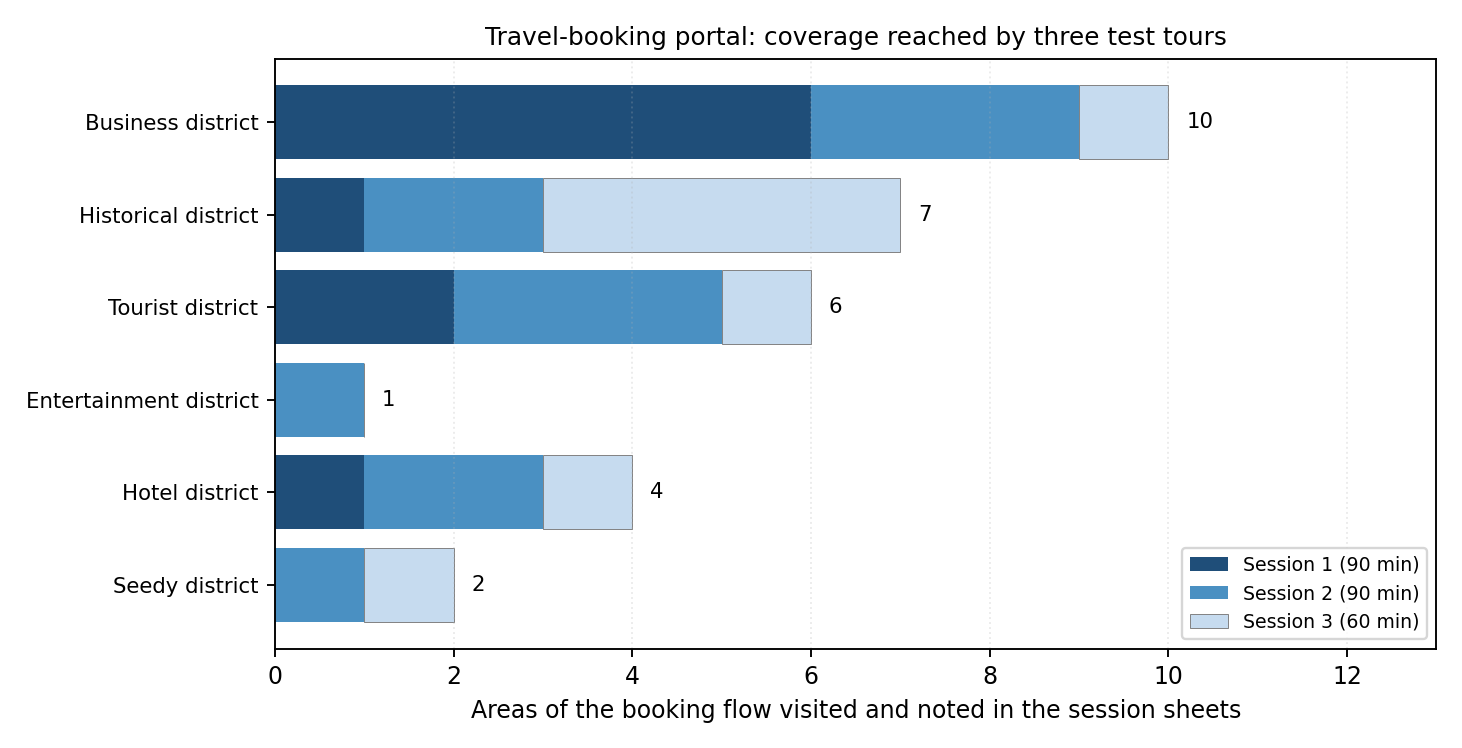
The team has time for one more 90-minute session before the iteration review. Which charter should the tester take into that session, and why?
A charter aimed at the seedy district around the payment step, because that district has almost the least recorded coverage while the payment step gained a new stored-credit option this iteration, so thin coverage coincides with the highest change-driven risk.
The syllabus applies exploratory testing after significant changes and uses recorded coverage, including risk coverage, to choose the next charter; this option combines both signals.
A charter aimed at the business district, because 10 recorded areas is the highest count and a district that has already attracted the most attention is the one where the team's understanding is deep enough to make a further session productive.
Choosing the best-covered district ignores the coverage information the session sheets provide; the point of recording coverage is to direct effort where it is thin and risky.
A charter that spreads the 90 minutes evenly across all six districts, so that the recorded counts become comparable and the coverage chart can be reported to the iteration review as balanced.
Levelling the bars optimises the chart rather than the risk, and thinly touching six districts in one session produces neither depth nor a usable session sheet.
No further session is chartered, because three sessions have already recorded thirty areas and the remaining time is better spent turning the session sheets into scripted regression cases for the historical district.
The iteration's changes to hold-and-release and to payment remain thinly explored, and converting notes into scripts is not what the remaining session time is for.
Exploratory testing is applied during the iteration, at the iteration review, after significant changes and where acceptance criteria are vague. Coverage recorded in session sheets - including risk coverage - is what guides the next charter. Here the thinnest districts are also the ones carrying this iteration's change and the highest risk: the seedy district covers negative testing and fault attacks on a payment step that gained a new option. Charters follow risk and change rather than an ambition to level the bars, and a session sheet showing thin coverage of a changed high-risk area is precisely the signal to charter it next.
A tester on the travel-booking portal is 70 minutes into a 90-minute exploratory…
A tester on the travel-booking portal is 70 minutes into a 90-minute exploratory session. The charter reads: "Mission - investigate whether a held itinerary containing at least one legacy-served leg releases its seats correctly when the hold expires; Scope - hold, extend and expiry paths for two-to-five-city itineraries, excluding payment." So far the session sheet records eleven areas visited, four confirmed anomalies, two questions for the business representative, and one behaviour the tester cannot judge because the charter says nothing about itineraries whose legs expire at different times. In the last 20 minutes the tester has found nothing new and has begun trying payment variations, which the charter excludes. What should the tester do, and how should the session be closed?
Stop working outside the scope, close the session inside its time box, and hold a post-session review that compares the charter against what actually happened, covering the four anomalies, the two questions and the next steps - with the differing-expiry behaviour and the payment idea captured as separate charters rather than added to this one.
This is the syllabus post-session review - charter versus reality, defects, questions, next steps - and it keeps new ground for new charters instead of quietly widening the current scope.
Continue with the payment variations to use the remaining 20 minutes productively and record them under the same charter, since the session sheet documents what was actually covered and the charter can be updated afterwards to match.
Rewriting the charter to match what happened destroys the charter-versus-reality comparison the post-session review depends on, and payment was deliberately excluded from this scope.
Extend the session beyond 90 minutes until the behaviour with differing expiry times can be judged, because a session should not close while an observation in the session sheet is still unresolved.
The time box is part of session-based test management, and an unresolved observation is a legitimate output that becomes a next step or a new charter rather than a reason to run on.
Close the session immediately and defer all four anomalies and both questions to the iteration retrospective, since a session that produced no new findings in its last 20 minutes has reached the point of diminishing returns and needs no review of its own.
Closing early is defensible, but skipping the post-session review discards the coverage, defect and question analysis that makes the session usable, and anomalies belong in the review rather than in a retrospective.
A test session is a time box of roughly 60 to 120 minutes with three phases: pre-session setup, test execution and post-session review. During execution the tester records coverage including risk coverage, evaluation notes, actual behaviour and anomalies. Drifting outside the charter is a signal to stop and either recharter or close: new ground outside the scope belongs in a new charter, not in the current session. The post-session review compares the test charter against reality and covers the defects found, the questions raised and the next steps - which is where the unjudgeable behaviour and the excluded payment idea are turned into follow-up charters.
Review this manual test case from the smart-metering billing suite. Title…
Review this manual test case from the smart-metering billing suite. Title: "Verify bill settlement". Steps: (1) Open the account. (2) If the account is on direct debit, wait for the collection date and check the bill shows Settled; if it is on card payment, pay the bill and check it shows Settled immediately; if it is a prepay account, top up and check the balance instead of the bill status. (3) If the account has a partial payment rule, repeat step 2 with half the amount and check the bill shows Part paid; otherwise skip. (4) If any check fails, note which branch was taken. Expected result: "The bill status is correct for the account type." Which test smell does this case exhibit, and what is the appropriate solution?
It is a God Test Case: the branching in steps 2 and 3 makes one case cover three account types and an optional rule, so the path taken depends on the account and the outcome cannot be read without knowing which branch ran. Split it into focused cases per account type plus one for the partial-payment rule, each with its own explicit expected result.
A single case attempting to cover everything through internal branching is the God Test Case smell, and splitting into focused cases with explicit expected results is its solution.
It is Hardcoded Test Data, because the case refers to direct debit, card and prepay accounts and to half the amount instead of parameterising the account type and the payment amount. The solution is to move these values into a data table referenced by the case.
Hardcoded Test Data concerns fixed values embedded in a case; here the defect is the branching structure, which parameterising the values would leave in place.
It is Bulk Steps, because step 2 combines waiting for a collection date, making a payment and performing a status check in a single numbered step. The solution is to break each action into its own numbered step so each has a verifiable outcome.
Bulk Steps is a real smell about too much packed into one step, but the defining problem here is the conditional logic that makes the whole case cover several account types at once.
It is Copy-Paste Duplication, because step 3 instructs the tester to repeat step 2 with a different amount rather than stating the steps again. The solution is to write the repeated steps out in full so each case is self-contained.
Nothing is duplicated here - the case reuses a step by reference - and writing steps out in full would lengthen the case without removing the branching.
Branching conditional logic that makes one test case cover three account types, an optional partial-payment path and a variable expected result is the God Test Case smell: a single case that tries to do everything, so that the path actually taken depends on the data and the result cannot be interpreted without knowing which branch ran. The solution is to split it into separate, focused test cases - one per account type and one for the partial-payment rule - each with its own explicit expected result. Hardcoded Test Data, Bulk Steps and Copy-Paste Duplication are different smells and none of them describes internal branching.
Three manual test cases sit consecutively in the streaming product's entitlement…
Three manual test cases sit consecutively in the streaming product's entitlement suite. TC-41 "Register a viewer" ends by leaving a newly registered viewer signed in. TC-42 "Subscribe to the tournament pass" begins at step 1 with "Open the subscription page" and assumes the viewer from TC-41 is still signed in and has no active pass. TC-43 "Cancel the tournament pass" begins with "Select Cancel" and checks that the pass end date equals the date set by TC-42. When the suite is run in its documented order all three pass. When a tester picks up TC-43 on its own, or when TC-42 is run twice in a row because a defect was retested, the checks fail even though the product behaves correctly. Which test smell is present, and what is the appropriate solution?
Interdependent Tests: TC-42 and TC-43 pass only because the preceding cases left a signed-in viewer and a known pass end date behind, so the result depends on the execution order. Give each case its own preconditions and setup and have it clean up after itself, so any case can run alone, in any order, or twice.
A result that depends on what a previous case left behind and on the documented order is exactly the Interdependent Tests smell, and independent setup with teardown is its solution.
Hidden Dependencies: the cases rely on state created elsewhere in the suite, and the solution is to document in each case which other cases must have run before it, so that a tester picking up TC-43 knows what to execute first.
The dependency here is already stated in the cases, and documenting the required order entrenches the coupling instead of removing it.
Environment Assumptions: the cases assume a particular state of the entitlement environment, and the solution is to add a shared environment precondition at the top of the suite describing the viewer and pass data the whole suite expects.
The assumption is about what sibling test cases left behind rather than about the environment, and a shared suite-level precondition would still leave TC-43 unable to run alone.
No Cleanup or Teardown: TC-41 leaves a viewer signed in and TC-42 leaves an active pass, and the solution is to add a teardown step to each case so the suite always finishes in its starting state.
Missing teardown is part of the picture and explains the repeated-run failure, but it does not explain why TC-43 fails when run alone; the coupling to earlier cases has to be removed as well.
TC-42 and TC-43 only work because earlier cases left the system in a particular state and because the documented execution order was followed, which is the Interdependent Tests smell. The remedy is to make each case establish its own preconditions and clean up after itself, so any case can be run alone, in any order, or repeated. Hidden Dependencies would describe a reliance that is not visible in the case at all; here the dependency is stated, which is what distinguishes the two. Environment Assumptions concerns assumptions about the environment rather than about sibling test cases, and No Cleanup or Teardown alone would not explain the failure of TC-43 when run in isolation.
Chapter 6 · Test Automation and Test Tools — 2 questions
The streaming team is deciding what to automate for the tournament. Candidates…
The streaming team is deciding what to automate for the tournament. Candidates are: the entitlement checks that run on every stream start; the upgrade-offer banner whose layout and wording change most weeks; the exploratory sessions on the commentary selector; and a set of checks on the playback API that have passed unchanged for eleven months. Which statement distinguishes the automation approaches as the syllabus does?
Automate the entitlement checks first because they are repetitive, deterministic and reduce a high risk; leave the weekly-changing upgrade banner as a poor candidate; keep the exploratory sessions manual; and review the eleven months of unchanged passing API checks, since checks that do not fail deliver little benefit for their maintenance cost.
Each judgement follows the syllabus: risk and value drive selection, volatile tests are poor candidates, exploratory work stays manual, and never-failing tests give little benefit.
Automate the upgrade-offer banner first, because the parts of the product that change most often are where automated regression protection pays back fastest, and defer the entitlement checks since they are already stable.
Frequently changing tests are named as poor automation candidates because of maintenance cost, and stability is not a reason to leave a high-risk check unautomated.
Automate the exploratory sessions on the commentary selector by scripting the routes the testers took, so that the exploration becomes repeatable and the manual effort can be redirected to the entitlement checks.
Scripting past routes is no longer exploratory testing; the syllabus states automation complements rather than replaces exploratory and manual testing.
Decide the automation scope in a separate technical planning session held outside the iteration, because deciding it at iteration planning would make the iteration content harder to predict for the business representatives.
The syllabus places these decisions at iteration planning or refinement and notes that doing so improves rather than harms the predictability of the iteration.
Section 6.1 has automation decisions driven by risk and value: repetitive, deterministic and high-value candidates are automated first, frequently changing tests are poor candidates, and tests that never fail deliver little benefit. The typical approach is component tests, API tests and a narrowly bounded set of end-to-end tests, and what to automate is decided at iteration planning or refinement. Exploratory and one-off testing stay manual, and the syllabus states plainly that test automation complements but does not replace exploratory and manual testing.
The streaming team deploys to production daily and is reviewing which categories of test tool actually help it in that continuous delivery setting. Which two statements match the tool categories the syllabus describes and the contribution it attributes to them? (Choose two.)
Monitoring and analytics tools contribute what the syllabus calls monitoring as testing, so production signals become a source of test information once the product is deployed daily.
Monitoring and analytics is one of the named categories, and monitoring as testing is the phrase the syllabus uses for its contribution.
AI tools can generate test cases from changes in code, requirements or user behaviour, predict build failures, analyse user stories for ambiguity and gaps in acceptance criteria, and generate realistic test data including edge cases.
These are the specific AI tool contributions the syllabus lists in section 6.2.
The syllabus names the specific products in each category so that teams can standardise on the same toolchain, which is what makes results comparable between teams delivering the same product.
The syllabus deliberately discusses categories only and names no products; cross-team benchmarking is separately discouraged in chapter 3.
Tool choice should start from the categories the team is already comfortable with, since familiarity shortens the feedback loop more than aligning the tools to a test strategy would in a daily-deployment setting.
The syllabus states the choice must follow from the test strategy and the automation layers rather than from convenience or fashion.
Configuration management and continuous integration tools fall outside the test tool categories, because they support the build rather than the testing and therefore belong to the development toolchain.
Both are explicitly listed among the tool categories helpful in Agile testing, since they underpin repeatable environments and continuous test feedback.
Section 6.2 lists categories rather than products: task management and tracking; communication and collaboration for refinement, planning, reviews and retrospectives; test design, implementation and execution including unit, API and GUI frameworks with support for ATDD and BDD as specification by example; continuous integration; configuration management; session recording and screenshot tools; monitoring and analytics, described as monitoring as testing; and AI tools that generate test cases from changes in code, requirements or user behaviour, predict build failures, analyse user stories for ambiguity and acceptance criteria gaps, and generate realistic test data with edge cases. Tool selection should follow the test strategy and the automation layers rather than convenience or fashion.