The Seven ISTQB Testing Principles, Explained Simply (CTFL v4.0)
The seven testing principles in the exact CTFL v4.0 wording, including the two that were renamed, how many marks they are really worth, and the traps that separate the confusable pairs.
The seven testing principles are the general guidelines in section 1.3 of the ISTQB Foundation Level syllabus v4.0: testing shows the presence, not the absence of defects; exhaustive testing is impossible; early testing saves time and money; defects cluster together; tests wear out; testing is context dependent; and the absence-of-defects fallacy. They sit in chapter 1, which carries 8 of the exam's 40 questions, and they are examined as a single K2 objective, meaning you have to explain them rather than recite them.
Two of the seven were renamed in v4.0, and most study material online still uses the older names. That is the single most useful thing to know before you read anything else about them.
The seven principles in the v4.0 wording
The syllabus attributes each principle to a specific piece of research and, for five of them, points forward to the section where the principle turns into practice. Those cross-references are the fastest way to understand why the principles are in chapter 1 at all: they are not trivia, they are the reasons the later chapters exist.
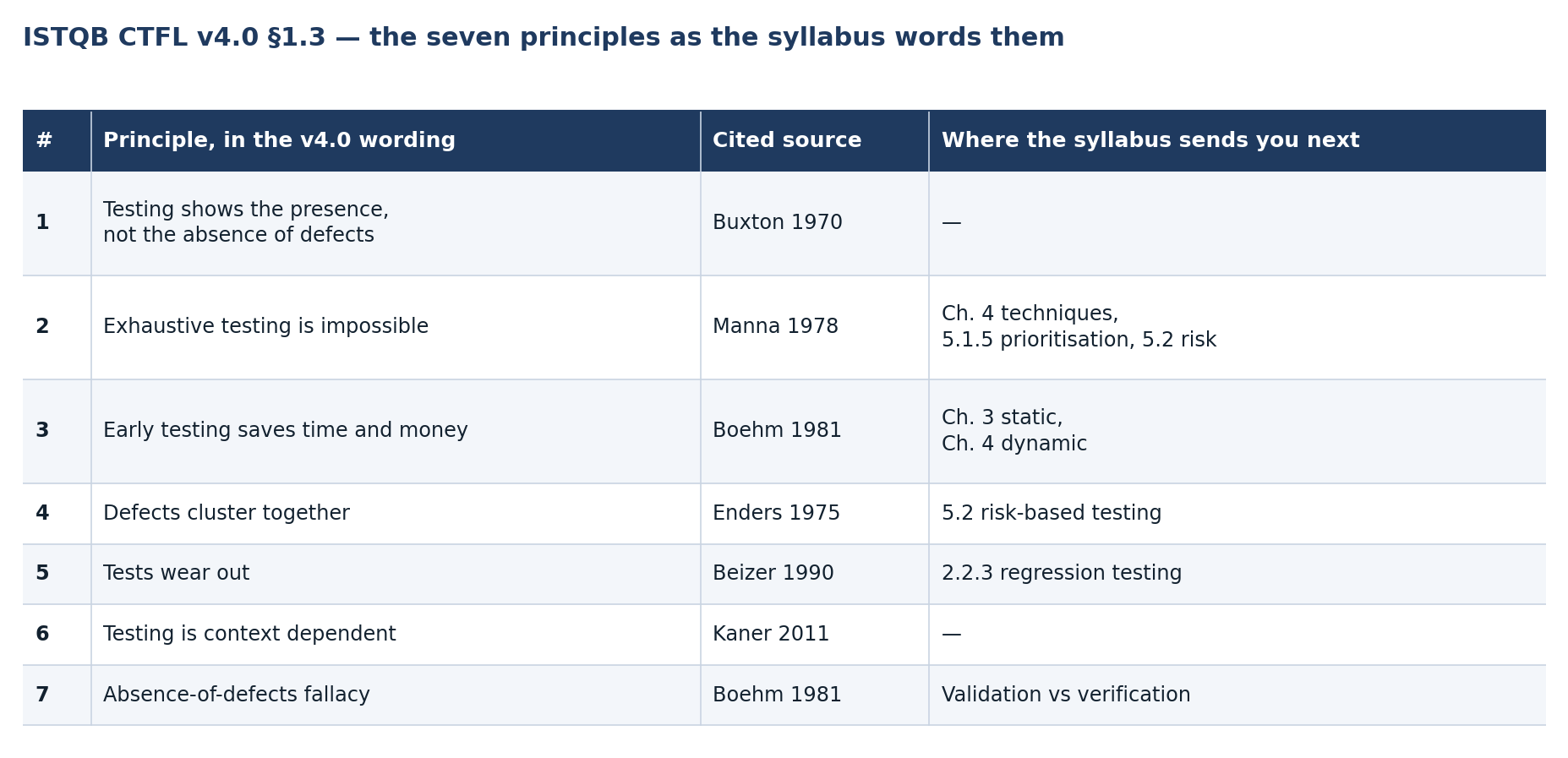
Read the right-hand column as a map. Principle 2 is the reason chapter 4 spends 290 minutes on test design techniques; principle 4 is the reason risk-based testing exists in section 5.2; principle 5 is why section 2.2.3 separates confirmation testing from regression testing. If you can name the destination, you understand the principle.
What changed in v4.0: two principles were renamed
Principle 5 used to be titled "beware of the pesticide paradox". In v4.0 it is tests wear out. The idea is unchanged, but the metaphor is gone from the heading, and v4.0 adds a qualifier the old wording did not have: repeating the same tests can still be beneficial, for example in automated regression testing. So "repeated tests are useless" is now a wrong answer, not a simplification.
Principle 7 used to be the "absence-of-errors fallacy". In v4.0 it is the absence-of-defects fallacy. Same concept, and the change matters only because search results and older courseware are split between the two names. If an answer option uses the old wording, it is not automatically the distractor.
How many marks are the principles actually worth?
Less than the internet tells you. The official exam structure gives chapter 1 exactly 8 questions out of 40, split into 2 at K1 and 6 at K2 — the full per-chapter breakdown is in our syllabus structure and chapter weights guide. The principles are one K2 learning objective inside that chapter, alongside roughly ten others covering testing objectives, testing versus debugging, error/defect/failure, test activities, work products, traceability, tester skills, the whole-team approach and independence.
ISTQB does not publish counts per learning objective, so anyone quoting "two to three questions on the principles" is guessing. A realistic expectation is one question, occasionally two. That is still worth having: at a 65% pass mark, 26 correct answers out of 40, one guaranteed-easy mark is a quarter of your typical margin.
Principle by principle, and the part people get wrong
1. Testing shows the presence, not the absence of defects
Testing lowers the probability that defects remain undiscovered. It never establishes correctness. The trap is the word prove: any option claiming testing proves anything about a clean system is wrong.
2. Exhaustive testing is impossible
Only trivial cases can be tested completely. The syllabus names the response explicitly: test techniques, test case prioritisation and risk-based testing. The trap is reading this as permission to test less; it is an instruction to choose deliberately.
3. Early testing saves time and money
Defects removed early cannot propagate into derived work products, so the cost of quality drops. Note that this covers both static and dynamic testing started as early as possible. Candidates lose this one by assuming "early testing" means executing tests sooner; reviews of requirements count too.
4. Defects cluster together
A small number of components hold most of the defects, or cause most of the operational failures. The syllabus calls it an illustration of the Pareto principle and treats both predicted and observed clusters as input to risk analysis. The trap is turning "prioritise the clusters" into "skip everything else".
5. Tests wear out
Repeat the same tests often enough and they stop finding new defects, so tests and test data need modifying and new tests need writing. Remember the v4.0 qualifier: repetition is still valuable in automated regression testing, where the point is detecting change, not discovery.
6. Testing is context dependent
There is no universally applicable approach. A safety-critical device and a casual mobile game are tested differently, and "more rigour is always better" is a wrong answer, not a cautious one.
7. Absence-of-defects fallacy
Testing every specified requirement and fixing every defect found can still produce a system that misses user needs, fails the customer's business goals, or loses to a competitor. Verification is not enough; validation has to happen as well. This is the principle that puts acceptance testing in the syllabus.
The three confusable pairs
Exam questions on the principles are almost always scenarios: a short story, then "which principle does this illustrate?". Nearly every wrong answer comes from three specific mix-ups. Each one is settled by a single question you can ask yourself in about five seconds.
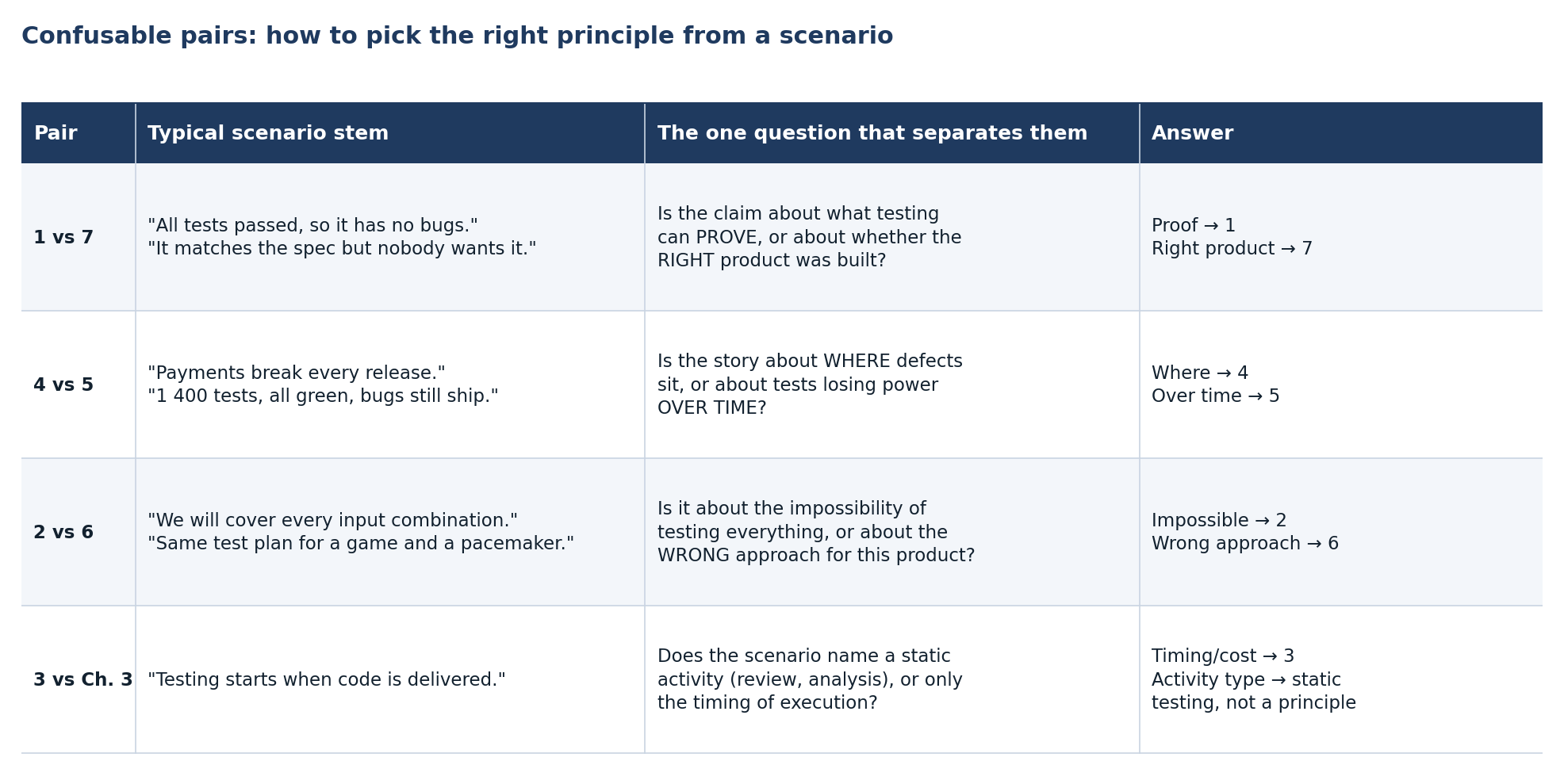
The last row is not a pair of principles at all, and that is the point. Plenty of chapter 1 scenarios that feel like principle 3 are really testing whether you can name a static activity, which belongs to chapter 3. Read the stem for the noun, not the mood.
Numbers you should not quote on the exam
Two figures follow these principles around the internet and neither is in the syllabus.
The 1:10:100 cost curve. The syllabus supports the direction of principle 3 and cites Boehm 1981, but publishes no multipliers. Any specific ratio is commentary.
"80% of defects in 20% of modules." The syllabus says a small number of components hold most defects and names the Pareto principle. It does not commit to 80/20, and an option that hangs on the exact split is usually the distractor.
Definitions from memory. Where a principle uses a defined term — defect, failure, verification, validation — the exam uses the ISTQB glossary wording, not a paraphrase.
How to practise this in ten minutes
Reading the list is not practice, because the exam never asks you to reproduce the list. Practice is mapping stories onto principles until the confusable pairs stop being confusable. Three steps that work:
Write each principle title on a card, then write two scenarios from your own project for each. If you cannot produce a real example for a principle, that is the one you do not understand yet.
Answer chapter 1 questions in a full mock rather than in isolation, so the principles compete for attention with test activities and roles the way they will on the day.
For every question you get wrong, read the rationale for all four options, not just the correct one. The distractors are where the confusable pairs live.
Our free CTFL practice exams are built to make that last step possible: every mock is 40 questions matched to the official 8/6/4/11/9/2 chapter split, so chapter 1 always shows up in the same proportion as the real exam, and every answer option carries its own rationale rather than a single "correct answer" note. If you want the chapter in isolation first, the Fundamentals of Testing chapter page collects the questions from this part of the syllabus in one place.
If you are still deciding how to structure the whole preparation rather than one chapter, start with our complete CTFL Foundation guide and come back to the principles once chapters 4 and 5 are under control. They carry half the exam between them; the principles carry one question.
Frequently asked
In CTFL v4.0 they are: testing shows the presence, not the absence of defects; exhaustive testing is impossible; early testing saves time and money; defects cluster together; tests wear out; testing is context dependent; and the absence-of-defects fallacy.
Not in the syllabus. Since v4.0 the principle is titled "tests wear out" and cites Beizer 1990. The pesticide metaphor is still a useful teaching image, but the exam uses the newer name.
Chapter 1 carries 8 of the 40 questions, split 2 K1 and 6 K2. The principles are one K2 learning objective among roughly ten in that chapter, so plan for about one question, occasionally two. ISTQB does not publish per-objective counts.
CTFL v4.0 calls principle 7 the absence-of-defects fallacy. The older v3.1 syllabus said absence-of-errors fallacy, which is why both phrasings are still circulating online.
You need to recognise them from a described situation, because the learning objective is K2 (explain), not K1 (recall). Memorising the titles helps, but the questions usually hand you a scenario and ask which principle it illustrates.
The syllabus supports the idea that early defect removal is cheaper and cites Boehm 1981, but it gives no multipliers. Treat any specific ratio as commentary, not as an examinable fact.
Part of the ExamCaliber editorial team. Every ExamCaliber question and rationale is written and reviewed by hand against the current syllabus — never scraped from exam dumps.