CTFL Chapter 4: Which Test Techniques Actually Get Asked (11 of 40 Questions)
Chapter 4 supplies 11 of the 40 CTFL questions: 0 K1, 6 K2, 5 K3. Here is which five learning objectives the K3 questions must come from, what each asks you to compute, and how to budget the time.
Chapter 4 of the ISTQB CTFL v4.0 syllabus, Test Analysis and Design, supplies 11 of the 40 exam questions, and the official exam structure fixes how those 11 are built: 0 at K1, 6 at K2 and 5 at K3. The five K3 questions, the ones that make you derive test cases rather than recognise a definition, can only come from five learning objectives: equivalence partitioning, boundary value analysis, decision table testing, state transition testing and acceptance test-driven development. Everything else in the chapter, including statement and branch coverage, is examined at K2. This article walks through what that means question by question.
The official numbers for chapter 4
The figures below come from the ISTQB Exam Structure Tables (v1.18, 27 May 2026), which every accredited exam provider has to follow, not from anyone's estimate of what "usually" comes up.
Chapter 4 provides 11 questions worth 11 points out of 40. In CTFL every question is worth one point regardless of K-level, which is different from the Advanced Level exams.
The split by cognitive level is K1 = 0, K2 = 6, K3 = 5. Chapter 4 is the only chapter with no K1 question at all, so nothing here is pure recall.
Across the whole exam there are exactly 8 K3 questions: 5 from chapter 4 and 3 from chapter 5. No other chapter contains a K3 objective.
Chapter 4 also has the largest training allocation in the syllabus, 390 of 1,135 minutes, so accredited courses spend about a third of their time here.
The exam structure table lists the chapter's fourteen learning objectives in groups and assigns questions to each group. One K2 question is pinned to FL-4.1.1, the objective that asks you to classify a technique as black-box, white-box or experience-based. The five K3 questions are tied to the five K3 objectives. The remaining five K2 questions are shared across the rest of the chapter, and a K3 objective can also be examined at K2 (a question about boundary value analysis may simply ask which statement about the 3-value approach is true). What cannot happen is the reverse: a K2 objective such as branch coverage never appears as a K3 derivation task.
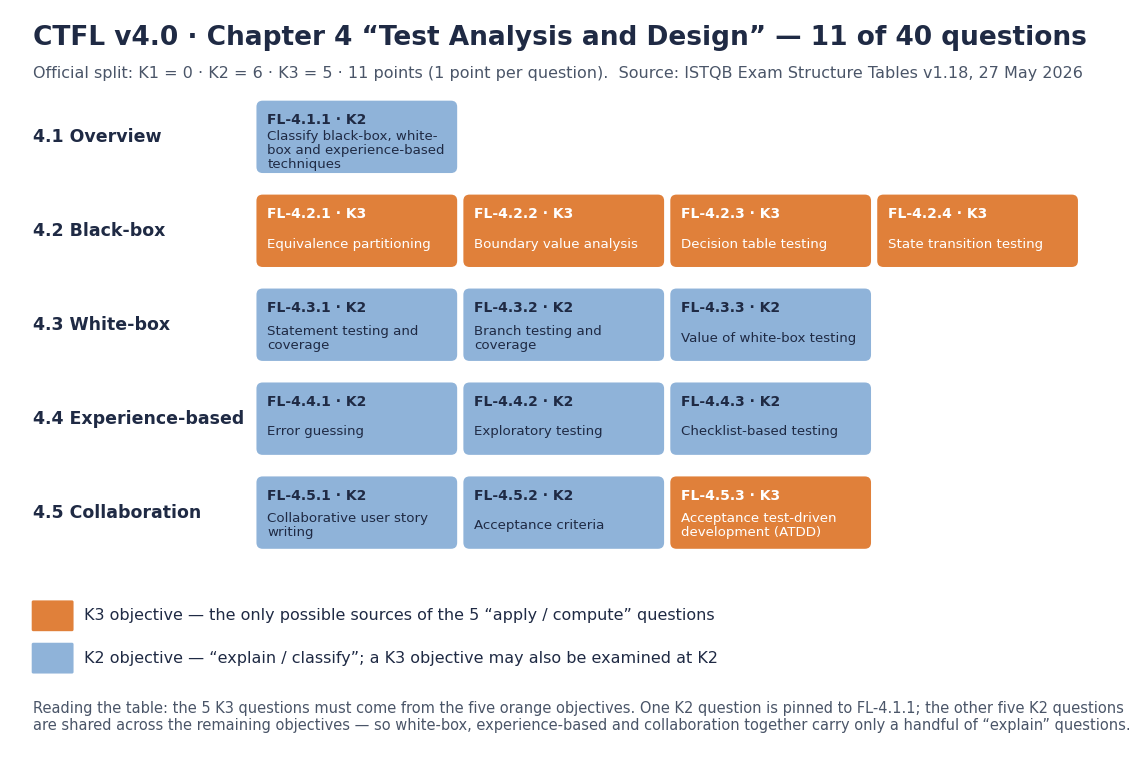
If you want the same view for all six chapters, our syllabus structure and chapter weights guide has the full 8/6/4/11/9/2 table with K-levels.
Where the five K3 questions come from
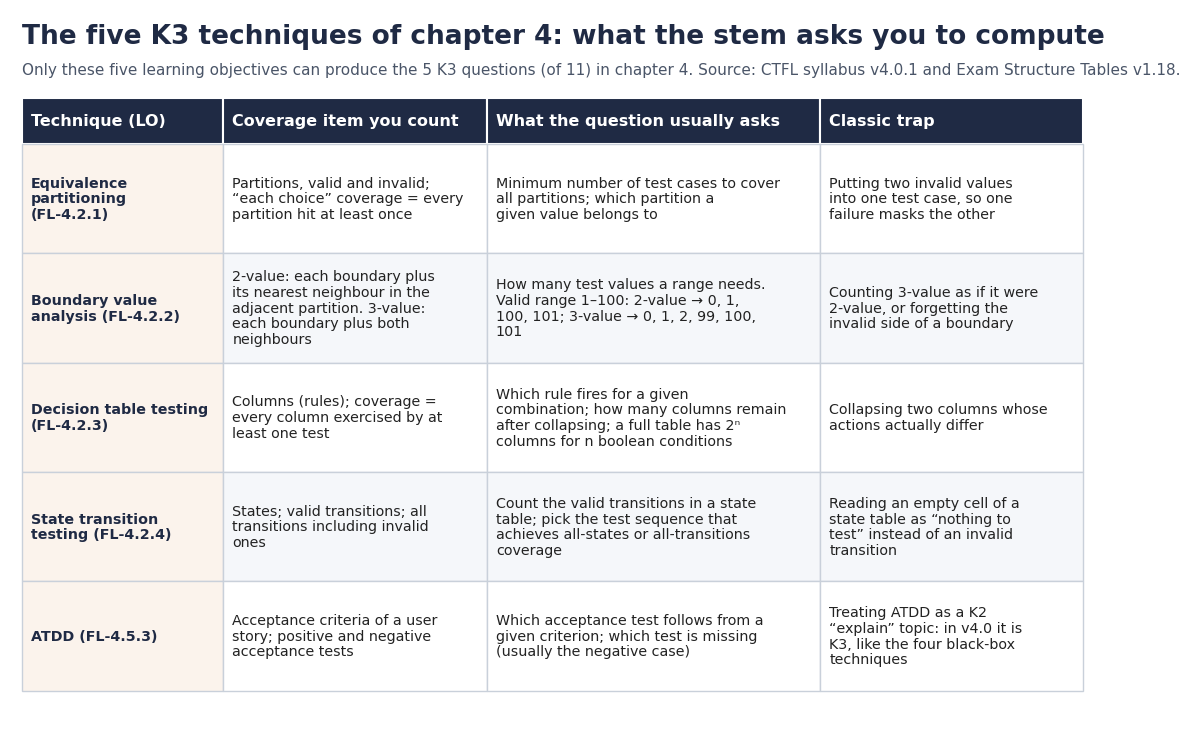
K3 means "apply": the stem gives you a specification fragment, a table or a diagram, and the options are numbers, sequences or test cases. The five objectives below are the only ones written at K3 in the v4.0 syllabus (v4.0.1, the errata release of 15 September 2024, changed none of them). The rules of each technique are covered in detail in our black-box test design techniques guide; here the focus is on what the exam can ask you to compute.
Equivalence partitioning (FL-4.2.1)
The coverage item is the partition. The syllabus measures coverage as the number of partitions exercised by at least one value divided by the total number of partitions, and calls the goal each choice coverage. A typical stem lists a field with a valid range and several invalid conditions and asks for the minimum number of test cases. Valid partitions from different parameters may be combined into one test case; invalid values should be tested one at a time, because a second invalid input can mask the first. Missing an invalid partition, or double-counting a value that falls on a boundary, is where marks are lost.
Boundary value analysis (FL-4.2.2)
v4.0 defines two variants and the exam names which one it wants. In 2-value BVA, each boundary value is tested together with its closest neighbour in the adjacent partition. In 3-value BVA, each boundary value is tested together with both of its neighbours. For a valid range of 1 to 100 with invalid partitions on either side, 2-value BVA gives 0, 1, 100 and 101, while 3-value BVA gives 0, 1, 2, 99, 100 and 101. The classic error is answering a 3-value question with the 2-value count, or forgetting that the invalid side of a boundary is part of the analysis. BVA only applies to ordered partitions, so a stem about an unordered set of values is pointing you at equivalence partitioning instead.
Decision table testing (FL-4.2.3)
The coverage item is the column. A limited-entry decision table with n boolean conditions has 2 to the power of n columns before collapsing, and 100% coverage means every column is exercised by at least one test case. Questions either give a scenario and ask which rule fires, or give a table and ask how many test cases are needed after columns are collapsed. Two columns may be merged only when a condition has no effect on the actions; merging columns whose actions differ is the standard distractor. Watch for infeasible combinations too: the syllabus allows them to be removed, and the correct count reflects that.
State transition testing (FL-4.2.4)
Three coverage measures are examinable: all states, valid transitions (also called 0-switch coverage) and all transitions, which adds the invalid ones. A state table is the usual vehicle, and its empty cells are invalid transitions, not gaps you can ignore. Expect to count the valid transitions in a table, to identify the shortest sequence that visits every state, or to spot which option is a valid path through a diagram. All-transitions coverage is the strongest of the three and implies the other two.
Acceptance test-driven development (FL-4.5.3)
This is the K3 objective most candidates overlook, because it lives in section 4.5 on collaboration-based approaches rather than next to the black-box techniques. The task is to derive acceptance tests from a user story and its acceptance criteria before implementation starts. The tests must cover the criteria with both positive and negative cases, they should be understandable to the whole team, and they are meant to become the automated acceptance tests later. A stem gives you a story with criteria and asks which acceptance test is correctly derived, or which case is missing; the missing one is usually the negative path.
What the six K2 questions look like
Six questions, more than half of the chapter, are "explain" and "classify" items. They are quicker than the K3 ones, but they carry the same one point each, and they are where the less glamorous sections of the chapter get their coverage.
Classifying techniques (FL-4.1.1). One guaranteed question. Black-box techniques derive tests from the specification and measure coverage against it; white-box techniques derive tests from the structure and measure coverage against code or design; experience-based techniques rely on the tester's knowledge and have no formal coverage measure. Expect a list of techniques and one that does not belong to the named category.
Statement and branch coverage (FL-4.3.1, FL-4.3.2, FL-4.3.3). In v4.0 these are K2, so you will not be asked to design a test set for a code fragment. You may still be asked what a coverage percentage means, why 100% branch coverage implies 100% statement coverage but not the other way round, or what white-box testing finds that black-box testing cannot (unexercised code). The 2018 syllabus called this decision coverage; v4.0 says branch coverage, and the exam uses the v4.0 term.
Experience-based techniques (FL-4.4.1 to FL-4.4.3). Error guessing and its systematic form, fault attacks; exploratory testing, often session-based with a charter and time box; and checklist-based testing, where the checklist is a set of test conditions rather than test cases. Questions here contrast the three or ask when each is appropriate, typically when specifications are thin or time is short.
User stories and acceptance criteria (FL-4.5.1, FL-4.5.2). The 3 C's of a user story (card, conversation, confirmation), the INVEST characteristics, and the two common formats of acceptance criteria: scenario-oriented (Given/When/Then) and rule-oriented. A question may hand you a criterion and ask whether it is verifiable.
Because one K2 question is fixed to FL-4.1.1 and five are shared across nine remaining objectives, the white-box, experience-based and collaboration sections together typically contribute only a few questions to any single exam. That is not a reason to skip them, but it is a reason not to spend chapter 4 study hours proportionally on them.
Three things old material gets wrong
Much of the free material for "chapter 4" online was written for the 2018 syllabus or copied from it. Three differences matter for the v4.0 exam.
Use case testing is gone. The 2018 syllabus had it as a K2 black-box technique; v4.0 removed it from chapter 4. A question that expects you to name use case testing as one of the black-box techniques is out of date.
ATDD is new, and it is K3. Section 4.5 on collaboration-based test approaches did not exist in 2018. Lists that give only the four black-box techniques as the K3 sources miss the fifth.
BVA is now formally two variants. The 2-value and 3-value definitions are explicit in v4.0, and a counting question names the variant it wants. Older material that treats "boundary and neighbours" as a single technique will not prepare you for the counting questions.
There is also a common misreading among current guides: statement and branch coverage are sometimes listed as K3 topics. They are K2 in v4.0, as the learning objective wording ("explain") and the exam structure table both confirm.
Time budget: 11 questions, about 21 minutes
ISTQB's own timing model behind the 60-minute exam allows one minute per K1 or K2 question and three minutes per K3 question. Applied to chapter 4 that is 6 minutes for the K2 items and 15 minutes for the five K3 items, roughly 21 of your 60 minutes for 27.5% of the marks. Two practical consequences follow.
Do not start the exam with the chapter 4 derivation questions if they appear early. A BVA count that goes wrong can eat five minutes. Answer the recall and explain questions first, then return with a clear head.
Write the coverage items down before you look at the options. For a decision table, list the columns; for a state table, count the valid cells; for BVA, write the boundary values on scrap paper. The distractors are built from the most common miscounts, so a written derivation protects you from them.
Non-native speakers taking the exam in a language other than their own are entitled to 25% extra time (75 minutes in total), which changes the arithmetic slightly but not the order of attack. The pass mark stays at 26 of 40 points. Details of the format are on the CTFL certification page.
How to practise chapter 4 specifically
Reading the techniques is not the same as being able to compute with them in under three minutes. A reasonable routine is one technique per session, a handful of derivations by hand, and only then mixed questions.
Work through the chapter-specific question set on our CTFL chapter 4 practice page, which draws only from chapter 4 objectives and shows a rationale for every option, including the wrong ones.
When you can score consistently on isolated derivations, switch to full-length timed mocks. Each of our CTFL mock exams follows the official 8/6/4/11/9/2 chapter split, so eleven chapter 4 questions appear in every one.
Read the official learning objective wording once. The CTFL syllabus page on istqb.org links the current syllabus and the sample exams; the ISTQB glossary is the source of the exact definitions the distractors play on.
Use the how-to-pass guide to place chapter 4 inside a week-by-week plan rather than studying it in isolation.
Chapter 4 is the biggest single block of marks and the biggest block of K3 marks, the place where the exam checks whether you can actually do the work. Knowing that exactly five questions demand derivation, and exactly which five objectives they can come from, turns a vague "study the techniques" into a checklist you can finish.
Frequently asked
Eleven of the 40 questions, worth 11 of the 40 points. The official Exam Structure Tables split them into 0 K1, 6 K2 and 5 K3 questions, making chapter 4 the largest chapter on the exam at 27.5% of the marks.
Exactly five learning objectives are K3 in CTFL v4.0: equivalence partitioning (FL-4.2.1), boundary value analysis (FL-4.2.2), decision table testing (FL-4.2.3), state transition testing (FL-4.2.4) and acceptance test-driven development (FL-4.5.3). The five K3 questions in chapter 4 can only come from these.
No. FL-4.3.1 and FL-4.3.2 are K2 objectives, so the exam can ask you to explain statement and branch coverage or their relationship, but not to design a test set for a code fragment. Some older guides list them as K3; that is not what the syllabus or the exam structure says.
In 2-value BVA each boundary value is tested with its closest neighbour in the adjacent partition; in 3-value BVA each boundary value is tested with both of its neighbours. For a valid range of 1 to 100, 2-value BVA gives 0, 1, 100 and 101, while 3-value BVA gives 0, 1, 2, 99, 100 and 101.
ISTQB's timing model allows one minute for a K1 or K2 question and three minutes for a K3 question, so the 6 K2 and 5 K3 questions of chapter 4 add up to about 21 of the 60 minutes. Non-native speakers get 25% extra time, 75 minutes in total.
Part of the ExamCaliber editorial team. Every ExamCaliber question and rationale is written and reviewed by hand against the current syllabus — never scraped from exam dumps.