CTFL Exam Day: 40 Questions, 60 Minutes, Retakes and the Non-Native Extension
The CTFL v4.0 exam is 40 questions in 60 minutes and 26 points to pass. Those numbers are global. The fee, the retake interval, the calculator, and when you see your score are not — they belong to whoever sells you the exam.
The ISTQB Certified Tester Foundation Level v4.0 exam is 40 multiple-choice questions in 60 minutes, and you pass with 26 of the 40 points. Those four numbers are identical in every country, and they are very nearly the only thing about exam day that is. What the exam costs, how soon you may sit it again after a failure, whether you may hold a calculator, whether your score appears on the screen or arrives three days later by email — none of that comes from ISTQB. It comes from whoever sells you the exam.
This article separates the two. It is the exam-day companion to our breakdown of the CTFL exam format, which covers question types, K-levels and the pass mark in detail.
What ISTQB fixes, and where it stops
Two documents govern the exam, and both are short. Exam Structures and Rules v1.2 (2 May 2025) sets the scoring rule — a score of at least 65% is required to pass — and states that at Foundation Level each question is worth exactly one point. Its companion, the Exam Structure Tables, currently version 1.19 of 19 August 2026, carries the per-certification row: CTFL v4.0, 40 questions, 40 points, pass mark 26, 60 minutes, 75 minutes with the extension.
What is striking is what those documents do not contain. Neither one mentions retakes, waiting periods, exam fees, calculators, dictionaries, scratch paper, or how a result reaches you. That is not an oversight. ISTQB's own exam help page says that the fees for re-taking exams and details of any rules on the minimum time interval allowed between exams will be available from your local member board or exam provider. The global body defines the exam; a local organisation prices it, schedules it and runs it.
This is why exam-day guides contradict each other so freely. One site tells you a simple non-programmable calculator is permitted; another states flatly that calculators are banned. Both can be accurate — about different providers. The only answer that applies to you is the one from the organisation whose voucher you are about to buy.
The 60 minutes are mostly spoken for before you sit down
The Exam Structure Tables do something most summaries skip over: they print the time ISTQB allows per question by cognitive level. One minute for a K1 question, one minute for a K2, three minutes for a K3 (and three for a K4, which CTFL does not use). The CTFL v4.0 question mix is fixed in the same table: 8 questions at K1, 24 at K2, 8 at K3.
Multiply it out. Eight minutes for the K1 questions, 24 for the K2 questions, 24 for the eight K3 questions. That is 56 minutes of a 60-minute exam, budgeted by the body that wrote the exam. Four minutes of slack for reading carefully, changing your mind, and the flagged question you promised to come back to.
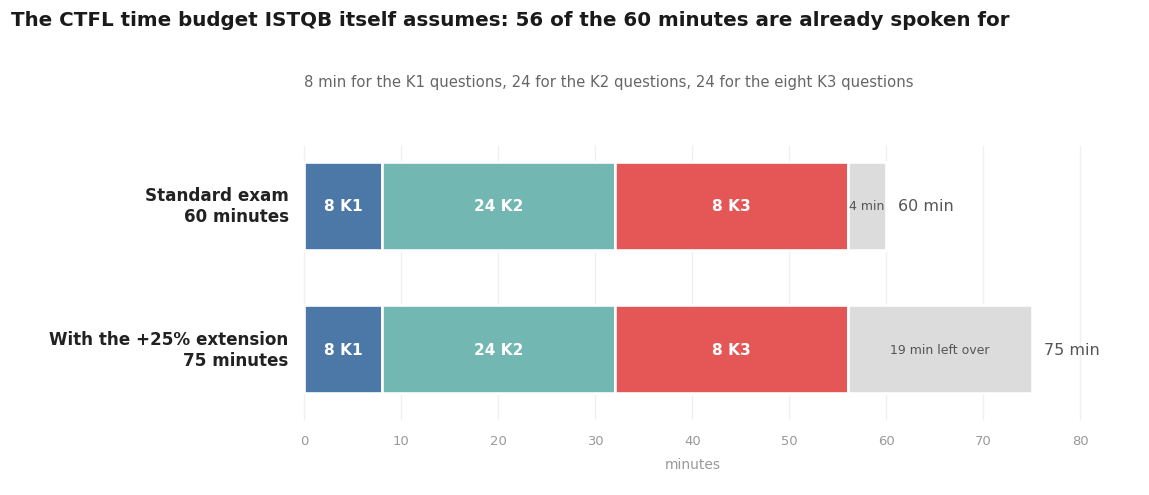
Two practical consequences follow. First, pacing is not a soft skill here, it is arithmetic: a K3 question you spend six minutes on is borrowing from three questions you would have answered correctly, and every question is worth the same single point regardless of how hard it was. Flag it and move. Second, the extension is not a courtesy — going from 60 to 75 minutes takes your slack from four minutes to nineteen, which is the difference between a tight exam and a comfortable one.
All eight K3 questions live in chapter 4, the test analysis and design chapter, and they are the ones that need a calculation rather than a recollection. If your timed practice keeps running over, that is where the time is going — our article on which chapter 4 techniques actually get asked maps the eleven questions of that chapter to the five applied learning objectives, and the full chapter weighting shows where the other 29 questions come from.
The +25% extension is about the exam's language, not your nationality
The rule in Exam Structures and Rules v1.2 is one sentence: if the candidate's native language is not the exam set language, the candidate is allowed an additional 25% time. For CTFL that is 60 minutes plus 15, so 75.
Read the condition precisely, because it is a comparison between two languages rather than a statement about you. It is not "English is not my first language" in the abstract; it is "the set I am sitting is not written in my first language". If your member board offers CTFL in your native language and you choose that version, there is no extension, because there is nothing to extend for. If you take the English set and English is not your native language, there is.
And it is not automatic. ISTQB's wording is that you are entitled to apply for the extension, and applying happens when you book. ASTQB asks candidates to contact them before registering so that a special voucher can be issued, and says paper-exam requests should be made at least a week in advance. AT*SQA handles it differently again: you select the "EXT" option for the exam while scheduling it in Webassessor. What does not work anywhere is mentioning it to the proctor once the clock is already running.
Who is actually running your exam
Three organisations stand between the syllabus and your screen, and almost every exam-day question people ask belongs to the second or third rather than the first. ISTQB writes the syllabus and fixes the exam structure. A member board or accredited exam provider — ASTQB, AT*SQA, iSQI, GASQ, ANZTB and others — sells you the exam, prices it, schedules it and sets its own local policies. A test centre or an online proctoring platform delivers the session and enforces the room rules.
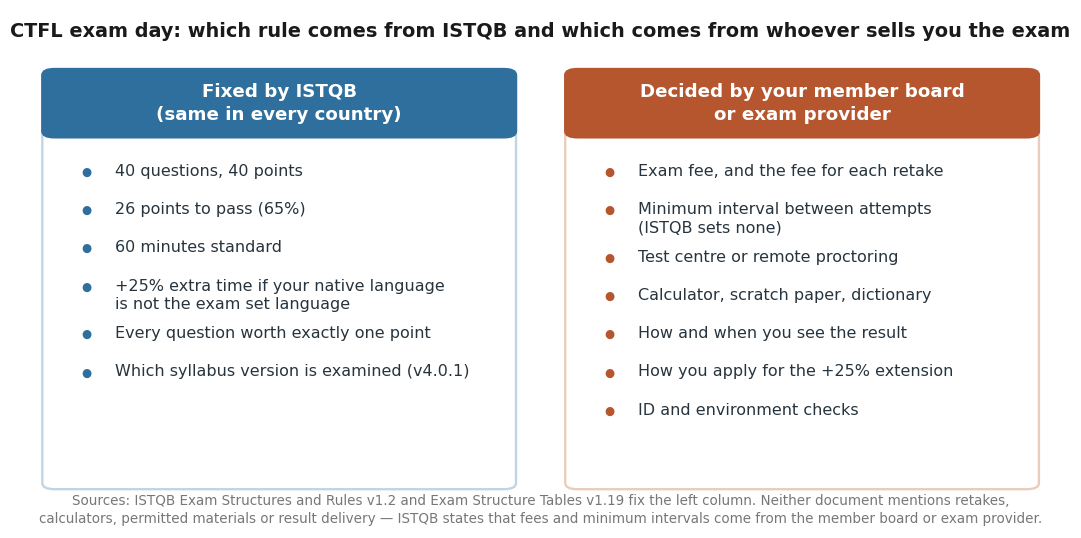
Before booking, it is worth getting the right-hand column in writing from your provider. The questions are short: what does a retake cost, how soon may I book one, which proctoring route do you use, what may I have on the desk, and when will I see the result.
Retakes: no cap, no ISTQB waiting period, a fee every time
ISTQB's position is short and generous: you can take the exams as many times as necessary to pass them. There is no limit on attempts and no globally mandated cooling-off period — the frequently repeated "you must wait thirty days" is not an ISTQB rule, and where it exists it is a provider's rule. ASTQB says the same thing in its own words: you may retake an ISTQB exam as many times as desired, but full payment is required for each attempt.
Which makes cost, not eligibility, the real constraint. ASTQB lists the CTFL exam at US $229, and every attempt is a fresh $229. Its free-retake offer is easy to misread: it covers advanced, specialist and agile exams for candidates who trained with an accredited provider, and it explicitly excludes Foundation Level, which requires full payment for retakes. So the useful question before a first attempt is never "can I retake this?" — the answer is yes — but "what will a second attempt cost me, and how quickly can I book it?"
When you find out whether you passed
ASTQB describes the official policy as the exam provider giving the score — pass or fail, plus percent correct — to the exam taker at the conclusion of the exam, with an official email notification from the system. The certificate is a separate artefact on a separate clock: AT*SQA synchronises results nightly, so an exam taken at a test centre today produces a downloadable high-resolution PDF certificate tomorrow, and topic-level scores appear in your account.
Other routes are slower, and the delay depends entirely on the proctoring service your provider uses. The pattern to expect is a provisional pass or fail quickly and the formal certificate later. Ask which route yours uses before the day, so the afternoon after the exam is not spent refreshing an inbox.
The room rules, and why they differ
Remote proctoring is stricter than most candidates expect, and the strictness is the platform's, not ISTQB's. AT*SQA's instructions are representative: a current government-issued photo ID is presented to the proctor before the exam starts; the proctor asks you to show the room; there should be no books, papers, pencils, pens or electronics in the exam area and nobody else in it; violations result in automatic failure. It also states plainly that you cannot use paper and pencil during an online exam — which quietly rules out the scribbled decision table some candidates plan their chapter 4 strategy around.
Test-centre rules are usually looser about scratch material and stricter about arrival times. Neither set is written down by ISTQB, so neither is portable between providers. Treat any exam-day checklist you find online — including this paragraph — as a prompt to check your own provider's page rather than as the rule itself.
What is worth rehearsing
Everything above is logistics, and logistics only matter because they change how the 60 minutes feel. The part you can actually train is the pacing: a full 40-question set, timed, with the same chapter distribution as the real exam, sat without pausing. If you finish with four minutes to spare, ISTQB's own model says you are on budget.
Our CTFL mock exams are built to that shape — 40 original questions, 60 minutes, a 65% pass mark, and a written rationale on every answer option rather than just the correct one. Start with the first one, and if you are still assembling a study schedule around it, the four-week Foundation study plan says which weeks the timed rehearsals belong in. Remaining questions about the exam itself are collected on our CTFL exam FAQ.
Frequently asked
60 minutes for 40 questions. If your native language is not the language the exam set is written in, you are entitled to 25% more time, which is 75 minutes. The extension has to be requested when you book, not on the day.
26 of the 40 points, which is the 65% pass mark ISTQB applies to every certification. Each Foundation Level question is worth exactly one point, so 26 correct answers pass and 25 do not.
ISTQB sets no cap on attempts and no minimum waiting period — it states that any interval rule and the retake fee come from your member board or exam provider. Ask yours before the first attempt, because you pay in full each time.
ASTQB describes the official policy as the exam provider giving you pass or fail and the percentage at the conclusion of the exam, followed by an email from the system. The certificate itself comes later — AT*SQA synchronises results nightly, so a test-centre exam today produces a downloadable certificate tomorrow.
ISTQB does not publish a rule about it. Neither Exam Structures and Rules v1.2 nor the Exam Structure Tables mentions calculators, scratch paper or dictionaries, so the answer is whatever your exam provider allows. AT*SQA, for example, states that you cannot use paper and pencil during an online exam.
Part of the ExamCaliber editorial team. Every ExamCaliber question and rationale is written and reviewed by hand against the current syllabus — never scraped from exam dumps.