ISO/IEC 42119: What the New AI Testing Standards Actually Say
As of September 2026 one part of ISO/IEC 42119 is published, one is a final draft and two are barely started. Here is the verified status of each part, how the series relates to TR 29119-11, and what the CT-AI syllabus actually examines.
ISO/IEC 42119 is the ISO series on testing AI systems, and as of September 2026 exactly one part of it is published: ISO/IEC TS 42119-2:2025, out since November 2025. Part 3 is sitting at the final draft stage, parts 7 and 8 are barely started, and parts 1, 4, 5 and 6 have no public project at all.
The distance between the series as announced and the series as it exists is where most of the commentary about it goes wrong. This article gives the verified stage of every part, shows how 42119 sits next to ISO/IEC TR 29119-11, and answers the question a CT-AI candidate actually has: is any of this examinable?
What is published, and what is not
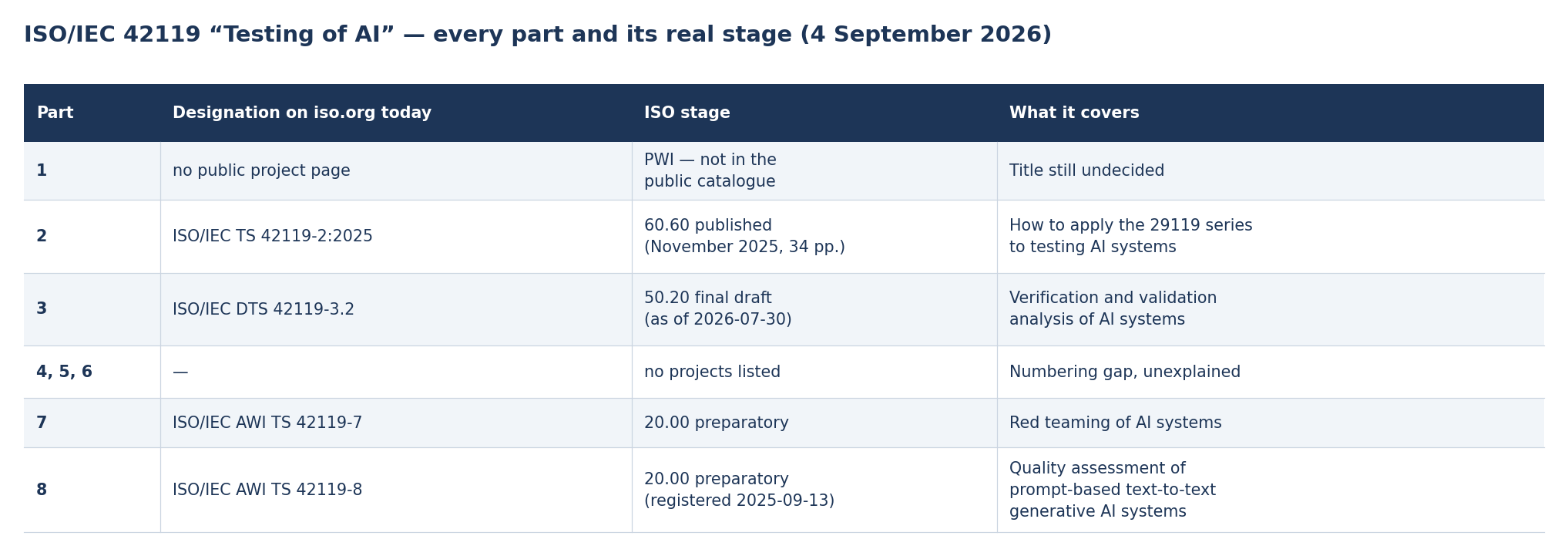
The stage codes are the whole story, so they are worth translating. 60.60 means published and on sale. 50.20 means the text is through its technical work and into a final ballot or proof stage: close, but still a draft, and a draft is not evidence you can put in front of an auditor. 20.00 means a working group has registered a project and a title, and there is nothing to read.
Two further distinctions get blurred in vendor write-ups. Part 2 is a Technical Specification rather than an International Standard, which is how ISO publishes something a committee expects to revise once practice catches up. And nothing in the series is certifiable. If a supplier offers ISO 42119 certification, the certifiable AI standard is ISO/IEC 42001, which specifies an AI management system and says nothing about how you test one.
It is also a short document. The ISO catalogue page for TS 42119-2:2025 lists 34 pages at CHF 159, which is a useful expectation to set before someone in your organisation buys it hoping for a technique catalogue.
The numbering gap nobody explains
Published articles about the series list parts 2, 3, 7 and 8 and move on. The obvious question, what happened to 1, 4, 5 and 6, goes unanswered. What the public catalogue shows is that there are no registered projects at those numbers, and that part 1 exists only as a preliminary work item whose title is still undecided, which is why it has no page you can open.
Preliminary items stay invisible until a committee registers them, so parts may still appear. The practical consequence today is to stop planning around the eight parts of 42119. There are two live documents and a skeleton.
What TS 42119-2 actually says
Its scope is narrower than the series title suggests. The document provides requirements and guidance on the application of the ISO/IEC/IEEE 29119 series to the testing of AI systems. That is a bridge, not a replacement.
The clause order carries the method. After the introductory material it goes to identifying risks in AI systems, and only then to test approaches, with three informative annexes behind them. Risks first, approach second, which is the reverse of how most AI test plans are written.
For anyone used to 29119 the shape is familiar and the input is not. The risks it starts from are the ones the AI part introduces: training data you did not design, behaviour that moves with a retrain, output volumes no one can hand-check, and a test oracle that has to be defined rather than looked up. Where 29119 already specifies a practice, part 2 adds the AI-specific context instead of writing a competing practice.
What it is not is a catalogue of AI-specific techniques. Metamorphic testing, adversarial input generation and drift monitoring are not spelled out procedure by procedure in these 34 pages, and anyone told otherwise will be disappointed on delivery.
Does it replace ISO/IEC TR 29119-11?
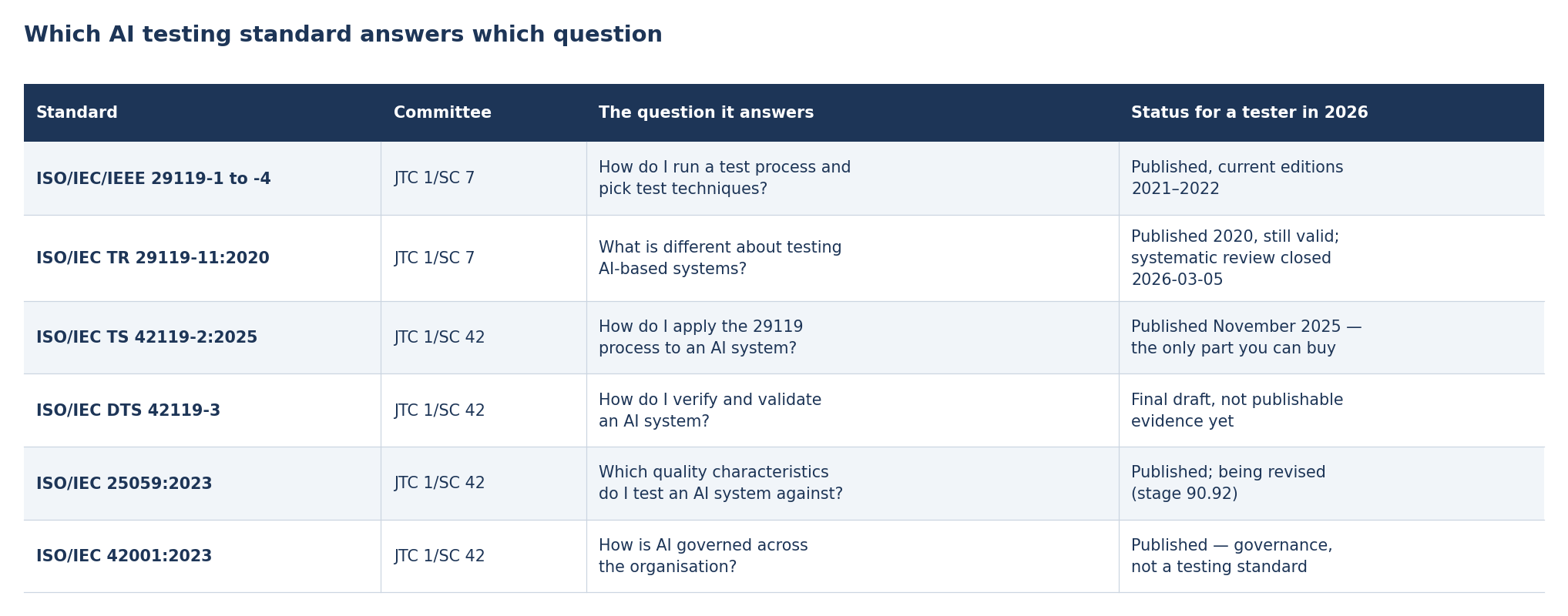
No, and the two are not even from the same committee. TR 29119-11:2020 is a Technical Report from ISO/IEC JTC 1/SC 7, software and systems engineering; the 42119 series comes from JTC 1/SC 42, artificial intelligence. A Technical Report is guidance and never carried requirements to begin with, so there is nothing in it for part 2 to supersede.
TR 29119-11 is still published. Its systematic review closed on 5 March 2026, so a decision to confirm, revise or withdraw it is pending, but nothing on the record says it is being retired in favour of 42119. Read the pair this way: TR 29119-11 tells you what is different about testing AI-based systems, TS 42119-2 tells you how to run that work inside the 29119 process.
What a CT-AI candidate is examinable on
The CT-AI v2.0 syllabus names the series once, in section 1.1.8, Regulations and Standards for AI, in a single sentence saying the 42119 series is being developed to cover various aspects of AI-based system testing. There is no learning objective about its parts, their stages or their scope.
The objective attached to that section is AI-1.1.8 at K2: explain how regulations and standards affect the development and testing of AI-based systems. So the examinable skill is the effect of standards on your work, not the catalogue. A question can ask why a standard changes the way testing is planned. It cannot ask which part of 42119 covers red teaming.
One wrinkle is worth knowing. That sentence says the series is being developed, while part 2 was published in November 2025, five months before v2.0 reached general availability on 17 April 2026. On the exam, answer as the syllabus words it. In an interview, knowing that part 2 shipped is the difference between having read about the series and having checked it.
Our CT-AI v2.0 vs v1.0 breakdown covers what else moved in the 2026 syllabus, and the ISTQB CT-AI guide covers the exam itself.
What changes in a test plan
Nothing in part 2 forces a change to how you test tomorrow morning. Three things in it are worth taking anyway.
Order. Put the AI-specific risk analysis before technique selection. A test plan that opens with a list of techniques is exactly the pattern the clause order argues against.
Vocabulary. ISO/IEC 25059 is where good gets defined for an AI system, extending the 25010 quality model, and the CT-AI syllabus leans on it directly at K2. It is being revised, so quote the characteristics rather than the edition.
Evidence. What survives an audit is the trace from an identified AI risk, to the test approach chosen for it, to the result. That documentation shape already exists in 29119-3; part 2 does not invent a new one.
Red teaming is the notable hole. It is part 7, at stage 20.00, so for the foreseeable future the practice has to come from somewhere other than ISO, which is what our article on testing agentic AI and LLMs works through.
42119 and the EU AI Act
The series gets sold as an AI Act play, so precision helps. Harmonised standards for the Act are drafted by CEN-CENELEC JTC 21, and its published work programme lists prEN 18228, 18281, 18283, 18284, 18285, 18286, the prEN 18229 trustworthiness series and prEN 18282, plus two direct adoptions of ISO/IEC work, prEN ISO/IEC 23282 and prEN ISO/IEC 24970. There is no 42119 item on it.
The absence carries information, because JTC 21 evidently does adopt ISO/IEC deliverables when it chooses to, and because a Technical Specification is not the usual vehicle for harmonisation in the first place. Part 2 gives you a structure for a test approach. It does not give you a presumption of conformity, and anyone implying otherwise is selling something.
Where this leaves you
Studying for CT-AI: learn AI-1.1.8 as written, at K2. Part numbers are context, not exam content.
Writing a test strategy for an AI feature: 34 pages is a cheap cross-check against your own risk list, and the clause order is the part worth copying.
Being sold 42119 compliance: ask which part. One of them exists as a published document and none of them are certifiable.
To see how the exam frames this material in practice, the ISTQB CT-AI practice tests work through it question by question, with a rationale on every answer.
Frequently asked
Partly. One part is published: ISO/IEC TS 42119-2:2025, Overview of testing AI systems, out since November 2025 at 34 pages. Part 3 (verification and validation analysis) was still at stage 50.20, the final draft stage, as of 30 July 2026. Parts 7 and 8 are at stage 20.00, meaning a project and a title exist and nothing is readable yet.
No. TR 29119-11:2020 is a Technical Report from ISO/IEC JTC 1/SC 7 and is still published; its systematic review closed on 5 March 2026 with no withdrawal recorded. The 42119 series comes from JTC 1/SC 42 and part 2 explicitly provides guidance on applying the ISO/IEC/IEEE 29119 series to AI systems, so it builds on 29119 rather than replacing any of it.
No. Part 2 is a Technical Specification, and technical specifications are not certification schemes. The certifiable AI standard is ISO/IEC 42001:2023, which specifies an AI management system. It covers governance, not how a system is tested.
Only as context. The CT-AI v2.0 syllabus names the series once, in section 1.1.8, in a single descriptive sentence. The learning objective for that section is AI-1.1.8 at K2: explain how regulations and standards affect the development and testing of AI-based systems. No learning objective asks about the parts, their scope or their status.
iso.org lists it at CHF 159 for the PDF or ePub, for 34 pages, as of September 2026. National standards bodies resell it at their own prices, and some corporate subscriptions include it.
Not as of September 2026. Harmonised standards for the AI Act are drafted by CEN-CENELEC JTC 21, and its published work programme contains no 42119 item, although it does include two direct adoptions of other ISO/IEC deliverables. Buying part 2 gives you a structure for your test approach, not a presumption of conformity.
Part of the ExamCaliber editorial team. Every ExamCaliber question and rationale is written and reviewed by hand against the current syllabus — never scraped from exam dumps.