ISTQB Foundation Level (CTFL v4.0): Der komplette Leitfaden 2026
Alles Wichtige zum ISTQB Foundation Level (CTFL v4.0): was es ist, das Prüfungsformat, die sechs Kapitel des Lehrplans und wie man sich effizient vorbereitet.
Das ISTQB Certified Tester Foundation Level (CTFL v4.0) ist die Einstiegszertifizierung im Bereich Softwaretesten des International Software Testing Qualifications Board. Es bestätigt ein gemeinsames Vokabular und ein grundlegendes Verständnis des Testprozesses, der Testentwurfsverfahren und des Testmanagements – und für die meisten Tester ist es das erste formale Zertifikat auf dem Weg. Dieser Leitfaden erklärt, was die Zertifizierung ist, wie die Prüfung abläuft, was der Lehrplan abdeckt und wie man sich 2026 effizient vorbereitet.
Was ist das ISTQB Foundation Level (CTFL)?
CTFL ist eine herstellerneutrale, weltweit anerkannte Zertifizierung. Sie richtet sich an alle, die mit Softwarequalität zu tun haben – manuelle Tester und Automatisierungstester, aber auch Business-Analysten, Entwickler und Projektmanager, die ein gemeinsames Verständnis des Testens wünschen. Es gibt keine formalen Voraussetzungen, weshalb es der natürliche Ausgangspunkt vor den Advanced- und Specialist-Tracks ist (etwa Test Analyst, Test Automation oder CT-AI).
Version 4.0, die aktuelle Ausgabe, hat den Lehrplan um explizite Lernziele und kognitive Stufen herum neu strukturiert und legt mehr Gewicht auf angewandte Fähigkeiten statt auf reines Auswendiglernen.
Das CTFL-v4.0-Prüfungsformat auf einen Blick
40 Multiple-Choice-Fragen – jede zählt einen Punkt.
65 % zum Bestehen – das sind 26 von 40 richtigen Antworten.
60 Minuten (75 Minuten – 25 % mehr – wenn Sie die Prüfung in einer Nicht-Muttersprache ablegen).
Ohne Hilfsmittel, keine formalen Voraussetzungen, online oder im Testzentrum verfügbar.
Die Fragen sind K-Stufen zugeordnet (K1 erinnern, K2 verstehen, K3 anwenden). K3-Fragen verlangen, dass Sie ein Verfahren tatsächlich anwenden – zum Beispiel Testfälle aus einer Grenze oder einer Entscheidungstabelle ableiten – Lesen allein bringt Sie also nicht durch. Die offiziellen Regeln hinter diesen Zahlen – Wiederholung, Zeitzuschlag, erlaubte Hilfsmittel – beantworten wir einzeln in den CTFL-Prüfungs-FAQ, und die Bewertung erklärt ISTQB CTFL Prüfungsformat und Bestehensgrenze im Detail.
Was der Lehrplan abdeckt: die sechs Kapitel
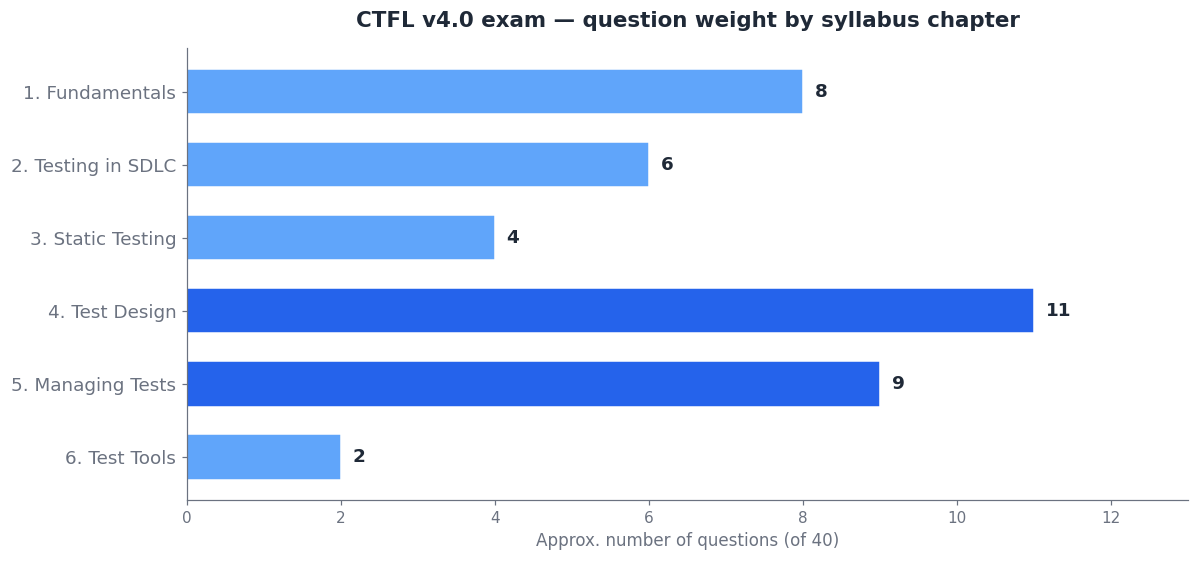
Der Lehrplan hat sechs Kapitel, und die Prüfung ist zu den umfangreicheren hin gewichtet. Eine grobe Orientierung, wie sich die 40 Fragen verteilen:
Grundlagen des Testens (~8 Fragen) – was Testen ist und warum es notwendig ist, die sieben Testprinzipien, der Testprozess und die Psychologie des Testens.
Testen während des SDLC (~6) – Testen in verschiedenen Entwicklungsmodellen, Teststufen, Testarten und Wartungstests.
Statisches Testen (~4) – Reviews und statische Analyse sowie warum das frühe Finden von Fehlern günstiger ist.
Testanalyse und -entwurf (~11) – die Testentwurfsverfahren. Dies ist das größte und anwendungsorientierteste Kapitel.
Steuerung der Testaktivitäten (~9) – Testplanung, risikobasiertes Testen, Überwachung und Steuerung sowie Fehlermanagement.
Testwerkzeuge (~2) – Werkzeugunterstützung beim Testen und worauf bei der Auswahl von Werkzeugen zu achten ist.
Die Testverfahren, die Sie beherrschen müssen (Kapitel 4)
Da Kapitel 4 die meisten Fragen trägt – und die meisten K3-Fragen – verdient es gezieltes Üben.
Black-Box-Verfahren
Äquivalenzklassenbildung – Eingaben gruppieren, die gleich behandelt werden sollten, und einen Wert pro Klasse testen.
Grenzwertanalyse (BVA) – die Ränder der Klassen testen, wo sich Fehler häufen.
Entscheidungstabellentest – Kombinationen von Bedingungen und ihre resultierenden Aktionen abdecken.
Zustandsübergangstest – Zustände, Übergänge und ungültige Übergänge abdecken.
Alle vier Verfahren sind mit Rechenbeispielen und Überdeckungsregeln in unserem Beitrag Black-Box-Testentwurfsverfahren mit Beispielen durchgerechnet.
White-Box-Verfahren
Kennen Sie Anweisungsüberdeckung und Zweigüberdeckung, wie man jede als Prozentsatz berechnet und warum 100 % Zweigüberdeckung 100 % Anweisungsüberdeckung impliziert, aber nicht umgekehrt.
Erfahrungsbasierte Verfahren
Fehlerraten (Error Guessing), exploratives Testen und checklistenbasiertes Testen – nützlich, wenn Spezifikationen dünn sind, und ergänzend zu den formalen Verfahren oben.
Wie schwer ist die Prüfung wirklich?
Für jemanden mit praktischer Testerfahrung ist CTFL v4.0 eher mittelschwer als schwierig. Die Fallen sind vorhersehbar: Kandidaten lernen Kapitel 1 zu intensiv (es wirkt vertraut) und vernachlässigen die anwendungsorientierten Teile der Kapitel 4 und 5. Da die Fragen Verständnis und Anwendung prüfen, reicht das bloße Auswendiglernen von Definitionen nicht – Sie müssen ein Verfahren unter Zeitdruck anwenden können.
Wie man sich auf CTFL v4.0 vorbereitet
Ein gezielter Vier-Wochen-Plan funktioniert für die meisten Kandidaten: zuerst das Vokabular aufbauen, die meiste Zeit den Verfahren aus Kapitel 4 widmen und mit vollständigen, zeitlich begrenzten Probeprüfungen abschließen. Einen wochenweisen Plan mit Tagesaufteilung, einer Ressourcen-Checkliste und Taktiken für den Prüfungstag finden Sie in unserem eigenen Leitfaden „ISTQB Foundation Prüfung bestehen: Ein 4-Wochen-Lernplan“. Unser CTFL-Leitfaden zum Bestehen ergänzt dazu die offizielle Kapitelaufteilung als Planungsgrundlage.
Häufige Fehler, die Sie vermeiden sollten
Definitionen auswendig lernen, ohne die K3-Anwendungsfragen zu üben.
Zeitlich begrenztes Üben überspringen – die Zeit zu überziehen ist ein häufiges, vermeidbares Scheitern.
Sich auf veraltetes v3.1-Material oder minderwertige Prüfungsdumps verlassen statt auf den aktuellen v4.0-Lehrplan.
Nur die falsch beantworteten Fragen überprüfen und nie nachsehen, warum Ihre richtigen Antworten richtig waren.
Wie ExamCaliber Sie bei der Vorbereitung unterstützt
ExamCaliber bietet vollständige CTFL-Probeprüfungen, die das echte Format widerspiegeln – 40 Fragen, realistisches Timing und eine Bestehensgrenze von 65 %. Jede Frage ist original, den aktuellen Lehrplankapiteln und K-Stufen zugeordnet und von einem namentlich genannten ISTQB-zertifizierten Experten geschrieben statt aus Dumps kopiert. Der entscheidende Unterschied fürs Lernen: Nach dem Absenden erhalten Sie eine schriftliche Begründung für jede Option – warum die richtige Antwort richtig ist und warum jeder Distraktor falsch ist – damit Sie die Begründung lernen, nicht nur die Lösung.
Frequently asked
Für Personen mit etwas Testerfahrung ist sie mittelschwer. Die Fragen prüfen Verständnis und Anwendung, nicht nur Auswendiglernen, daher besteht das größte Risiko darin, die Kapitel zu Testentwurf und Testmanagement zu unterschätzen.
Die Prüfung hat 40 Multiple-Choice-Fragen und Sie benötigen 65 % zum Bestehen – das sind 26 von 40 richtigen Antworten.
Sie haben 60 Minuten. Wenn Sie die Prüfung in einer Sprache ablegen, die nicht Ihre Muttersprache ist, erhalten Sie in der Regel 25 % zusätzlich (insgesamt 75 Minuten).
Nein. CTFL ist die Einstiegszertifizierung und hat keine formalen Voraussetzungen, auch wenn grundlegende Kenntnisse der Softwareentwicklung hilfreich sind.
Version 4.0 wurde um klarere Lernziele herum neu strukturiert, die Inhalte zu Testverfahren wurden gestrafft und es wurde mehr Wert auf die praktischen, angewandten (K3) Fähigkeiten gelegt, die ein arbeitender Tester nutzt.
Mocks sind unerlässlich, aber allein nicht ausreichend. Kombinieren Sie den offiziellen Lehrplan mit vollständigen, zeitlich begrenzten Probeprüfungen und überprüfen Sie die Begründung für jede Antwort – richtig wie falsch.
Part of the ExamCaliber editorial team. Every ExamCaliber question and rationale is written and reviewed by hand against the current syllabus — never scraped from exam dumps.