Are ISTQB Certifications Worth It in 2026? An Honest Take
ISTQB has issued more than 1.1 million certificates, which settles the question of recognition and nothing else. What the exam actually measures, what it costs, which syllabuses are retiring, and four questions to ask before you pay.
The question is usually asked in a tone that expects a yes or a no, and it does not have one. What it has is a short list of things you can check before you pay: what the exam actually measures, what it costs in money and in hours, whether anyone in your situation is asking for it, and whether the syllabus you are about to buy still has a future. Two of those four are printed on istqb.org. This article works through all of them.
One number frames the rest. As of May 2025, ISTQB reported 1.5 million exams administered and more than 1.1 million certifications issued across over 130 countries, through a network of more than 300 accredited training providers. That settles the recognition question: a hiring manager in another country will know what the line on your CV means. It also settles the differentiation question, in the opposite direction. A credential held by more than a million people is not the thing that makes you the interesting candidate.
What the exam actually measures
CTFL v4.0 is 40 multiple-choice questions worth 40 points, 26 of them needed to pass, in 60 minutes — 75 if you sit it in a language that is not your own. The full format, question by question, is a separate discussion; what matters here is what is absent from it. No code. No tool. No portfolio. No interview. So the honest description of what a pass proves is this: under time pressure you can apply the vocabulary and the process model of the syllabus well enough to get 26 of 40 right.
That is a narrower claim than either side of this argument usually makes, and it is not nothing. A shared vocabulary is what lets a test report be read by somebody who did not write it, and it is why a defect report from a certified tester in one country tends to look like one from another. It is also not evidence that you can find a bug that matters.
Above Foundation the exams get more analytical rather than more practical. CT-AI v2.0, for instance, is still 40 questions in 60 minutes, but they are worth 44 points and you need 29 of them — the questions are weighted by how much reasoning they demand. The format does not change. What changes is what is asked of you inside it.
Recognition is real. Verification is not automatic.
This is worth knowing before you count on the certificate in a hiring process. ISTQB's Successful Candidate Register, the official global register of certified testers, is opt-in: data is transferred only where the individual has given consent, inclusion is arranged through your member board or exam provider, and it may carry a fee. An employer who searches the register and does not find you has not found evidence that you are uncertified — they have found an empty result, and the fallback is to ask the board that issued the certificate, which may also charge for the answer.
The practical consequence is small and dull: keep the PDF and the certificate number yourself. Do not assume the register will speak for you.
The two currencies: money and hours
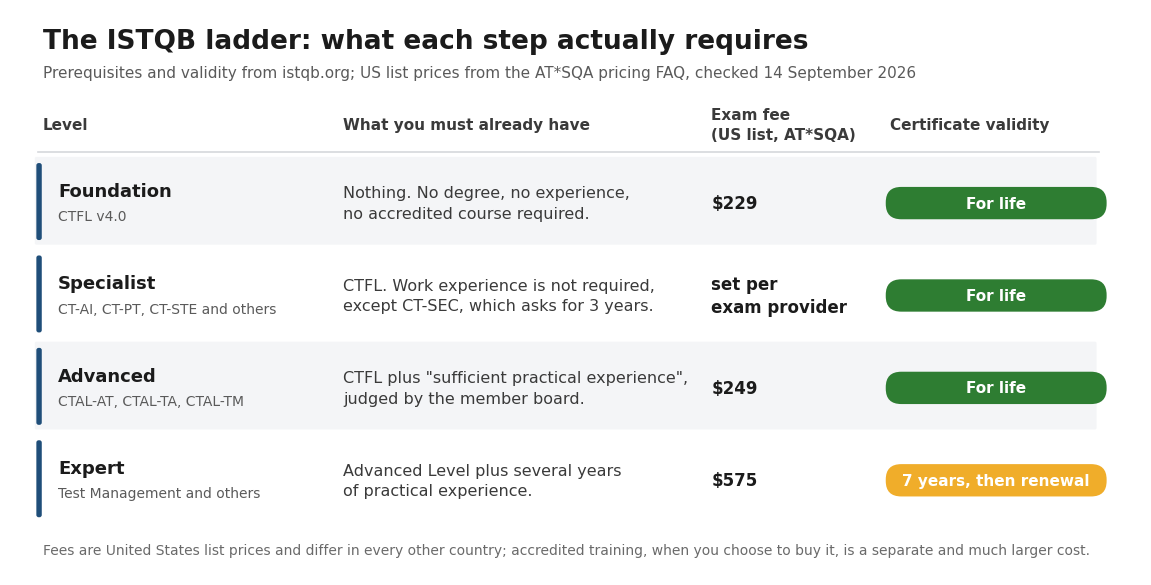
Money is the easy currency, and the honest version is that there is no single price. In the United States, AT*SQA lists the Foundation exam at $229, the Advanced Level exams at $249 each and the Expert Level exams at $575. Every other country has its own member board and its own number, so quote your own board's page rather than an article's.
Hours are harder, and this is where most writing on the subject quietly invents a figure. ISTQB does not publish pass rates and does not publish study-time statistics. When you read that Foundation takes 40 to 80 hours and that 85 to 90 percent of prepared candidates pass, you are reading somebody's estimate presented as a measurement. The only official signal is in the syllabus itself: each chapter prints a recommended minimum of accredited training time, and that is a floor for a taught course, not a forecast for your evenings.
There is a better estimate available, and it is one you can make yourself. Sit a full-length timed mock before you book anything, and count how far off 26 you are. Everything after that is arithmetic instead of guesswork.
Three situations where it pays for itself
Something is filtering on it. Consultancies, outsourcing vendors and public-sector tenders often write ISTQB into a requirement line. When a certificate is a gate, the argument about whether it measures skill stops being relevant: you either have it or you are not in the pipeline.
You are moving into testing and have nothing else to show yet. The syllabus is a curriculum. It tells you what to learn, in what order, with a defined end — and the exam date is the deadline that makes it actually happen. That structure is worth real money to somebody starting from zero, independently of the certificate at the end of it.
Your employer pays and gives you the time. Then one of the two currencies is not yours to spend, and the decision is much simpler than this article makes it look.
Three situations where it is money burned
You already do the work and nobody has asked for it. A tester who has been shipping for six years does not become more employable by confirming that they know what a test condition is.
You are buying it instead of practising. An exam that never asks you to open a tool cannot, on its own, make you better with the tool. The certificate is a claim about knowledge, and it is only as useful as the work sitting behind it.
The syllabus you are about to pay for is on its way out. This one is common enough, and avoidable enough, to deserve its own section.
Check the syllabus is not retiring before you pay
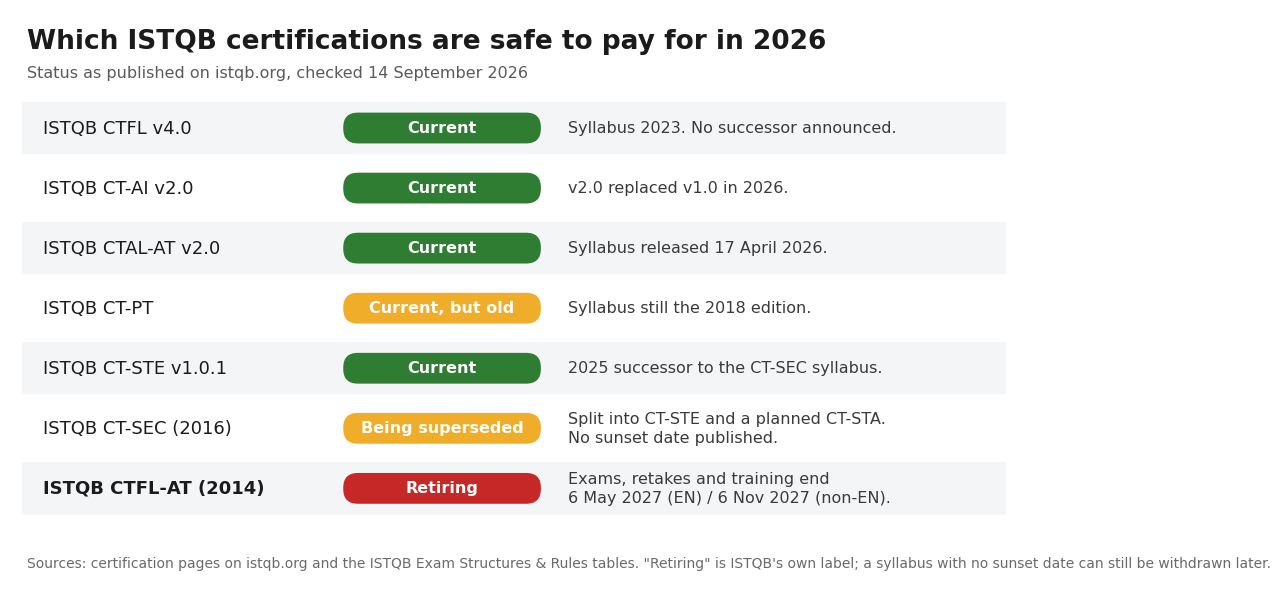
ISTQB marks certifications that are being withdrawn with a [Retiring] tag and publishes sunset dates for them. Right now one of those is a Foundation-level extension that people are still buying. CTFL-AT, the Agile Tester extension, ends on 6 May 2027 for English and 6 November 2027 for other languages; after those dates there are no exams, no retakes and no training. ISTQB points candidates to CTFL v4.0, which absorbed the agile material, and to CTAL-AT v2.0, whose syllabus was released on 17 April 2026. The migration between the two is worth reading before you commit either way.
Security is a different shape of the same problem. The 2016 CT-SEC syllabus has been split in two: CT-STE, released in 2025, covers actually performing security testing, and a CT-STA for security test analysis is planned. CT-SEC carries no retiring tag and no sunset date, so it has not been withdrawn — but there is no grandfathering either. Holding CT-SEC does not give you CT-STE.
And old is not the same as retiring. CT-PT is current on a syllabus written in 2018. That tells you how quickly that corner of the catalogue moves, not that the certificate is about to stop existing. The rule is cheap to follow either way: open the certification page on istqb.org, look for the tag and the dates, and only then pay.
Foundation first, then the specialism your week actually looks like
Everything above Foundation requires CTFL, so if you intend to go further it is not really a choice — it is the gate. Advanced Level adds "sufficient practical experience", judged by your member board rather than by a published number, and CT-SEC is the outlier that asks for three years. If Foundation is where you are starting, the complete CTFL v4.0 guide covers the syllabus, and the study plan for the exam covers the four weeks before it.
After that, choose by where your working week actually goes rather than by which acronym sounds most impressive.
AI-based systems and ML components — CT-AI. Start with the CT-AI certification guide and the CT-AI study plan.
Browser automation — A4Q Selenium Tester, which is the one certification here that does expect you to read code. The Selenium Tester guide and the exam study plan both start from the syllabus.
Load, stress and scalability — CT-PT, with the 2018 caveat above.
Security testing — CT-STE, which needs only CTFL behind it, rather than the older CT-SEC and its three-year experience requirement.
One thing in your favour: the certificate does not expire
ISTQB states plainly that Foundation, Specialist and Advanced Level certificates are valid for life. Only Expert Level expires, after seven years, and then needs renewal. There is no continuing-education scheme to feed, no annual fee, nothing to let lapse.
That is worth holding on to, because it changes how the retiring-syllabus problem reads. A sunset date does not invalidate a certificate anybody already holds; what ends is the ability to sit or retake that exam. So the risk of buying into a syllabus with a short future is not that your certificate evaporates. It is that you spend the fee and the hours on the version of a subject that ISTQB has already moved past, and that nobody can follow you onto that path afterwards.
Four questions before you pay
Is anyone actually asking for it? A job ad, a tender, a manager, a client. If the answer is nobody, the certificate has to justify itself as learning alone.
Is the syllabus current? Open the certification page on istqb.org and look for the retiring tag and the sunset dates.
Do you meet the prerequisite? CTFL for everything above Foundation, practical experience for Advanced Level, three years for CT-SEC.
Can you already pass a full-length timed mock? If you can, you are buying a certificate rather than learning something. If you cannot, the syllabus still has something to teach you — and that is the version of this purchase that is clearly worth the money.
So: worth it? As a gate-opener and as a curriculum, frequently. As a differentiator among more than a million holders, no. As a substitute for having tested something difficult, never. If you are leaning towards yes, the cheapest next step is not a course — it is one full-length mock exam with a written rationale on every option, sat under the clock, to find out which of the four questions above you are really answering.
Frequently asked
No. ISTQB does not list an accredited course among the requirements for Foundation Level, and exam providers sell the exam separately from training — AT*SQA, for example, lists the Foundation exam on its own at $229. A course is a choice about how you prepare, not a condition of entry.
ISTQB does not publish a global retake limit. Retake rules, waiting periods and fees are set by the member board or exam provider that runs your exam, so check theirs before you book. The one hard deadline is a sunset date: once a certification retires, retakes stop with it.
No. There is no official pass-rate statistic, which is why the figures quoted around the web vary so widely. Any percentage you read is an estimate by whoever published it, not a measurement from ISTQB.
Only indirectly. The Foundation syllabus treats tool support conceptually and never asks you to write code, so it will not demonstrate automation ability on its own. A tool-specific certification such as A4Q Selenium Tester sits much closer to the actual work.
No. CTFL is a prerequisite for the specialist and advanced certifications, so Foundation is the first exam regardless of which specialism you are aiming at.
Part of the ExamCaliber editorial team. Every ExamCaliber question and rationale is written and reviewed by hand against the current syllabus — never scraped from exam dumps.